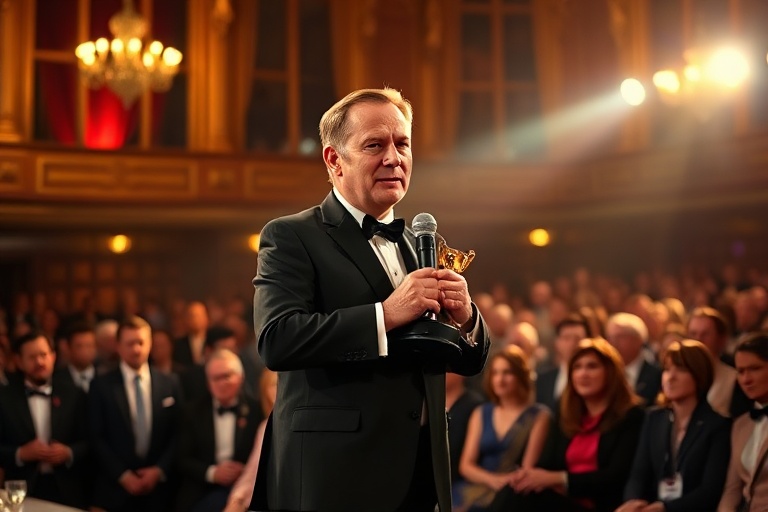
Martin Lewis, the British financial journalist and founder of MoneySavingExpert.com, recently delivered a keynote address at the British Academy of Film and Television Arts (BAFTA) that resonated far beyond the usual confines of financial discourse. His speech, titled “Money, Media, and Meaning,” positioned financial education not just as a practical necessity but as a cultural imperative in an era of economic uncertainty and misinformation.
Lewis, known for demystifying complex financial concepts for millions of Britons, used the BAFTA platform—a venue typically associated with film, television, and the arts—to argue that financial literacy should be treated with the same cultural weight as literature or cinema. The event, held at BAFTA’s London headquarters, drew an audience of industry leaders, policymakers, and media figures, reflecting the growing recognition of financial education as a public good.
The Role of Media in Shaping Financial Behavior
Lewis opened his speech by critiquing the media’s role in shaping public perceptions of money. He highlighted how sensationalist headlines, misleading advertisements, and the glorification of debt in popular culture often distort financial decision-making. “Media doesn’t just report on money—it shapes how we think about it,” he stated. “And when that messaging is flawed, the consequences aren’t just personal; they’re societal.”
He cited examples from financial journalism, reality television, and even video games, where irresponsible financial behavior is often normalized or even celebrated. Lewis argued that the entertainment industry, in particular, has a responsibility to promote financial literacy, just as it promotes health or environmental awareness. “If we can teach people about love, war, and adventure through storytelling, why can’t we teach them about budgeting, saving, and investing?”
Key Points from Lewis’s Speech
- Financial education as a cultural right: Lewis framed access to financial knowledge as a fundamental right, comparable to education in literature or history.
- The media’s dual role: While media can empower individuals with knowledge, it can also mislead, particularly when driven by profit motives.
- Collaboration between sectors: He called for partnerships between financial experts, media producers, educators, and policymakers to create more responsible content.
- Consumer empowerment: Lewis emphasized that financial literacy isn’t just about avoiding debt—it’s about enabling people to make informed choices that improve their lives.
Global Perspectives on Financial Literacy
Lewis’s speech also situated the UK’s financial literacy challenges within a broader global context. While the UK has made strides in recent years—such as the introduction of mandatory financial education in schools—many countries lag behind. According to the OECD’s 2023 financial literacy survey, only 53% of adults across participating countries demonstrate a basic understanding of financial concepts, with significant disparities between high- and low-income nations.
In Scandinavia, for example, financial education is integrated into school curricula from an early age, and public service campaigns promote responsible financial behavior. Meanwhile, in the United States, financial literacy remains a patchwork of state-led initiatives, with inconsistent outcomes. Lewis pointed to these contrasts as evidence that financial education is not just an economic issue but a matter of social equity. “Money doesn’t discriminate, but our access to understanding it often does,” he noted.
The cultural dimension of financial literacy was another focal point. In some societies, discussing money is taboo, while in others, it’s a point of pride or competition. Lewis cited Japan’s “kakaku chōsa” (price research) culture as an example of how financial prudence can be woven into daily life without stigma. Conversely, in countries where consumerism is heavily marketed, financial literacy often takes a backseat to immediate gratification.
Reactions and Implications
The response to Lewis’s speech has been overwhelmingly positive, with calls for greater integration of financial education into mainstream culture. BAFTA itself announced plans to collaborate with MoneySavingExpert.com on a series of public awareness campaigns, including short films and panel discussions aimed at young adults. The initiative will leverage the storytelling power of film and television to convey financial lessons in engaging ways.
Policymakers have also taken note. In the UK, the All-Party Parliamentary Group on Financial Education has renewed its push for a national strategy, while the European Commission is exploring ways to harmonize financial literacy programs across member states. Lewis’s speech has given these efforts a high-profile platform, demonstrating that financial education is not a niche concern but a mainstream priority.
Critics, however, argue that media campaigns alone cannot address systemic issues like wage stagnation, housing affordability, or the cost-of-living crisis. Lewis acknowledged these limitations but stressed that financial literacy is a necessary first step. “We can’t solve poverty through education alone,” he said, “but without education, people are powerless to navigate the systems that perpetuate inequality.”
The Road Ahead
Looking forward, Lewis outlined a vision where financial education is as ubiquitous as health or safety campaigns. He proposed several actionable steps:
- Mandatory media literacy: Integrating financial education into school curricula, with a focus on critical consumption of financial messaging.
- Industry accountability: Encouraging media producers to adopt ethical guidelines around financial content, similar to those in place for health or environmental issues.
- Public-private partnerships: Collaborations between governments, NGOs, and corporations to fund and distribute financial education resources.
- Cultural storytelling: Leveraging film, television, and digital media to make financial literacy relatable and aspirational.
Lewis’s BAFTA speech was more than a call to action—it was a cultural reset. By positioning financial education within the realm of arts and media, he challenged the assumption that money is a dry, technical subject reserved for experts. Instead, he framed it as a vital part of the human experience, one that deserves the same creativity, passion, and urgency as any other cultural endeavor.
As the world grapples with economic instability, technological disruption, and widening inequality, the need for financial literacy has never been greater. Lewis’s message is clear: if we want to build a society that is not only wealthier but wiser, we must start by teaching people how to understand and manage their money—not just as consumers, but as informed citizens.