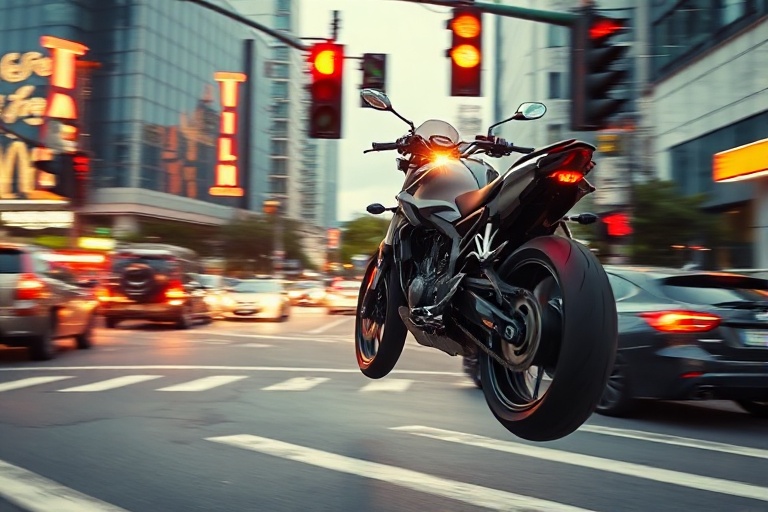
The red light glows against the dusk as motorcycles weave through the gridlocked traffic. This scene repeats itself in cities from Ho Chi Minh City to Rome, where two-wheeled commuters navigate urban chaos with practiced ease. The motorcycle at the traffic light has become more than just a moment of stillness—it’s a cultural snapshot of modern mobility, economic necessity, and urban adaptation.
While cars idle in bumper-to-bumper frustration, motorcycles slip into the gaps. Riders perch on their bikes, feet planted on the pavement, helmets resting on handlebars or secured under arms. They wait not with impatience, but with the quiet confidence of those who understand the rhythm of the city. This practice isn’t just a quirk of traffic behavior—it reflects deeper patterns in how people move, survive, and even thrive in dense urban environments.
Why Do Motorcycles Dominate at Traffic Lights?
The prevalence of motorcycles at red lights isn’t accidental. In many cities, these vehicles offer a practical solution to urban congestion, high fuel costs, and limited parking. But the reasons go beyond utility. In cities like Jakarta, where traffic moves at a crawl for hours each day, motorcycles provide a level of flexibility that cars simply cannot match.
Consider these factors:
- Maneuverability: Motorcycles can navigate through tight spaces, cutting across lanes or filtering to the front of the queue.
- Fuel efficiency: With rising gas prices, smaller engines consume less fuel, making them economical choices for daily commuters.
- Parking ease: Motorcycles require far less space than cars, allowing riders to park on sidewalks or in designated two-wheeler zones.
- Affordability: In developing economies, motorcycles are often more accessible than cars, offering a middle ground between bicycles and automobiles.
In Vietnam, for example, the Honda Win—a rugged, no-frills motorcycle—has become a symbol of economic mobility. It’s not just a vehicle; it’s a lifeline for families, small businesses, and students. The sight of a dozen motorcycles clustered at a red light isn’t just a traffic scene—it’s a testament to how transportation shapes daily life.
Cultural and Economic Contexts Around the World
Motorcycles at traffic lights tell different stories depending on where you are. In Bangkok, riders often carry multiple passengers, turning a solo commute into a communal experience. In Rome, scooters are parked vertically in rows, leaning against each other like dominos, while their riders chat in the shade of historic buildings. In Bogotá, motorcycles are a lifeline for delivery workers, weaving through the Andes-bound traffic with insulated bags strapped to their backs.
These variations highlight how motorcycles serve distinct roles in different cultures:
- Deliveries and gig work: In cities like Manila and São Paulo, motorcycles are the backbone of the gig economy, ferrying food, documents, and packages across sprawling metropolises.
- Family transport: In rural India and Pakistan, motorcycles often serve as family vehicles, with entire households piling onto a single bike for short trips.
- Status and style: In European cities like Lisbon and Barcelona, scooters are fashion statements, with riders opting for vintage Vespa models or sleek electric options.
- Survival in chaos: In Lagos and Nairobi, motorcycles—often called “okadas” or “boda-bodas”—are essential for navigating poorly maintained roads and unpredictable traffic.
In each case, the motorcycle at the traffic light isn’t just a vehicle—it’s a cultural artifact. It reflects economic realities, social norms, and even aesthetic preferences. For some, it’s a tool of independence; for others, a necessity born of necessity.
The Safety Debate: Risk and Regulation
Of course, the motorcycle at the traffic light isn’t without controversy. Safety concerns loom large in cities where helmet laws are loosely enforced or nonexistent. In Vietnam, where motorcycles account for over 90% of road users, traffic fatalities remain a critical issue. The National Traffic Safety Committee reports that in 2022, over 7,000 people died in road accidents, with motorcyclists comprising a significant portion.
Governments have responded with mixed results. Some cities, like Ho Chi Minh City, have introduced “red light jumping” fines for motorcyclists who filter through traffic illegally. Others, like Amsterdam, have designated “filter lanes” to guide motorcycles safely to the front of the queue. In Manila, helmet laws are strictly enforced, but compliance varies widely.
The debate isn’t just about enforcing rules—it’s about rethinking urban infrastructure. Cities like Taipei have invested in dedicated motorcycle lanes, reducing conflicts between two- and four-wheeled traffic. Meanwhile, in Delhi, authorities have experimented with motorcycle-only zones to streamline flow during rush hours.
But regulation alone isn’t enough. Education plays a crucial role. Organizations like the Global Health Advocacy initiative have launched campaigns in Southeast Asia to promote helmet use and defensive riding. These efforts highlight a simple truth: the motorcycle at the traffic light isn’t just a symbol of urban life—it’s a reminder of the need for safer, more inclusive streets.
The Future of Two-Wheeled Urban Mobility
As cities grow and climate concerns intensify, the role of motorcycles in urban transport is evolving. Electric scooters and motorcycles are gaining traction in Europe and North America, offering zero-emission alternatives to gas-guzzling cars. Companies like Zero Motorcycles and Vespa are betting big on this shift, designing models that cater to both commuters and eco-conscious riders.
In Asia, governments are investing in motorcycle-friendly infrastructure. Bangkok’s “SkyPark” project, for example, includes elevated motorcycle lanes designed to reduce congestion on ground-level roads. Meanwhile, in Jakarta, ride-hailing apps like Gojek have integrated motorcycles into their platforms, turning them into tools for economic empowerment as well as transport.
The motorcycle at the traffic light may seem like a small detail, but it’s a barometer of urban change. As cities adapt to climate pressures, economic shifts, and technological advancements, two-wheeled transport will likely play an even larger role. Whether it’s the roar of a combustion engine or the quiet hum of an electric motor, the sound of motorcycles at red lights will continue to define the soundtrack of urban life.
Conclusion
The motorcycle at the traffic light is more than a fleeting moment in the day—it’s a window into the soul of a city. It tells stories of resilience, ingenuity, and adaptation. From the bustling streets of Jakarta to the historic boulevards of Rome, these riders are not just waiting for the light to change; they’re shaping the future of urban mobility.
As we look ahead, the challenge isn’t just to manage traffic—it’s to create cities where motorcycles, cars, cyclists, and pedestrians can coexist safely and sustainably. The motorcycle at the traffic light reminds us that progress isn’t just about technology or infrastructure. It’s about people—and the way they move through the world.