Wolfsburg: The City Built by Volkswagen and Its Bold Future
Volkswagen’s Wolfsburg: The Industrial Heart of Automotive Innovation
Nestled in the Lower Saxon plains of Germany, Wolfsburg isn’t just another city on the map. It’s a living testament to automotive ambition, corporate vision, and the rise of a company that would come to define global mobility. Home to Volkswagen AG, Wolfsburg is a planned urban center built around a single company, its skyline dominated by factory smokestacks and glass towers, its streets humming with the rhythm of assembly lines. More than a headquarters, Wolfsburg is a city that grew—literally—from the ambitions of a single car.
The city’s origins trace back to 1938, when the Nazi regime founded “Stadt des KdF-Wagens bei Fallersleben” as part of its KdF (Strength Through Joy) program. The goal: produce an affordable “people’s car,” the Volkswagen Beetle. After World War II, British military authorities restarted production under Ivan Hirst, a British Army officer, and by 1949, the company was handed over to the West German government and the state of Lower Saxony. That decision set the stage for Wolfsburg’s transformation from a wartime propaganda project into a cornerstone of postwar German industry.
The Volkswagen Effect: How a City Was Built Around a Car
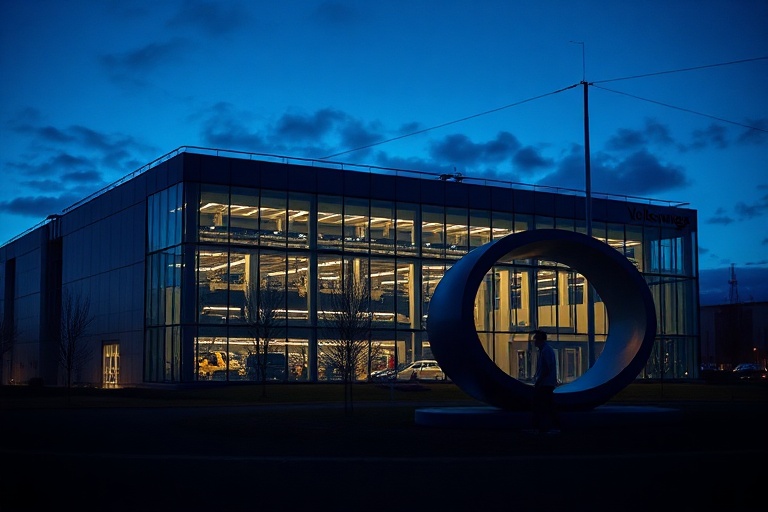
Wolfsburg is one of the few cities in the world where the urban landscape is inseparable from its dominant industry. The Volkswagen Group’s global headquarters sits at the city’s core, a sleek glass-and-steel complex that overlooks the sprawling Autostadt—the company’s iconic customer center and theme park. Designed by architects including Gunter Henn, Autostadt isn’t just a showroom; it’s a cultural landmark where visitors can pick up their new VW vehicles from futuristic glass towers, each representing a brand in the group—from Audi to Porsche.
The city’s layout reflects its corporate identity. Major streets are named after models—Poloallee, Golfallee, Passatstraße—and the public transit system is branded “VWmobil.” Even the local soccer club, VfL Wolfsburg, was founded by Volkswagen workers in 1945 and later sponsored into prominence. In 2009, Wolfsburg’s women’s team won the UEFA Women’s Champions League, a rare moment where the city’s sporting identity transcended local fame.
Wolfsburg’s population of about 125,000 is a melting pot of engineers, designers, and factory workers, many of whom relocated from across Germany and Europe. The city’s architecture blends utilitarian industrial design with modernist planning. The Alvar Aalto-designed Wolfsburg Cultural Center stands in contrast to the factory’s imposing silhouette, offering a space for music, theater, and dialogue in a city otherwise defined by production lines.
Beyond the Assembly Line: Wolfsburg’s Cultural and Educational Evolution
While Wolfsburg remains inextricably linked to Volkswagen, the city has actively diversified its identity. The Technische Universität Braunschweig, one of Germany’s leading technical universities, operates a campus in Wolfsburg focused on mobility systems and sustainable engineering. This partnership fuels innovation and draws students from around the world, creating a younger, more diverse population.
Cultural institutions have flourished in recent decades. The Kunstmuseum Wolfsburg, opened in 1994, hosts contemporary art exhibitions that draw international visitors. Its striking cylindrical building, designed by architects Peter P. Schweger and Karl-Heinz Petzinka, has exhibited works by artists like Andy Warhol and Yayoi Kusama. The museum’s presence signals Wolfsburg’s intent to be seen as more than an industrial town—it’s a city with a cultural pulse.
The city also hosts the annual Automobil Sommer festival, blending car culture with music, food, and art. In winter, the Christmas market transforms the city center into a festive plaza of lights and treats. These events reflect a growing civic pride that extends beyond corporate loyalty.
Yet challenges remain. Wolfsburg’s economy is heavily dependent on the automotive sector, leaving it vulnerable to shifts in global demand, electrification, and trade policies. The transition to electric vehicles poses both risk and opportunity. Volkswagen’s ID. series, built in Wolfsburg, represents a bold pivot toward zero-emission mobility. The city’s future hinges on its ability to adapt without losing its identity.
Sustainability and the Future: Can Wolfsburg Reinvent Itself?
Wolfsburg is at a crossroads. The company that built it faces immense pressure to decarbonize. In 2021, Volkswagen announced plans to become carbon-neutral by 2050, with Wolfsburg as a key production site. The company has invested over €800 million in transforming the plant into a green factory, integrating renewable energy, battery recycling, and hydrogen-powered logistics.
Local initiatives are emerging in response. The “Wolfsburg Climate Pact” unites businesses, schools, and citizens in reducing emissions. The city has installed solar panels on public buildings and expanded cycling infrastructure, though critics argue progress is uneven. The challenge is balancing economic survival with environmental responsibility.
Autonomous driving presents another frontier. Volkswagen’s software subsidiary CARIAD, based in Wolfsburg, is developing the technological backbone for self-driving vehicles. The city’s proximity to major German automotive suppliers—Bosch, Continental, and ZF—positions it at the heart of the mobility revolution.
Wolfsburg’s story is a study in industrial symbiosis: a company creating a city, a city shaping a company. It’s a model of top-down urban planning, where corporate vision dictates civic life. But as the world moves toward sustainability and digital mobility, Wolfsburg must evolve or risk becoming a relic of the 20th century.
Why Wolfsburg Matters Beyond the Beetle
Wolfsburg challenges the notion that cities must grow organically. It was conceived, built, and sustained by a single corporation, a rare experiment in planned industrial urbanism. Its lessons are vital for planners and policymakers considering how to integrate industry and community in an era of rapid technological change.
The city also raises questions about identity. Can a place defined by one company survive its decline? Wolfsburg’s answer lies in diversification, education, and culture. The Kunstmuseum and university are not just amenities—they’re lifelines to a future beyond the assembly line.
As Volkswagen navigates the shift to electric and software-defined vehicles, Wolfsburg stands as both a symbol of industrial might and a cautionary tale. It’s a city built on wheels, now facing the challenge of steering toward a greener, more inclusive horizon.
For travelers, Wolfsburg offers more than factory tours. It’s a chance to witness how a company can shape a society—and how that society might outgrow its creator. Whether you’re drawn by the allure of classic cars, the pulse of modern engineering, or the quiet evolution of urban life, Wolfsburg delivers a story worth following.
And if you’re inspired to explore other cities shaped by industry or innovation, consider visiting our travel section, where Wolfsburg sits among stories of transformation and ambition.