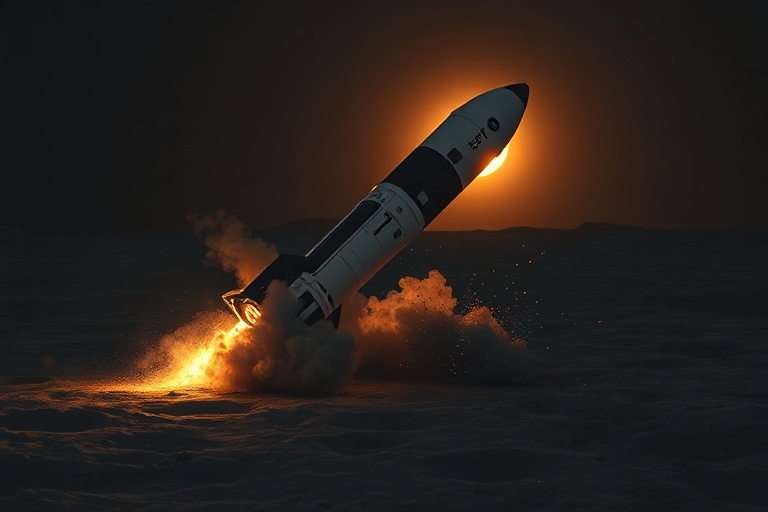
Falcon 9 Rocket Collides with the Moon: A Warning for Space Exploration
Space Debris and the Growing Challenge of Orbital Congestion
The recent near-collision between a SpaceX Falcon 9 rocket stage and the Moon highlights a growing concern for space agencies and astronomers worldwide. On March 4, 2022, an expended Falcon 9 second stage, launched in 2015, drifted into a chaotic trajectory after failing to execute a deorbit burn. Instead of re-entering Earth’s atmosphere, it became a rogue projectile hurtling toward the lunar surface at roughly 5,800 mph. While the impact itself went unobserved, telescopes and lunar orbiters later confirmed the crater it created near Hertzsprung Crater on the Moon’s far side.
This incident is not an isolated event but part of a broader pattern. The number of active and defunct satellites, spent rocket stages, and fragmented debris in Earth’s orbit has surged. According to the European Space Agency (ESA), there are over 36,500 pieces of space debris larger than 10 centimeters currently tracked. While most remain in low Earth orbit, some—like the Falcon 9 stage—drift into cislunar space, where they pose risks to both robotic and future crewed missions.
Cultural perceptions of space exploration often focus on heroic launches and groundbreaking discoveries. Yet behind the scenes, the silent proliferation of orbital clutter raises critical questions about sustainability and responsibility. As private companies like SpaceX, Blue Origin, and others expand their presence in space, the need for international regulation becomes urgent. The Moon may seem distant, but the ripple effects of our actions in orbit are becoming impossible to ignore.
The Technical Breakdown: How a Rocket Stage Became a Lunar Threat
The Falcon 9 second stage involved in the lunar collision was part of the Deep Space Climate Observatory (DSCOVR) mission. Launched on February 11, 2015, the rocket successfully delivered its payload to the Lagrange Point L1, a gravitationally stable point between Earth and the Sun. However, after deploying DSCOVR, the second stage lacked sufficient fuel for a controlled deorbit maneuver.
In the vacuum of space, objects do not naturally slow down. Without propulsion or atmospheric drag, spent rocket stages can remain in orbit for decades—or indefinitely. Engineers initially hoped the stage would eventually drift into a stable orbit around the Sun. But gravitational interactions with the Earth-Moon system altered its trajectory, sending it on a collision course with the Moon instead.
Bill Gray, an independent astronomer and orbital dynamics researcher, first identified the impending impact using publicly available tracking data. His calculations, later corroborated by NASA and the Jet Propulsion Laboratory, confirmed the stage would strike the Moon on March 4. The event was not observed in real time, but subsequent analysis of lunar imagery from NASA’s Lunar Reconnaissance Orbiter revealed a fresh crater approximately 20 meters wide.
This incident underscores a gap in space traffic management. While agencies like NASA and ESA maintain databases of tracked objects, private operators are not always required to share detailed trajectory data. As commercial spaceflight accelerates, the need for a global framework to track and manage deep-space debris has never been clearer.
Global Reactions: From Scientific Curiosity to Ethical Debate
The lunar collision sparked reactions across continents, revealing diverse perspectives on space exploration’s future. In Japan, where JAXA has emphasized robotic lunar exploration through its SLIM and Hakuto-R missions, scientists viewed the event as a cautionary tale. “Space debris is not just an Earth-orbit problem—it’s a cislunar one,” said Dr. Hiroshi Yamakawa, president of JAXA. “We must plan for long-term sustainability, not just short-term gains.”
In Europe, the ESA echoed these concerns. The agency has been a vocal advocate for the “Zero Debris Charter,” an initiative calling for no new debris in critical orbital regions by 2030. “We cannot treat the Moon as a dumping ground,” said Holger Krag, Head of ESA’s Space Safety Programme. “Every impact, every crater, is a loss of pristine lunar surface that future missions may want to study.”
Meanwhile, in the United States, the Federal Aviation Administration (FAA) and SpaceX both downplayed the incident’s significance. A SpaceX spokesperson stated that the company had “no plans to alter its launch trajectories,” while the FAA noted that current regulations do not require tracking of deep-space debris. This laissez-faire approach contrasts sharply with growing international calls for stricter oversight.
The incident also resonated in cultural discourse. Science fiction often romanticizes space as infinite and untouched. But the reality is far more constrained. As lunar missions multiply—including NASA’s Artemis program and China’s Chang’e missions—so does the risk of accidental interference. The Moon is no longer just a celestial body to observe. It is becoming a shared environment, one that demands stewardship.
What’s Next? Mitigation, Policy, and the Future of Deep-Space Travel
Addressing the challenge of orbital debris requires a multi-pronged approach. Below are key strategies being discussed at international forums:
- Enhanced Tracking: Expanding global networks to monitor objects beyond low Earth orbit, including cislunar space.
- Controlled Deorbiting: Requiring all rocket stages to carry sufficient fuel for controlled re-entry or lunar disposal.
- International Agreements: Updating the Outer Space Treaty to include binding debris mitigation protocols.
- Active Debris Removal: Developing robotic missions to capture and deorbit defunct satellites and rocket stages.
- Public Transparency: Mandating that private companies share trajectory data for all deep-space objects.
NASA’s Artemis Accords, signed by over 30 countries, include principles for sustainable lunar exploration. But without enforcement mechanisms, their impact remains limited. Meanwhile, private companies continue to prioritize cost and speed over long-term sustainability—a tension that could lead to further incidents.
The Falcon 9 lunar collision serves as a wake-up call. It is a reminder that space is not a limitless frontier but a fragile ecosystem. Just as we regulate air traffic and maritime zones, we must develop analogous systems for orbital and cislunar space. The Moon is not just a destination. It is a shared heritage—and one that demands collective responsibility.
As nations and corporations set their sights on lunar bases, mining operations, and even tourism, the clock is ticking. The next decade will determine whether humanity repeats the mistakes of terrestrial pollution or forges a new path of interplanetary stewardship. The choice is ours—and it begins with acknowledging that even in the void of space, nothing goes unnoticed.