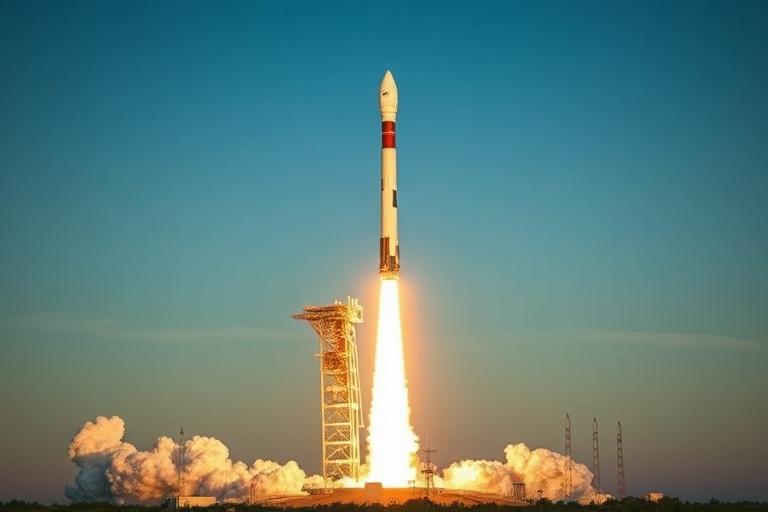
Since its first launch in 2010, SpaceX’s Falcon 9 has become the most flown and reliable rocket in the commercial space industry. Designed and operated by Elon Musk’s aerospace company, this two-stage rocket has transformed how satellites, cargo, and even astronauts reach orbit. Its combination of reusability, cost efficiency, and proven performance has made it a cornerstone of modern spaceflight.
The Design and Capabilities of Falcon 9
The Falcon 9 stands 70 meters tall and has a diameter of 3.7 meters. Its first stage is powered by nine Merlin 1D engines, which burn a combination of rocket-grade kerosene (RP-1) and liquid oxygen (LOX). The second stage uses a single Merlin Vacuum engine optimized for operation in space, allowing it to deliver payloads to higher orbits or even interplanetary trajectories.
One of Falcon 9’s most significant innovations is its reusability. Unlike traditional expendable rockets, the first stage is designed to return to Earth and land vertically—either on a drone ship at sea or a landing pad near the launch site. This capability has drastically reduced the cost of space access. According to SpaceX, reusing a first stage can cut launch costs by up to 30%.
The rocket has a payload capacity of up to 22,800 kilograms to low Earth orbit (LEO) and 8,300 kilograms to geostationary transfer orbit (GTO). Over the years, SpaceX has upgraded the Falcon 9, introducing the Block 5 variant in 2018, which includes performance improvements and enhanced reusability. The Block 5 is certified for up to 100 flights, a major milestone in reducing the long-term cost of spaceflight.
Payloads and Missions
Falcon 9 has been instrumental in deploying a wide range of payloads. The rocket regularly carries communication satellites for companies like Starlink, Iridium, and Intelsat. Its reliability has also made it the go-to choice for resupplying the International Space Station (ISS) through NASA’s Commercial Resupply Services program.
In May 2020, Falcon 9 made history by launching NASA astronauts Doug Hurley and Bob Behnken to the ISS aboard the Crew Dragon spacecraft. This mission, known as Demo-2, marked the first time a commercial company had sent humans into orbit. Since then, Falcon 9 has continued to support NASA’s Commercial Crew Program, ferrying astronauts to and from the ISS on a regular basis.
Another notable mission was the Transiting Exoplanet Survey Satellite (TESS), launched in 2018. TESS has since identified thousands of exoplanet candidates, expanding our understanding of planets beyond our solar system. Falcon 9’s versatility has also enabled it to launch scientific missions, such as the Deep Space Climate Observatory (DSCOVR) and the Jason-3 oceanography satellite.
The Economic Impact of Reusability
Before Falcon 9, rockets were typically discarded after a single use, making spaceflight an incredibly expensive endeavor. The average cost of launching a payload to LEO was around $10,000 per kilogram. SpaceX’s reusability model has slashed this cost to approximately $2,700 per kilogram, according to some estimates.
This reduction in cost has opened up new opportunities for businesses and governments. Companies like SpaceX itself, OneWeb, and Amazon’s Project Kuiper have launched massive constellations of satellites to provide global broadband internet. Meanwhile, countries with emerging space programs, such as Israel and New Zealand, have relied on Falcon 9 to deploy their first satellites.
The economic ripple effects extend beyond the space industry. The increased demand for launches has spurred growth in related sectors, including satellite manufacturing, launch infrastructure, and even insurance. The commercial space sector, valued at around $370 billion in 2020, is projected to grow substantially as launch costs continue to decline.
A Competitive Landscape
Falcon 9 faces competition from other launch vehicles, both domestic and international. United Launch Alliance’s Atlas V and Vulcan rockets, as well as Blue Origin’s New Glenn (expected to debut in 2024), are among the primary competitors. Internationally, Europe’s Ariane 6, Russia’s Soyuz, and China’s Long March rockets also vie for market share.
Despite this competition, Falcon 9 remains the most frequently launched rocket in the world. In 2023 alone, SpaceX conducted 96 orbital launches, with Falcon 9 accounting for the vast majority. This dominance is due in part to its proven track record, but also to SpaceX’s aggressive launch cadence and ability to secure contracts with both government and commercial customers.
However, competition is intensifying. China’s space program, backed by significant government investment, has made rapid strides in recent years. The country’s Long March 5 rocket has successfully launched heavy payloads, including components of its Tiangong space station. Meanwhile, Europe’s Ariane 6, though delayed, aims to offer a cost-competitive alternative to Falcon 9.
Challenges and Future Prospects
Despite its successes, Falcon 9 has faced challenges. The most notable was the September 2016 explosion of a Falcon 9 during a pre-launch static fire test, which destroyed the Amos-6 satellite. SpaceX identified the cause—a breach in the second stage’s cryogenic helium system—and implemented corrective measures. Since then, the rocket has maintained an impressive record of reliability, with no further catastrophic failures.
Another challenge is the environmental impact of rocket launches. While Falcon 9’s kerosene fuel is less toxic than some alternatives, the carbon emissions from each launch are significant. SpaceX has explored greener propellants, but for now, Falcon 9 remains dependent on RP-1 and LOX. The company is also working on reducing the environmental footprint of its operations, including efforts to recover and recycle rocket components.
What’s Next for Falcon 9?
Falcon 9’s future remains bright, with SpaceX continuing to push the boundaries of what’s possible. The rocket will play a critical role in the deployment of the Starlink constellation, which aims to provide global high-speed internet. As of 2024, SpaceX has launched over 5,000 Starlink satellites, with plans to expand the network to tens of thousands more.
The rocket will also support NASA’s Artemis program, which aims to return humans to the Moon. While the Space Launch System (SLS) is the primary vehicle for Artemis, Falcon 9 may be used for secondary payloads or resupply missions. Additionally, Falcon 9 is expected to continue launching crewed missions to the ISS and potentially even private space stations in the future.
Looking further ahead, SpaceX’s next-generation Starship rocket is intended to eventually replace Falcon 9. Starship, a fully reusable, super-heavy lift vehicle, promises even lower launch costs and greater payload capacity. However, development has faced delays, and Falcon 9 is likely to remain a workhorse for years to come.
Conclusion: A Lasting Legacy in Spaceflight
Falcon 9 has undeniably changed the space industry. Its combination of reusability, reliability, and cost efficiency has made space more accessible than ever before. From launching satellites to sending astronauts to the ISS, the rocket has demonstrated that commercial spaceflight is not just a possibility but a reality.
As SpaceX continues to innovate and competitors emerge, Falcon 9’s legacy will likely endure. It has set a new standard for what a rocket should be—versatile, affordable, and sustainable. For the foreseeable future, Falcon 9 will remain at the heart of humanity’s efforts to explore and utilize space.
For those interested in the broader trends shaping the space industry, be sure to explore our Technology section, where we cover the latest developments in aerospace, satellite technology, and beyond.