France’s coastline is dotted with cities that have shaped the nation’s maritime identity, but few rivalries are as stark as that between Le Havre and Marseille. One rises from the ashes of wartime destruction to become a UNESCO-listed symbol of reconstruction. The other thrives as a multicultural gateway to the Mediterranean, pulsing with energy day and night.
These two port cities are not just rivals in geography—they represent contrasting philosophies of urban development, economic resilience, and cultural identity. While Marseille has long basked in the Mediterranean sun, Le Havre has quietly rebuilt itself into a modern marvel after near-total devastation in World War II. Their differences tell a broader story about how cities adapt, survive, and define themselves in a rapidly changing world.
The Historical Foundations: From Destruction to Renaissance
Le Havre’s story is one of deliberate rebirth. Founded in 1517 by King Francis I, the city was originally a modest fishing village called Le Hâvre de Grâce. Its fortunes changed when it became a strategic port for transatlantic trade and naval operations. Yet, its defining chapter unfolded during World War II.
The city endured 54 Allied bombing raids between 1940 and 1944. Over 80,000 buildings were destroyed—nearly 80% of the urban fabric. In the aftermath, France faced a monumental task: rebuild a city that could support both economic revival and modern living. Enter Auguste Perret, a visionary architect who proposed a radical plan: a city constructed entirely in reinforced concrete, organized around geometric precision and functionalist ideals.
The result is today’s Le Havre—a UNESCO World Heritage Site since 2005. Its grid-like streets, uniform façades, and towering concrete structures stand as a testament to post-war reconstruction and architectural innovation. The city’s identity is rooted not in antiquity, but in modernity and resilience.
A Contrast: Marseille’s Ancient Allure and Enduring Spirit
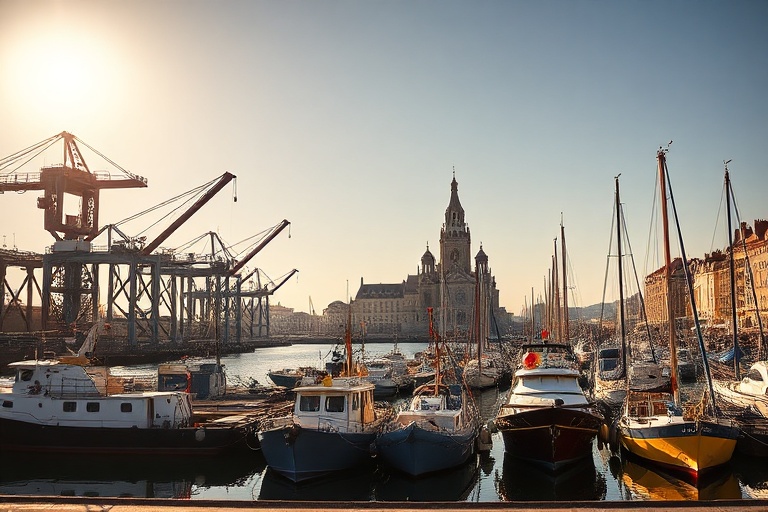
Marseille, by contrast, is one of Europe’s oldest cities. Founded by Greek settlers in 600 BCE as Massalia, it predates Rome and has been a crossroads of civilizations ever since. Its Vieux Port (Old Port) has been the heart of Mediterranean trade for over 2,600 years. The city’s layered history is visible in its architecture: Roman ruins beside medieval cathedrals, Baroque churches next to 19th-century mansions.
While Le Havre was being rebuilt from rubble, Marseille thrived despite its own struggles—industrial decline, social unrest, and waves of immigration that reshaped its demographic fabric. The city became a symbol of France’s multicultural reality, with large communities from North Africa, Italy, and beyond. Marseille’s identity is not defined by a single architectural style, but by its chaotic, vibrant, and deeply human character.
Urban Form and Identity: Order vs. Chaos
The physical and social landscapes of Le Havre and Marseille could hardly be more different. Le Havre is a city designed by planners, with wide boulevards, symmetrical plazas, and a color palette dominated by shades of gray and beige. Its urban fabric is clean, orderly, and legible—a city built for efficiency and movement.
Marseille, on the other hand, is a city of contrasts. Narrow, winding streets spill into sunlit plazas. Historic buildings lean precariously over alleyways. The city’s topography—nestled between sea and hills—creates a sense of enclosure and intimacy. Marseille feels alive, unpredictable, and deeply authentic. It doesn’t follow a master plan; it evolves organically.
This contrast extends to public perception. Le Havre is often seen as underrated—a city that punches above its weight in culture and economy but lacks the tourist magnetism of Paris or Nice. Marseille, meanwhile, is celebrated (and sometimes criticized) for its unfiltered character. It’s a city that refuses to be tamed, where street art, music, and cuisine blend into a living collage.
Cultural and Economic Divergence
The cultural ecosystems of these cities reflect their identities. Le Havre’s cultural scene is curated and contemporary. The modernist Musée d’Art Moderne André Malraux (MuMa) houses one of France’s finest collections of Impressionist works, while the Volcan cultural center—a striking example of 1980s brutalist architecture—hosts theater, music, and exhibitions. The city’s annual Le Havre Film Festival draws international acclaim.
Marseille’s cultural life thrives in its streets and neighborhoods. The Mucem (Museum of European and Mediterranean Civilizations) stands as a bridge between cultures, while the Friche la Belle de Mai—a former tobacco factory turned arts complex—serves as a hub for creativity and social innovation. Marseille’s music scene, from raï to hip-hop, pulses with energy that reflects its diverse communities. The city’s cuisine, too, tells a story: bouillabaisse, panisse, and navettes are not just dishes—they’re cultural artifacts.
Economically, both cities play crucial roles. Le Havre remains a major port, handling millions of tons of cargo annually and serving as a key link in the Atlantic trade network. It’s also home to a growing tech sector, with startups and research centers benefiting from its strategic location and modern infrastructure. Marseille, meanwhile, is France’s second-largest port and a critical gateway to North Africa and the Middle East. Its economy is more diversified, with strong sectors in healthcare, tourism, and creative industries.
Broader Implications: What These Cities Teach Us
The rivalry between Le Havre and Marseille is more than a geographic or cultural contrast—it’s a case study in how cities adapt to change. Le Havre’s story is one of planned renewal, where destruction led to innovation. Marseille’s tale is one of organic survival, where history and diversity create resilience. Both models offer lessons for urban planners, policymakers, and communities worldwide.
In an era of climate change, economic uncertainty, and social fragmentation, these cities show that there’s no single path to success. Some places may need bold, top-down reconstruction. Others thrive through incremental, community-driven growth. What both demonstrate is the power of identity—how a city defines itself shapes its future.
Lessons for Other Port Cities
Port cities around the world face similar challenges: balancing tradition with modernity, managing immigration and cultural change, and adapting to shifts in global trade. Le Havre and Marseille offer contrasting strategies:
- Design and Planning: Le Havre’s reconstruction was a top-down effort that prioritized order and efficiency. It shows how architecture can shape social behavior and economic activity. Other cities, such as Rotterdam or Hamburg, have drawn inspiration from this model in their post-war redevelopment.
- Organic Growth: Marseille’s evolution reflects the power of bottom-up development. Its neighborhoods retain a sense of authenticity that planned cities often lack. Cities like Naples or Lisbon share this organic character, where history and culture are inseparable from the urban fabric.
- Cultural Integration: Both cities have successfully integrated immigrant communities, though in different ways. Marseille’s multiculturalism is visible and celebrated, while Le Havre’s immigrant populations are more integrated into the city’s modernist vision. This raises questions about how cities balance assimilation with cultural preservation.
- Economic Diversification: Marseille’s varied economy offers a model for cities overly reliant on a single industry. Le Havre, meanwhile, shows how reinvention can attract new investment and talent. Both cities demonstrate that economic resilience requires adaptability.
Looking Ahead: The Future of Le Havre and Marseille
Both cities face challenges in the coming decades. Le Havre must contend with the rise of automation in port operations and the need to diversify its economy further. It’s investing in green technologies and digital innovation, positioning itself as a leader in sustainable port logistics. The city’s UNESCO status also brings pressure to preserve its modernist heritage while accommodating growth.
Marseille, meanwhile, grapples with social inequality, housing shortages, and the pressures of mass tourism. The city’s recent initiatives—such as the renovation of the Cité Radieuse, Le Corbusier’s iconic modernist housing complex—aim to revitalize both its physical and social fabric. Efforts to improve public transportation and reduce pollution are slowly transforming the urban experience.
Yet, despite their differences, both cities share a common trait: they are places of reinvention. Le Havre rebuilt itself from destruction. Marseille constantly reinvents itself through its people. In a world where cities are increasingly seen as engines of progress or battlegrounds of inequality, these two port cities offer a reminder: identity is not static. It’s something we build, together, one decision at a time.
Whether through the geometric precision of Le Havre’s streets or the chaotic vibrancy of Marseille’s markets, France’s port cities continue to shape not just their own futures, but the narrative of what cities can be.
Explore more on French urban culture and maritime history: