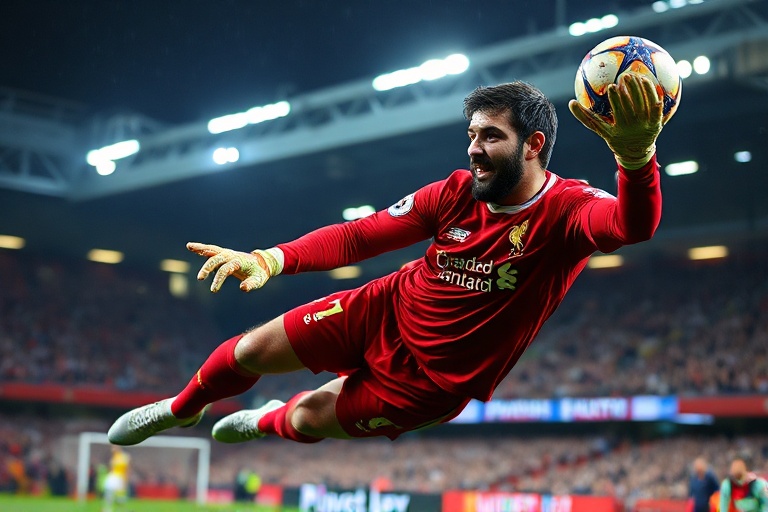
When Alisson Becker joined Liverpool in July 2018 for a reported £66.8 million, he became the world’s most expensive goalkeeper at the time. The Brazilian international arrived from Roma with high expectations, but few could have predicted the transformative impact he would have on a club still searching for its first Premier League title in nearly three decades.
Six years later, Alisson stands not only as Liverpool’s first-choice custodian but as one of the most respected goalkeepers in modern football. His arrival coincided with a defensive reformation under Jürgen Klopp, one that redefined how goalkeepers contribute to team success. More than just a shot-stopper, Alisson has reimagined the role of the goalkeeper in high-pressing systems, combining technical excellence with leadership that extends far beyond the penalty area.
A New Model of Goalkeeping
Alisson’s influence is rooted in a philosophy that treats the goalkeeper as the first attacker. His distribution—whether launching counterattacks with pinpoint long passes or playing out from the back under pressure—has become a cornerstone of Liverpool’s style. This approach demands immense composure, spatial awareness, and technical ability, qualities Alisson possesses in abundance.
His ball-playing ability has forced opponents to adjust their pressing strategies. Teams can no longer simply press high and force errors from Liverpool’s defenders because Alisson’s passing range often bypasses entire midfields. In the 2019–20 season, Liverpool’s average possession exceeded 60%, a figure unthinkable under previous regimes. Much of that stability stems from the confidence Alisson instills.
In possession, he functions almost like an auxiliary midfielder. His ability to read the game allows him to anticipate pressure before it arrives, positioning himself to receive the ball in safe zones. This spatial intelligence reduces the risk of turnovers and keeps Liverpool’s build-up play fluid. It’s a skill set that has reshaped expectations for what a top-level goalkeeper should contribute.
Key Attributes of Alisson’s Play
- Distribution: Completes over 85% of passes, with long-range accuracy often launching counterattacks.
- Positioning: Rarely caught out of position, thanks to elite reading of the game and spatial awareness.
- Command of the Box: Dominates the six-yard area, using his height (6’4”) and agility to claim crosses and set-piece situations.
- Footwork: Comfortable with the ball at his feet, comfortable in tight spaces, and capable of playing under pressure.
- Leadership: Vocal presence that organizes the defensive line and maintains structure during transitions.
From Roma Prodigy to Anfield Icon
Alisson’s journey to Liverpool was neither immediate nor guaranteed. Born in Novo Hamburgo, Brazil, in 1992, he began his career at Internacional before moving to Europe with Roma in 2016. Initially deployed as a backup to Wojciech Szczęsny, he earned his chance due to an injury and never relinquished the starting role. By the time he left for Liverpool, he had established himself as Serie A’s best goalkeeper, winning the league’s Goalkeeper of the Year award in 2018.
His arrival at Liverpool was met with skepticism by some, who questioned whether his relatively quiet first season at Roma translated to Premier League readiness. Those doubts were quickly dispelled. Alisson conceded just 22 goals in his debut season—a club record at the time—and played a pivotal role in Liverpool’s Champions League triumph that same year. He became the first goalkeeper to win the UEFA Goalkeeper of the Season award in consecutive years (2018–19 and 2021–22), a testament to his consistency.
Yet, his most defining moment may have come in the 2019 UEFA Super Cup against Chelsea, where he saved Tammy Abraham’s penalty in the shootout to secure Liverpool’s sixth trophy under Klopp. That victory symbolized more than silverware—it represented the birth of a new era.
The Human Behind the Gloves
Beyond statistics and trophies, Alisson is known for his character. His calm demeanor, even in high-pressure moments, has endeared him to teammates and fans alike. He is fluent in Portuguese, English, and Italian, a linguistic versatility that aids communication in multicultural dressing rooms. Off the pitch, he is deeply involved in charitable work, particularly through his support for education and healthcare initiatives in Brazil.
In 2021, he and his wife, Natalia Loewe, launched the Alisson Becker Institute, aimed at improving access to sports and education for underprivileged children in Brazil. His commitment to social causes reflects a maturity that extends beyond football, positioning him as a role model in the sport.
Broader Implications: How Alisson Changed the Goalkeeper Paradigm
Alisson’s success has had ripple effects across football. His rise has accelerated the trend of clubs prioritizing technically gifted goalkeepers who can play with their feet. Clubs like Manchester City, Bayern Munich, and even lower-budget teams now scout for goalkeepers with distribution skills comparable to outfield players.
This shift has also influenced coaching methodologies. Goalkeeper coaches now emphasize ball-playing abilities as highly as shot-stopping. Training sessions increasingly incorporate positional play drills where goalkeepers practice receiving the ball under simulated pressure, mirroring the demands of modern systems like Klopp’s Gegenpressing or Pep Guardiola’s positional play.
Moreover, Alisson’s career has highlighted the globalization of goalkeeper development. His path—from Brazil to Italy to England—demonstrates how talent pipelines are no longer confined to traditional European academies. Clubs in South America and Africa are now producing goalkeepers who can adapt to the technical demands of European football, further diversifying the talent pool.
Yet, with this evolution comes new challenges. The increased focus on a goalkeeper’s ability to play with their feet has led some pundits to question whether traditional shot-stopping skills are being undervalued. Alisson himself has acknowledged this tension, emphasizing that both aspects of goalkeeping remain essential. His consistency across both areas has set a new benchmark for what is expected from top-tier custodians.
Looking Ahead: What’s Next for Alisson?
As Liverpool enters a new phase under Arne Slot, Alisson remains a central figure. At 31 years old, he is approaching the latter stages of his prime, but his physical profile and tactical understanding suggest he can maintain elite performance for several more years. The club’s pursuit of a new contract reflects his ongoing value.
There are also broader questions about his international legacy. Despite being Brazil’s first-choice goalkeeper since 2018, he has yet to win a major tournament with the Seleção. The 2026 World Cup in the United States, Canada, and Mexico represents a final opportunity to add a global accolade to his collection.
Regardless of what the future holds, Alisson’s impact on Liverpool is already historic. He has redefined the role of the goalkeeper, elevated the club’s defensive identity, and set a new standard for excellence in his position. In an era where football is increasingly defined by tactical innovation, Alisson Becker has proven that the goalkeeper is no longer just the last line of defense—but the first architect of attack.
For Liverpool fans, he is more than a player; he is a symbol of a golden generation. For football, he is a blueprint for the modern goalkeeper.
And for those watching from the stands or the sidelines, his story reminds us that greatness is not measured solely in saves, but in the moments that change the game before it even begins.
Explore more on Liverpool’s tactical evolution and goalkeeper trends in our Sports and Analysis sections.