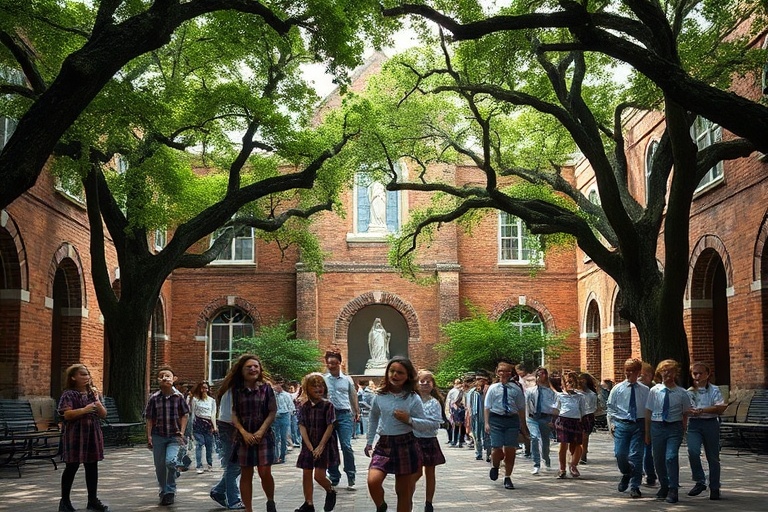
Catholic schools occupy a unique space in the American educational landscape, blending academic rigor with spiritual formation. Their history stretches back centuries, yet they continue to adapt to changing societal norms while maintaining core traditions. These institutions serve not only as places of learning but also as pillars of community identity, particularly in regions where Catholic heritage runs deep.
The enrollment trends in Catholic schools reflect broader cultural shifts. According to the National Catholic Educational Association, enrollment has declined from its peak in the 1960s, yet these schools remain vital in many urban and suburban areas. Their ability to combine faith-based education with college preparatory curricula makes them attractive to families seeking both academic excellence and moral grounding.
The Historical Roots of Catholic Education
The origins of Catholic schools in the United States trace back to the early 19th century, when waves of Catholic immigrants sought to preserve their faith and language through parochial education. The first Catholic school in America, established in 1810 in Maryland, set a precedent for institutions that would later become community anchors. By the late 19th century, waves of immigration and the need for Catholic families to maintain religious identity led to a rapid expansion of these schools.
These schools were often staffed by religious orders such as the Sisters of Charity, the Christian Brothers, and the Jesuits, whose members dedicated their lives to teaching. The parish-based model ensured that education was accessible to working-class families, creating a tradition of service that persists today. Even as public education expanded, Catholic schools maintained their appeal by offering a values-based alternative to secular institutions.
Key Milestones in Catholic School History
- 1810: Establishment of the first Catholic school in the U.S. (St. Mary’s School, Maryland)
- 1884: The Third Plenary Council of Baltimore mandated that every parish establish a school
- 1920s-1950s: Peak enrollment, with over 4 million students in Catholic schools
- 1970s: Decline in enrollment due to demographic shifts and rising costs
- 2000s-Present: Focus on urban ministries, scholarship programs, and specialized curricula
Academic Excellence and Community Impact
Studies consistently show that Catholic schools outperform public schools in standardized testing, graduation rates, and college attendance. The 2020 report from the U.S. Department of Education’s National Assessment of Educational Progress (NAEP) found that Catholic school students scored significantly higher in reading and math than their public school peers. This academic success is often attributed to smaller class sizes, rigorous discipline, and a structured environment.
Beyond academics, Catholic schools emphasize character development through service learning, sacramental preparation, and moral instruction. For many families, these schools provide a sense of belonging that extends beyond the classroom. A 2019 study by the University of Notre Dame found that Catholic school graduates were more likely to volunteer in their communities and exhibit higher levels of civic engagement than their public school counterparts.
“Catholic schools have long been a sanctuary for families seeking not just education, but formation—where faith, reason, and service intersect.” — Dr. Mary Pat Donoghue, Executive Director of the U.S. Conference of Catholic Bishops’ Secretariat of Catholic Education
Modern Challenges and Adaptations
Despite their strengths, Catholic schools face persistent challenges. Rising operational costs, declining vocations among religious teachers, and competition from charter schools and secular private institutions have forced many schools to close or merge. According to the Center for Applied Research in the Apostolate (CARA), nearly 1,300 Catholic schools closed between 2000 and 2020, reducing the total number of schools by about 20%.
However, some schools have found innovative ways to survive. The growth of school voucher programs in states like Indiana and Ohio has provided financial relief to families, while scholarship funds supported by dioceses and private donors have kept tuition affordable. Additionally, some Catholic schools have expanded their offerings to include STEM-focused curricula, dual-enrollment programs with local colleges, and specialized arts education.
Strategies for Sustainability
- Partnerships with Dioceses and Foundations: Collaborations with organizations like the Catholic Education Foundation have provided critical funding for struggling schools.
- Emphasis on Marketing and Outreach: Schools are increasingly using social media and community events to highlight their unique value proposition.
- Hybrid and Online Learning: Some schools have adopted blended learning models to reduce costs while maintaining academic quality.
- Focus on Urban Ministries: Parishes in underserved areas are revitalizing schools by integrating them into broader community development initiatives.
The Broader Implications for American Education
The decline of Catholic schools is not just an issue for the Church—it reflects broader trends in American education. The rise of school choice movements, the growing influence of standardized testing, and the increasing secularization of public life have reshaped the educational landscape. Yet, Catholic schools offer a counterpoint to these trends, proving that faith-based education can coexist with academic achievement.
For policymakers, Catholic schools represent a model of school choice that prioritizes parental autonomy and community values. Programs like the federal Opportunity Scholarship Program and state-level tax-credit scholarships have demonstrated that families, when given the means, will choose faith-based education for their children. This has sparked debates about the role of government in funding religious institutions, with Supreme Court rulings like Espinoza v. Montana Department of Revenue (2020) affirming the constitutionality of such programs.
The future of Catholic schools will likely depend on their ability to adapt without losing their core identity. As society becomes more diverse and secular, these institutions must find ways to welcome students from different backgrounds while remaining grounded in their Catholic mission. Initiatives like the University of Notre Dame’s ACE (Alliance for Catholic Education) program, which trains teachers for Catholic schools, highlight the ongoing commitment to preserving these schools as places of both learning and faith.
Conclusion: A Legacy Worth Preserving
Catholic schools occupy a distinctive place in American education, offering a blend of academic discipline, moral formation, and community cohesion. While they face significant challenges, their track record of success—both in the classroom and in shaping character—underscores their enduring value. As debates about school choice, educational equity, and the role of faith in public life continue, Catholic schools remain a compelling example of how tradition and innovation can coexist.
For families seeking an education that goes beyond textbooks, Catholic schools provide an alternative that prioritizes the whole person—mind, body, and soul. Their survival will depend on the collective efforts of parishes, donors, educators, and policymakers, but their legacy is one that has already shaped generations of students.
To explore more about how Catholic schools compare to other educational models, visit Dave’s Locker Education section. For insights into how faith-based institutions influence broader cultural trends, check out Dave’s Locker Culture category.