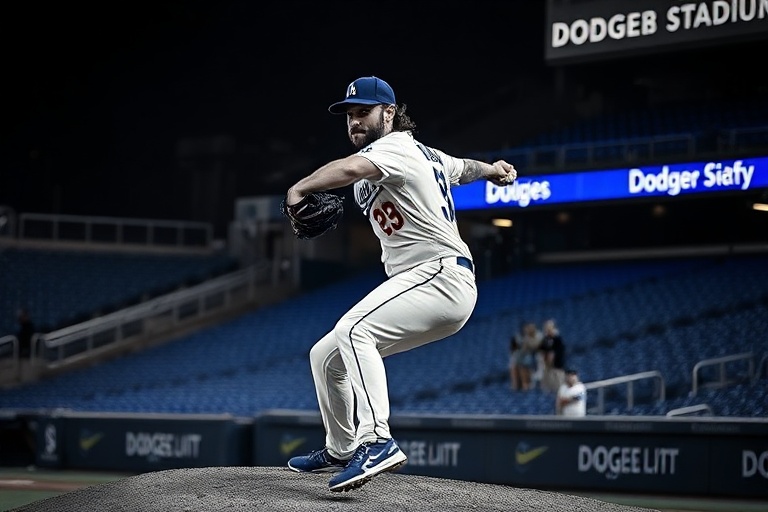
Dustin May’s Rise: How the Dodgers Ace Defied Expectations
Dustin May’s rise from a lightly regarded draft pick to a cornerstone of the Los Angeles Dodgers’ pitching rotation has been anything but conventional. Drafted in the third round of the 2016 MLB Draft out of Westview High School in Texas, May didn’t follow the fast-track path of top prospects. Instead, his development relied on raw athleticism, an unorthodox delivery, and an unshakable mental approach to the game. Today, he stands as a testament to the Dodgers’ ability to cultivate talent that others overlook.
May’s journey has been marked by both physical evolution and strategic adaptation. His signature “hello, goodbye” delivery—where he rears back and delivers a fastball with a near-violent motion—has drawn comparisons to some of the game’s most dominant pitchers. Yet, it’s his ability to harness that power while refining his secondary offerings that has made him indispensable to a Dodgers team constantly seeking pitching depth.
The Mechanics Behind May’s Dominance
May’s pitching mechanics are a study in controlled chaos. His high leg kick and elongated stride create a dramatic stretch in his delivery, generating significant torque in his upper body. This unorthodox approach allows him to maximize velocity without sacrificing command, a rare combination in modern baseball. His fastball, which routinely sits in the mid-90s, has been clocked as high as 99 mph, making it one of the most fearsome weapons in the game.
But May’s effectiveness extends beyond pure velocity. His ability to manipulate the baseball with a cutter, curveball, and changeup has forced hitters to adjust to multiple planes of movement. His cutter, in particular, has become a weapon against right-handed hitters, while his curveball remains one of the most deceptive in the league when he stays within the strike zone.
- High leg kick and elongated stride: Creates torque and deception, allowing him to generate power without sacrificing control.
- Mid-90s fastball with late movement: His fastball plays up due to its late life and ability to tunnel with his cutter.
- Three-pitch mix: Cutter, curveball, and changeup give him a balanced arsenal that keeps hitters off balance.
- Mechanical consistency: Despite his unorthodox delivery, he maintains repeatable mechanics that allow for command even under pressure.
What sets May apart is his ability to maintain this level of performance in high-leverage situations. His composure on the mound, even in the most pressure-packed moments, has made him a go-to arm for manager Dave Roberts. Whether it’s a must-win game or a critical playoff moment, May has repeatedly delivered, solidifying his reputation as a pitcher who thrives when the stakes are highest.
Statistical Breakdown: How May Became a Dodgers Staple
May’s statistical progression over the past few seasons tells the story of a pitcher who has not only refined his craft but also adapted to the evolving demands of Major League Baseball. His 2023 season was a career-best, with a 2.54 ERA and a 1.07 WHIP over 163 innings. Those numbers placed him among the league leaders in ground-ball percentage and strikeout-to-walk ratio, metrics that underscore his ability to limit damage while generating outs.
His ground-ball tendencies, in particular, have made him a valuable asset in a Dodgers rotation that often prioritizes contact management. May’s ability to induce weak contact has been a key factor in the Dodgers’ defensive shifts and overall run prevention. His 58.3% ground-ball rate in 2023 ranked in the top 10 among qualified starting pitchers, a testament to his ability to control the pace of the game.
May’s strikeout numbers have also seen steady improvement. His 2023 campaign featured a career-high 23.1% strikeout rate, up from 18.5% in 2021. This uptick can be attributed to his increased reliance on his cutter, which has become a swing-and-miss pitch. His ability to tunnel his fastball and cutter has made it difficult for hitters to distinguish between the two until the last possible moment, forcing them into defensive swings.
- 2023 ERA of 2.54: A career-best mark that placed him among the NL’s elite pitchers.
- 1.07 WHIP: Demonstrates his ability to limit baserunners while keeping the ball in the yard.
- 58.3% ground-ball rate: One of the highest in baseball, making him a ground-ball machine.
- 23.1% strikeout rate: A significant jump from previous seasons, highlighting his growing dominance.
May’s performance has not gone unnoticed by his peers. In a 2023 Players’ Tribune article, he discussed the importance of mental preparation and the role of failure in his development. His willingness to embrace adversity and refine his approach has resonated with younger pitchers within the Dodgers organization, positioning him as a de facto leader in the clubhouse.
Broader Implications: May’s Role in the Dodgers’ Future
The Dodgers’ pitching philosophy has long revolved around high-velocity arms who can miss bats and limit walks. May fits this mold perfectly, but his value extends beyond his individual contributions. His presence in the rotation provides the Dodgers with a safety net—a pitcher who can absorb innings, limit damage, and bridge the gap to their elite bullpen arms like Brusdar Graterol and Evan Phillips.
May’s contract situation also looms large over the Dodgers’ long-term planning. Signed to a two-year, $14 million deal in 2023, he represents one of the most cost-effective high-leverage arms in baseball. His ability to deliver at this price point gives the Dodgers financial flexibility, whether it’s reallocating resources to other areas of need or extending their own young talent.
Beyond the Dodgers, May’s success serves as a blueprint for teams looking to develop pitchers with unorthodox mechanics. His career trajectory challenges the conventional wisdom that only “textbook” deliveries produce consistent results. Instead, May’s story highlights the importance of adaptability, mental toughness, and a willingness to refine one’s craft—traits that are often overlooked in favor of raw athleticism.
For fans of the game, May’s rise is a reminder that talent can emerge from unexpected places. His journey from a third-round draft pick to a Dodgers ace underscores the unpredictability of baseball and the value of patience in player development. As the Dodgers continue to navigate the challenges of a competitive NL West and the ever-evolving landscape of Major League Baseball, May’s role will only grow in significance.
Conclusion: What’s Next for Dustin May?
At just 29 years old, Dustin May is entering the prime of his pitching career. His 2023 season proved that he is no longer an emerging talent but a proven commodity. As the Dodgers look to defend their division title and contend for another World Series, May’s ability to anchor the rotation will be pivotal.
Looking ahead, the focus will be on maintaining his durability and refining his secondary pitches. If May can continue to limit walks and induce weak contact, he has the potential to become a perennial All-Star and a cornerstone of the Dodgers’ pitching staff for years to come. His story is far from over, and baseball fans would be wise to keep an eye on the next chapter of his career.
For now, May stands as a testament to the Dodgers’ ability to find and develop pitching talent that others overlook. His success is a reminder that in baseball, as in life, the most rewarding paths are often the ones less traveled.
To explore more about the Dodgers’ pitching strategy and their impact on MLB trends, visit our Sports and Analysis sections for in-depth coverage.