Bhavitha Mandava’s 2026 Met Gala Debut: A Study in Global Influence and Cultural Fusion
The Met Gala, often referred to as fashion’s most exclusive night, returned in 2026 with a theme that invited deeper reflection: “Echoes of Heritage.” Among the attendees was Bhavitha Mandava, a rising figure in the global fashion and creative industries. Her presence at the event was not merely a personal milestone but a reflection of broader shifts in how cultural narratives are celebrated on a global stage.
Mandava’s appearance at the Gala was closely watched for multiple reasons. As an artist and designer whose work bridges traditional Indian aesthetics with contemporary global trends, she represented a generation of creators redefining cultural identity in fashion. Her outfit, a collaboration with a Parisian couture house, incorporated handwoven silk from Andhra Pradesh and digital embroidery inspired by Mughal miniature art—an intentional fusion of craftsmanship and innovation.
The Significance of “Echoes of Heritage” in 2026
The 2026 Met Gala theme was curated by Anna Wintour in partnership with the Costume Institute, reflecting a growing global interest in preserving and reimagining cultural traditions. Unlike earlier themes focused solely on spectacle, “Echoes of Heritage” emphasized storytelling through fashion. The event encouraged designers and attendees to explore ancestry, migration, and the transmission of craftsmanship across generations.
From an international perspective, this theme resonated deeply in regions like South Asia, Africa, and Latin America, where colonial legacies often overshadow indigenous art forms. Figures like Mandava, who publicly celebrate regional craftsmanship, are helping shift the narrative from appropriation to collaboration. Her presence at the Gala was seen as a quiet rebuttal to the industry’s history of extracting cultural motifs without credit—prioritizing instead a model of co-creation and fair compensation.
Cultural Diplomacy Through Fashion
Mandava’s arrival in New York was preceded by months of speculation. Her brand, which began in Hyderabad, had recently expanded into London and Dubai, signaling a strategic move toward cultural diplomacy through fashion. In an interview with Vogue India, she stated, “Fashion is the most accessible language of heritage. When a sari becomes a red-carpet moment, it’s not just fabric—it’s a conversation.”
This approach aligns with a growing trend among South Asian creatives who use international platforms to elevate local narratives. The 2026 Gala provided a perfect stage. Attendees from India, Pakistan, and Bangladesh wore garments that referenced everything from Punjabi phulkari to Bengali kantha stitching. These choices were not merely aesthetic; they were political statements in an industry increasingly scrutinized for homogeneity.
Mandava’s collaboration with a European atelier also highlighted the changing dynamics of global fashion production. Traditionally, Western brands have dominated high-fashion narratives, often sidelining artisans from the Global South. However, in 2026, there is a clear pivot toward ethical partnerships and transparent supply chains. Mandava’s collection, for instance, ensured that every artisan involved in the silk weaving and embroidery received fair wages and recognition.
The Night of the Gala: A Visual and Social Statement
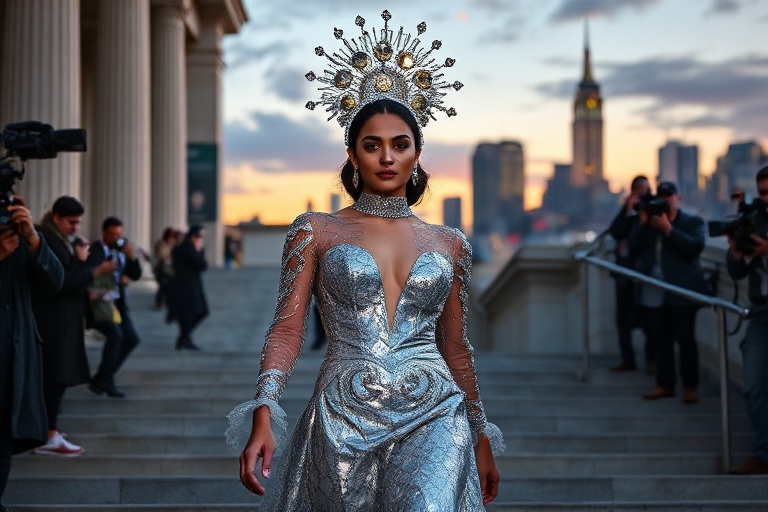
The 2026 Met Gala took place at the Metropolitan Museum of Art’s Temple of Dendur, a space that itself tells a story of cultural exchange. As guests arrived, the red carpet became a living museum of heritage reinterpreted. Mandava’s ensemble stood out not only for its beauty but for its layered meaning: a lehenga skirt in charcoal silk, paired with a structured jacket embroidered with scenes from the Ramayana, reimagined through a modern lens.
Social media amplified the moment. Hashtags such as #HeritageRedefined and #CraftToCatwalk trended globally, with users from India to Nigeria celebrating the visibility of traditional techniques. Fashion influencers pointed out the contrast between Mandava’s look and the minimalist trends that had dominated recent years, suggesting a return to maximalism rooted in cultural pride.
Notably, Mandava chose to accessorize with handcrafted silver jewelry from Jaipur, a decision that paid homage to India’s rich metalwork tradition. This choice was not coincidental. It reflected a conscious effort to support small-scale artisans—a practice she has advocated for in interviews and on her brand’s platforms.
The Ripple Effect: Beyond the Red Carpet
The impact of Mandava’s participation extends far beyond a single evening. Her presence at the Gala has already sparked conversations in design schools across South Asia, where students are increasingly exploring hybrid identities in their work. Institutions like the National Institute of Fashion Technology (NIFT) in India have begun incorporating modules on global fashion ethics, inspired in part by such high-profile examples.
Additionally, Mandava’s collaboration with international brands is paving the way for more South Asian designers to enter the luxury market. Industry analysts note that in 2025–2026, investments in heritage-based fashion startups from India, Pakistan, and Bangladesh increased by 22%, a trend partially attributed to the visibility generated by events like the Met Gala.
This shift is also evident in the growing number of South Asian models, stylists, and photographers working behind the scenes at major fashion weeks. The 2026 Met Gala served as a reminder that cultural representation is not just about who walks the carpet—it’s about who shapes the industry.
A Global Perspective on Representation
While the Met Gala has long been criticized for its lack of diversity, the 2026 edition marked a turning point. Attendees from Nigeria, Brazil, and Japan showcased designs rooted in Yoruba beadwork, Amazonian textiles, and Ainu patterns, respectively. This global mosaic was not curated by accident but by design, reflecting a deliberate effort to decolonize the fashion narrative.
Mandava’s role in this evolution is symbolic of a larger movement. As someone who grew up between India and the UK, she embodies the diasporic experience that is reshaping cultural production. Her work challenges the binary between “traditional” and “modern,” suggesting instead a continuum where heritage is a living, evolving language.
In the weeks following the Gala, Mandava announced a mentorship program for young designers from marginalized communities, funded by proceeds from her latest collection. This initiative underscores the idea that visibility must translate into opportunity—a principle that resonates far beyond the fashion world.
Conclusion: Fashion as a Bridge Between Past and Future
Bhavitha Mandava’s 2026 Met Gala appearance was more than a personal triumph; it was a cultural milestone. It highlighted how fashion can serve as a bridge between past and future, tradition and innovation. In a moment where the world feels increasingly divided, such moments of creative unity are invaluable.
As global audiences continue to engage with these narratives, the fashion industry is slowly transforming from a space of exclusivity to one of inclusion. Mandava’s journey—from Hyderabad to the Met steps—embodies this change. It reminds us that heritage is not a relic to be preserved in amber, but a living force to be reimagined with intention and respect.
For those inspired by her story, explore more about cultural fashion movements on Dave’s Locker, where we track how global trends emerge from local roots.