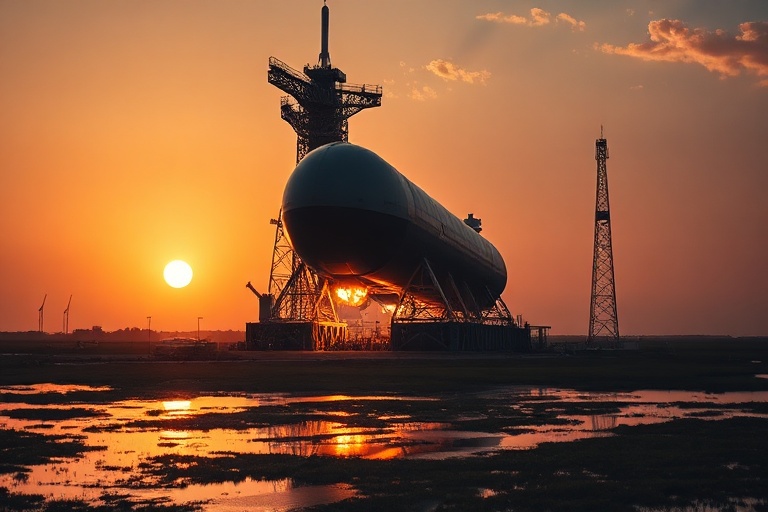
Starship: The Future of Space Exploration and Mars Colonization
SpaceX’s Starship stands as one of the most ambitious projects in aerospace history. Designed to be fully reusable, this massive rocket system aims to revolutionize space travel by reducing costs and increasing payload capacity. Unlike traditional rockets that are discarded after a single use, Starship is engineered for rapid turnaround and multiple flights, making it a critical component of future missions to the Moon, Mars, and beyond.
The vehicle consists of two main parts: the Super Heavy booster and the Starship spacecraft. Together, they form a colossal launch system capable of carrying up to 100 metric tons to Earth orbit. When fully operational, Starship could carry humans and cargo to the Moon as part of NASA’s Artemis program and eventually support the colonization of Mars. Its development has already attracted global attention, with test flights demonstrating both progress and the challenges inherent in such a groundbreaking endeavor.
Engineering Marvel: The Design and Capabilities of Starship
Starship’s design prioritizes reusability and efficiency. The Super Heavy booster, powered by 33 Raptor engines, provides the initial thrust needed to escape Earth’s gravity. Once in space, the Starship spacecraft—equipped with six Raptor engines—takes over, capable of in-space maneuvers and landings on celestial bodies. This two-stage system is a departure from conventional rockets, which typically use a single stage for launch and another for payload delivery.
A key innovation is Starship’s stainless-steel construction, which offers durability and heat resistance during re-entry. The rocket’s sleek, futuristic appearance is not just for show; it reflects a deliberate choice to balance strength and weight. The spacecraft’s heat shield, made of hexagonal tiles, is designed to withstand the extreme temperatures of atmospheric re-entry, a critical feature for safe return to Earth.
The payload capacity of Starship is unmatched. While the Saturn V rocket, which carried astronauts to the Moon during the Apollo missions, could lift about 140 metric tons, Starship’s design allows for up to 150 metric tons in its fully reusable configuration. This versatility makes it suitable not only for crewed missions but also for deploying large satellites, space telescopes, and even commercial space stations.
Reusability: The Cost-Saving Revolution
One of Starship’s most transformative aspects is its reusability. Traditional rockets are single-use, incurring massive costs with each launch. Starship, however, is designed to land vertically after missions, allowing it to be refurbished and reflown. SpaceX estimates that this could reduce the cost per launch to as little as $2 million, a fraction of the $60 million or more typical for current commercial launches.
This cost efficiency is crucial for NASA’s plans to return humans to the Moon. The agency has selected Starship as the lunar lander for its Artemis program, which aims to establish a sustainable human presence on the Moon by the end of the decade. By leveraging Starship’s reusability, NASA hopes to reduce the financial burden of lunar exploration and pave the way for future missions to Mars.
Testing and Challenges: The Road to Operational Status
Starship’s development has not been without setbacks. The first integrated flight test in April 2023 ended in an explosion just minutes after liftoff, with the rocket failing to separate its stages as planned. While the test did not achieve all its objectives, it provided valuable data that informed subsequent improvements. A second test flight in November 2023 fared better, with the spacecraft successfully separating from the booster before both were lost.
Despite these challenges, progress has been steady. SpaceX has conducted numerous suborbital tests, including “hop” tests where prototypes briefly flew to low altitudes and landed back on Earth. These tests have helped refine the rocket’s control systems and landing procedures. The company remains optimistic about achieving a successful orbital flight, which would mark a major milestone in Starship’s development.
Regulatory hurdles have also posed challenges. The Federal Aviation Administration (FAA) has closely scrutinized Starship’s testing, particularly after the first flight test resulted in significant debris and environmental concerns. SpaceX has worked to address these issues, implementing changes to minimize the impact of future launches. The FAA’s oversight ensures that Starship’s development proceeds safely and responsibly, balancing innovation with public safety.
Milestones and Future Missions
Starship’s potential extends far beyond Earth orbit. NASA’s Artemis program is just one of the many initiatives that could benefit from its capabilities. Elon Musk, SpaceX’s CEO, has long envisioned Starship as the key to establishing a self-sustaining city on Mars. By transporting large numbers of people and cargo, Starship could enable humanity to become a multi-planetary species.
The first crewed mission to Mars, tentatively scheduled for the late 2020s or early 2030s, would represent a monumental achievement. However, such a mission would require overcoming numerous technical and logistical challenges, including life support systems, radiation protection, and the psychological well-being of astronauts during the long journey. SpaceX is actively working on solutions to these problems, including developing in-space refueling capabilities to extend Starship’s range.
In the meantime, Starship is also poised to play a role in commercial spaceflight. Companies like Space Adventures and Axiom Space have expressed interest in using Starship for private missions, including lunar flybys and orbital tourism. These ventures could generate revenue for SpaceX while accelerating the development of space-based industries.
Competition and Industry Impact
Starship is not the only heavy-lift rocket in development. NASA’s Space Launch System (SLS) and China’s Long March 9 are among the competitors vying for a share of the growing space market. However, Starship’s reusability and lower cost give it a competitive edge. While SLS is designed for single-use missions and has faced criticism for its high costs, Starship’s potential to drastically reduce the price of space access could democratize space exploration.
The commercial space industry is watching Starship’s progress closely. Companies like Blue Origin and Rocket Lab are developing their own heavy-lift rockets, but none have reached the scale or ambition of Starship. If successful, Starship could become the workhorse of a new era in spaceflight, enabling everything from satellite deployment to interplanetary colonization.
Governments and private entities alike are investing in space infrastructure, and Starship is at the forefront of this movement. Its success could spur further innovation, leading to advancements in propulsion, materials science, and life support systems. The ripple effects of Starship’s development could extend beyond aerospace, influencing industries as diverse as energy, manufacturing, and telecommunications.
The Broader Implications for Humanity
Beyond its technical achievements, Starship represents a philosophical shift in humanity’s relationship with space. For decades, space exploration was the domain of governments and a select few astronauts. Starship, with its focus on commercial viability and reusability, could make space accessible to a broader audience. This democratization could inspire a new generation of scientists, engineers, and explorers.
The environmental impact of spaceflight is another consideration. While rockets emit significant amounts of carbon dioxide, SpaceX has explored ways to mitigate this, including using methane as a fuel, which produces fewer soot particles than traditional rocket fuels. Additionally, the long-term benefits of space exploration—such as advancing technology, discovering new resources, and expanding human knowledge—could outweigh the environmental costs.
Starship also raises ethical questions about the colonization of other planets. As humanity looks toward Mars, debates about planetary protection and the potential contamination of extraterrestrial environments have gained prominence. SpaceX has committed to working with international bodies to ensure that its missions adhere to planetary protection guidelines, balancing exploration with the preservation of potential alien life.
Conclusion: A New Era in Spaceflight
Starship is more than just a rocket; it is a symbol of humanity’s ambition to explore and inhabit the cosmos. Its development reflects the relentless pursuit of innovation, even in the face of formidable challenges. While the road to full operational status is still long, each test flight brings us one step closer to a future where space travel is as routine as air travel is today.
The implications of Starship’s success are profound. From enabling lunar bases to paving the way for Mars colonization, this ambitious project could redefine our place in the universe. As SpaceX continues to refine and test Starship, the world watches with anticipation, eager to witness the next chapter in humanity’s journey beyond Earth.
For now, the focus remains on overcoming the remaining technical hurdles and proving that Starship can deliver on its promises. If successful, it will not only revolutionize spaceflight but also inspire future generations to look to the stars with hope and determination.