tristan da cunha
Tucked away in the South Atlantic Ocean lies a place so isolated it feels like a relic from another time. Tristan da Cunha, often called the most remote inhabited archipelago on Earth, is a British Overseas Territory that exists in near-total obscurity. With a population of just 246 people—all descended from a handful of 19th-century settlers—this volcanic island chain presents a fascinating case study in human resilience, environmental fragility, and the psychological toll of extreme isolation.
Accessible only by a six-day boat journey from South Africa, Tristan da Cunha operates under a self-imposed quarantine. The nearest landmass, Saint Helena, sits 1,500 miles to the north. This extreme isolation has shaped every aspect of life on the island, from governance to culture, creating a society that operates in stark contrast to the hyper-connected world most of us inhabit.
The Geography and Environment of Tristan da Cunha
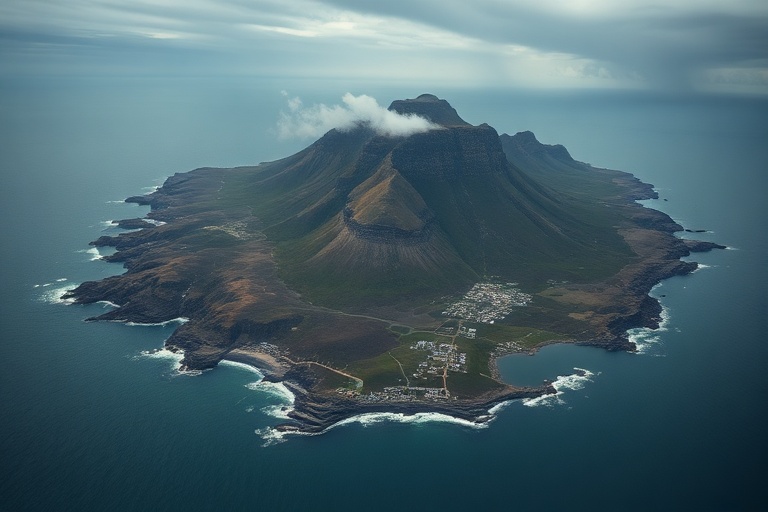
Tristan da Cunha consists of four main islands: Tristan (the largest and only inhabited one), Inaccessible Island, Nightingale Island, and Gough Island. The main island, Tristan, is dominated by a massive shield volcano that last erupted in 1961, forcing the entire population to evacuate temporarily. The landscape is rugged, with steep cliffs plunging into the ocean and a central peak, Queen Mary’s Peak, rising to 2,062 meters.
The islands lie within the Roaring Forties, a region notorious for its fierce winds and unpredictable weather. The surrounding waters are rich in marine life, particularly the Tristan rock lobster, which has become the backbone of the island’s economy. The isolation has preserved the ecosystem in remarkable ways, with species found nowhere else on Earth. Gough Island, in particular, is a UNESCO World Heritage Site due to its pristine environment and critical role as a seabird sanctuary.
Yet this isolation also makes the islands vulnerable. Invasive species, climate change, and the introduction of diseases pose existential threats. The 2021 discovery of mice on Gough Island—believed to have contributed to the decline of seabird populations—highlighted the delicate balance of this ecosystem.
Life on the Edge: Society and Governance
Life on Tristan da Cunha is governed by a unique blend of tradition and necessity. The island operates under a council system, with a chief islander and a council of eight elected members overseeing daily life. Decisions are made collectively, reflecting the small, tightly-knit community where everyone knows each other’s business. There are no prisons, no police, and no need for them—conflicts are resolved through dialogue and, when necessary, exile from the island.
Residents rely on a single store, run by the island government, which stocks everything from canned goods to the rare luxury item. Supplies arrive once a year via a fishing vessel, and fresh produce is a rarity. Most food is imported, though some islanders keep sheep, cows, and chickens. The island has no airport, no paved roads, and no hotels. Visitors are rare, and those who do arrive often describe a sense of stepping back in time.
The island’s remoteness has also shaped its culture. Music and storytelling play a central role, with traditional folk songs passed down through generations. The islanders celebrate an annual “Garden Party” and “Old Year’s Day,” festivals that blend British traditions with local customs. Yet, despite their British citizenship, the islanders have developed a distinct identity, shaped by their isolation and shared history.
Key Aspects of Life on Tristan da Cunha
- Population: 246 (as of 2023)
- Economy: Primarily based on fishing (Tristan rock lobster) and farming
- Education: A single school serving children up to age 16; older students often leave for further education
- Healthcare: A small hospital staffed by a single doctor; serious cases require evacuation
- Communication: Limited to satellite internet and a single telephone line
The Psychological Toll of Isolation
Perhaps the most intriguing aspect of Tristan da Cunha is the psychological resilience required to live there. Studies on the island’s inhabitants have revealed fascinating insights into human adaptability. Despite the lack of privacy and the constant presence of the same social circle, residents report high levels of life satisfaction. The absence of modern distractions like social media or 24-hour news cycles has fostered a deep connection to nature and community.
Yet, the isolation also takes a toll. Mental health resources are virtually nonexistent, and the nearest psychiatric care is thousands of miles away. The islanders have developed coping mechanisms, including a strong sense of humor and a collective approach to problem-solving. The annual supply ship arrival is a major event, breaking the monotony and providing a rare connection to the outside world.
Researchers have compared Tristan da Cunha to other isolated communities, such as those in Antarctica or on space missions. The island offers a unique laboratory for studying human behavior in extreme conditions. A 2018 study published in the journal Royal Society Open Science found that the islanders exhibited lower levels of stress and higher levels of well-being than urban populations, challenging assumptions about the negative effects of isolation.
Broader Implications: Lessons from the Edge
The story of Tristan da Cunha is more than just a curiosity—it offers valuable lessons for the rest of the world. In an era where technology connects us in unprecedented ways, the island serves as a reminder of the human capacity for adaptation. It challenges our assumptions about progress, highlighting the trade-offs between connectivity and simplicity.
The island’s environmental fragility also underscores the global nature of ecological challenges. While Tristan da Cunha is remote, its fate is tied to broader issues like climate change and invasive species. The discovery of mice on Gough Island, for example, was linked to global shipping routes, demonstrating how actions thousands of miles away can have local consequences.
From a geopolitical perspective, Tristan da Cunha holds strategic importance. Its location in the South Atlantic makes it a valuable outpost for monitoring maritime traffic and environmental changes. The UK maintains a small military presence, and the island has been used as a base for scientific research, particularly in meteorology and ornithology.
For those interested in off-grid living or sustainable communities, Tristan da Cunha offers a case study in self-sufficiency. The islanders have developed systems to manage resources efficiently, relying on fishing quotas and communal labor. Yet, their reliance on imports also highlights the vulnerabilities of such a model, particularly in the face of climate change or disruptions to global supply chains.
What Tristan da Cunha Teaches Us
- Resilience: Human communities can thrive in extreme conditions with strong social bonds and adaptability.
- Simplicity: Isolation can foster a deeper connection to nature and reduce the stress of modern life.
- Interdependence: Even the most remote communities are affected by global issues like climate change and invasive species.
- Cultural Identity: Isolation can lead to the development of unique traditions and a strong sense of community.
For those who dream of escape, Tristan da Cunha is a reminder of both the challenges and rewards of a life lived far from the madding crowd. It is a place where time moves slowly, where every decision has consequences, and where the natural world dictates the rhythm of life. In a world increasingly dominated by technology and connectivity, the island offers a rare glimpse into a quieter, more deliberate way of living.
Yet, Tristan da Cunha also serves as a cautionary tale. The island’s isolation is both its greatest strength and its most significant vulnerability. As climate change and globalisation reshape the world, the fate of Tristan da Cunha hangs in the balance. Will it remain a sanctuary of tranquillity, or will the pressures of the modern world encroach upon its shores? Only time will tell.
For more on remote communities and unique travel destinations, explore our Travel and Culture sections.