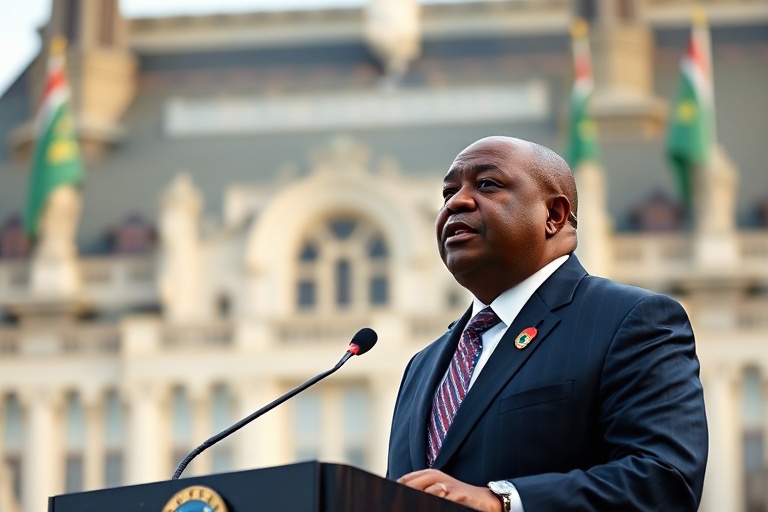
Cyril Ramaphosa: A Global Perspective on South Africa’s Leadership Transitions
Cyril Ramaphosa’s presidency in South Africa has unfolded against a backdrop of deep economic challenges, social unrest, and shifting global alliances. Since assuming office in 2018, he has navigated a delicate balance between domestic demands for reform and international expectations for stability. His leadership style—a blend of negotiation and pragmatism—reflects both the legacy of apartheid-era activism and the pressures of modern governance.
Ramaphosa’s political career spans decades, from his role in negotiating South Africa’s transition to democracy to his current position as the country’s fifth post-apartheid president. His journey offers a lens into how South Africa’s leadership has evolved since Nelson Mandela’s iconic tenure, revealing tensions between reconciliation, economic growth, and social justice.
The Roots of a Political Figure: From Labor Activist to State Leader
Born in 1952 in Johannesburg’s Soweto township, Ramaphosa’s early activism against apartheid shaped his political identity. As a student leader in the 1970s, he joined the Black Consciousness Movement before later aligning with the African National Congress (ANC). His most transformative years came in the 1980s when he became a key figure in the Congress of South African Trade Unions (COSATU), advocating for workers’ rights during the struggle against white-minority rule.
After apartheid’s end, Ramaphosa played a crucial role in drafting South Africa’s constitution. His sharp legal mind and negotiating skills earned him respect, though his political path was not without controversy. In the 1990s, he transitioned from labor leadership to business, amassing significant wealth—a move that drew criticism from some quarters who saw it as a departure from his activist roots.
His return to frontline politics in 2012, when he became ANC deputy president, marked a turning point. By 2018, following Jacob Zuma’s resignation amid corruption scandals, Ramaphosa ascended to the presidency, promising a new era of accountability and economic revival.
Policy Challenges and Economic Realities Under Ramaphosa
Ramaphosa inherited a nation grappling with stagnant growth, high unemployment, and entrenched inequality. His administration has pursued a mix of market-friendly reforms and social welfare initiatives, but progress has been uneven. Key challenges include:
- Economic stagnation: South Africa’s GDP growth has remained sluggish, averaging below 2% annually under his leadership, despite efforts to attract foreign investment.
- State-owned enterprise crises: Entities like Eskom (the national power utility) have faced persistent financial and operational failures, straining public resources.
- Land reform debates: Ramaphosa’s cautious approach to land redistribution has drawn criticism from both landless communities and conservative voices.
- Corruption legacy: While he has emphasized anti-graft measures, perceptions of corruption persist, particularly in procurement scandals.
Internationally, Ramaphosa has positioned South Africa as a mediator in African conflicts, such as the Russia-Ukraine war, where Pretoria’s neutral stance has sparked debate. His foreign policy balances historical ties with Western nations and growing engagements with BRICS partners like China and India.
Cultural Shifts and Public Perception
Ramaphosa’s leadership has coincided with a cultural reckoning in South Africa. The #ZumaMustFall protests and broader dissatisfaction with the ANC have reshaped public discourse, with many youth activists demanding systemic change. His image as a disciplined, almost ascetic figure contrasts with the extravagance of his predecessor, yet skepticism lingers about his ability to deliver tangible improvements.
The arts and media have reflected these tensions. Filmmakers like John Kani and writers such as Sisonke Msimang have explored themes of betrayal and renewal in post-apartheid South Africa, often critiquing the gap between political promises and lived realities. Meanwhile, Ramaphosa’s cautious diplomacy has been both praised for stability and faulted for lacking bold vision.
In the realm of sports, his government has faced scrutiny over funding for national teams, particularly after South Africa’s underwhelming performances in recent global tournaments. Yet, initiatives like the Rugby World Cup-winning Springboks’ 2019 campaign have provided fleeting moments of national pride.
Global Comparisons: Leadership in Turbulent Times
Ramaphosa’s tenure invites comparisons with other leaders who inherited fractured societies. Like Colombia’s Gustavo Petro, he faces the dual challenge of addressing historical injustices while fostering economic pragmatism. His cautious reformism mirrors Indonesia’s Joko Widodo’s balancing act between development and democratic norms.
However, Ramaphosa’s situation is uniquely South African—rooted in the country’s apartheid legacy and the ANC’s dominant-party system. Unlike leaders in younger democracies, he must contend with institutionalized patronage networks that resist change.
Conclusion: The Weight of Expectations
Cyril Ramaphosa’s presidency remains a study in contrasts: a reformer constrained by systemic inertia, a global statesman navigating geopolitical tensions, and a symbol of hope for a nation still healing from its past. His legacy will likely hinge on whether he can translate his moral authority into tangible improvements for South Africa’s majority.
As the country approaches its next election cycle, the question isn’t just about Ramaphosa’s individual performance but about the durability of South Africa’s democratic experiment. In a region where leadership transitions often spark instability, his ability to maintain equilibrium—between growth and equity, between tradition and modernity—will define his place in history.