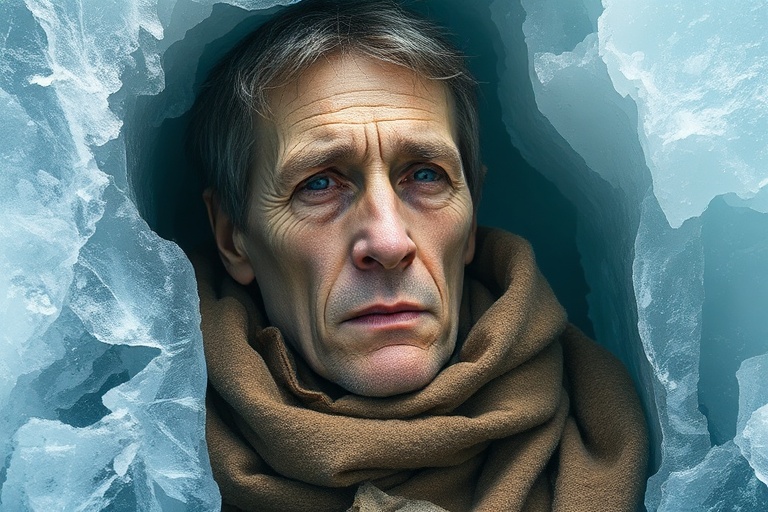
Iceman Ötzi: 5,300-Year-Old Frozen Time Capsule Reveals Ancient Secrets
The discovery of Ötzi the Iceman in the Ötztal Alps in 1991 was more than an archaeological breakthrough—it was a moment that blurred the lines between past and present. Preserved for over five millennia in the ice, Ötzi offered scientists an unprecedented glimpse into Copper Age life. His body, tools, and even his last meal became a frozen archive of human history. Decades later, the Iceman continues to challenge our understanding of ancient societies, technology, and even the limits of preservation.
The Discovery That Changed Everything
On September 19, 1991, German hikers Erika and Helmut Simon stumbled upon a dark shape protruding from the ice near the Hauslabjoch pass. What they initially mistook for a discarded doll turned out to be the mummified remains of a man who had died around 3300 BCE. The sheer preservation of Ötzi’s body—his skin, organs, and even tattoos—was staggering. Unlike most ancient remains, which decompose or are reduced to bones, Ötzi remained remarkably intact due to the protective layer of ice that encased him for centuries.
The recovery process was a delicate operation. Archaeologists and glaciologists worked together to extract Ötzi without damaging his fragile remains. They used ice axes to carefully chip away at the glacier, ensuring that every artifact—from his copper axe to his leather garments—was preserved for study. The site was so remote that helicopters had to transport the team and equipment, adding another layer of complexity to the excavation.
Key Facts About Ötzi’s Discovery
- Location: Hauslabjoch pass, Ötztal Alps (border between Austria and Italy)
- Date of Discovery: September 19, 1991
- Estimated Age: 5,300 years old (Copper Age)
- Preservation: Naturally mummified in ice, with intact skin, organs, and tattoos
- Initial Misidentification: Thought to be a recent climber due to exposed body parts
What Ötzi’s Body Revealed About Ancient Life
Ötzi’s body was a treasure trove of information. CT scans revealed that he suffered from arthritis, had a genetic predisposition to heart disease, and even carried traces of birch polypore fungus, which may have been used for medicinal purposes. His last meal—a mix of einkorn wheat, meat, and vegetables—suggested a diet typical of Neolithic farmers. But perhaps most intriguing were his tattoos, which consisted of 61 lines and crosses made from soot or fireplace ash. These markings, found on his lower back, knees, and ankles, are believed to be the world’s oldest known tattoos, possibly used for therapeutic or ritualistic purposes.
His clothing and equipment also painted a vivid picture of Copper Age life. He wore a cloak made of woven grass, a leather loincloth, and shoes stuffed with hay for insulation. His axe, with a copper blade and yew handle, was a rare and valuable tool, suggesting he was of high status. The presence of a flint dagger, a bow, and a quiver of arrows indicated he was prepared for both hunting and defense. These items were not just tools but symbols of a society transitioning from the Stone Age to the Bronze Age.
The Science Behind the Preservation
Ötzi’s remarkable state of preservation raises fascinating questions about how and why his body remained intact for so long. The key lies in the unique conditions of the Alps. The glacier that encased him provided a near-perfect environment—cold temperatures slowed decomposition, while the pressure of the ice prevented oxygen from reaching his body. Additionally, the acidic nature of the ice helped inhibit bacterial growth, further preserving his tissues.
But preservation wasn’t just about the ice. Ötzi’s body also benefited from the rapid freezing that occurred after his death. Unlike bodies that decompose slowly in warmer climates, Ötzi’s tissues were flash-frozen, locking in cellular structures. This allowed scientists to extract DNA, analyze his gut bacteria, and even reconstruct his facial features with astonishing accuracy. The Iceman became a biological time capsule, offering insights that would be impossible to glean from traditional skeletal remains.
Researchers have since studied Ötzi’s genome, identifying genetic markers that link him to modern-day populations in Sardinia and Corsica. This suggests that the genetic makeup of Copper Age Europeans was more diverse than previously thought. Ötzi’s DNA also revealed that he had brown eyes and blood type O, traits that are still common today. These discoveries have reshaped our understanding of human migration and genetic continuity over millennia.
The Broader Implications of Ötzi’s Legacy
Ötzi’s discovery has had far-reaching implications beyond archaeology. His case has influenced fields as diverse as climatology, genetics, and even forensic science. The study of his remains has provided critical data on how ancient humans adapted to extreme environments, how diseases evolved over time, and how early societies developed complex tools and technologies.
One of the most significant impacts has been on climate science. Ötzi’s body and artifacts have served as a benchmark for understanding how glaciers have retreated over the past 5,000 years. As global temperatures rise, glaciers worldwide are melting at unprecedented rates, exposing long-buried artifacts—and even human remains. Ötzi’s discovery has highlighted the urgency of preserving these natural archives before they vanish forever.
Ötzi has also become a cultural icon, inspiring books, documentaries, and even a museum dedicated to his story. The South Tyrol Museum of Archaeology in Bolzano, Italy, where Ötzi is housed, attracts hundreds of thousands of visitors each year. His story has captivated the public imagination, bridging the gap between ancient history and modern curiosity. In a world where technology often distances us from the past, Ötzi serves as a tangible connection to our ancestors.
For researchers, Ötzi remains a living laboratory. New technologies, such as 3D imaging and advanced DNA sequencing, continue to unlock secrets hidden in his body. In 2012, scientists extracted Ötzi’s entire genome, revealing insights into his health, diet, and even his physical appearance. These advancements demonstrate how a single discovery can shape scientific inquiry for generations.
Why Ötzi Still Matters Today
- Climate Change: Ötzi’s preservation offers a stark reminder of how rapidly glaciers are disappearing, along with the secrets they hold.
- Medical Research: His health conditions provide a baseline for studying the evolution of diseases like heart disease and arthritis.
- Cultural Heritage: Ötzi’s story highlights the importance of preserving archaeological sites in the face of environmental and human threats.
- Interdisciplinary Collaboration: His discovery has fostered cooperation between archaeologists, geneticists, climatologists, and historians.
- Public Engagement: Ötzi has made ancient history accessible, sparking curiosity and education among people of all ages.
The Iceman’s legacy is a testament to the power of preservation—both of the past and of the natural world. As glaciers melt and ancient artifacts resurface, Ötzi’s story serves as a cautionary tale about the fragility of history. Yet it also offers hope, reminding us that even after 5,300 years, the past can still speak to us if we listen closely enough.
For those interested in exploring more about archaeological discoveries and their impact on modern science, be sure to check out the Science and Technology sections on Dave’s Locker. These categories delve into how ancient findings continue to shape our understanding of the world today.