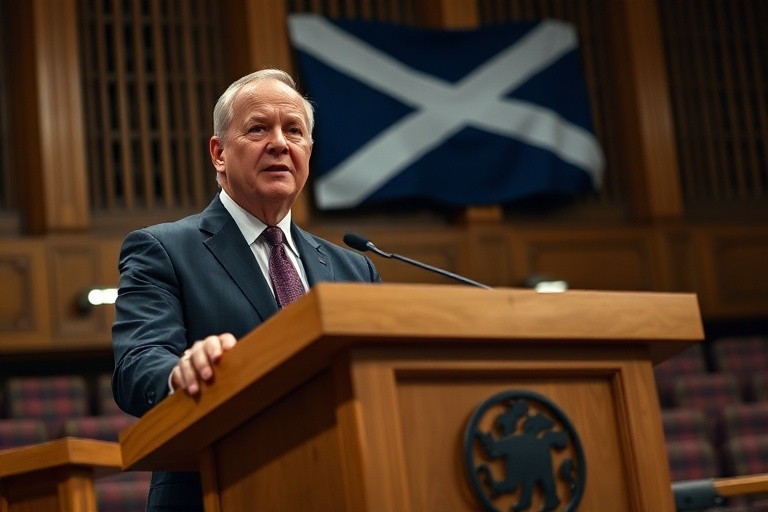
John Swinney’s political career spans over three decades, marked by unwavering commitment to public service, strategic leadership, and an ability to navigate the complexities of Scottish and UK politics. As one of the most enduring figures in the Scottish National Party (SNP), Swinney has held pivotal roles, including Deputy First Minister of Scotland and Cabinet Secretary for Finance. His career reflects a blend of political acumen, ideological consistency, and adaptability in an ever-changing political landscape.
Born in Edinburgh in 1964, Swinney’s early involvement in politics began during his time at the University of Edinburgh, where he studied politics. His entry into the SNP at 15 set the stage for a lifelong dedication to Scottish independence and progressive governance. Over the years, Swinney has been a constant presence in Scottish politics, serving as a Member of the Scottish Parliament (MSP) since 1999 and playing a key role in shaping the SNP’s policies on devolution, economics, and social justice.
Political Career Highlights: From Backbenches to Leadership
Swinney’s political journey is defined by several key milestones. After joining the SNP, he quickly rose through the ranks, becoming the party’s youngest ever leader in 1998—a role he held until 2000. Though his tenure as leader was brief, it established him as a formidable strategist and voice for the party’s independence agenda.
His return to frontline politics came in 2007 when he was appointed Cabinet Secretary for Finance and Sustainable Growth under First Minister Alex Salmond. In this role, Swinney played a crucial part in managing Scotland’s finances during a period of economic uncertainty, particularly following the 2008 financial crisis. His approach emphasized fiscal responsibility while advocating for policies that supported public services and economic growth.
In 2014, Swinney was named Deputy First Minister of Scotland, a position that solidified his influence within the SNP and the Scottish Government. His responsibilities expanded to include education, where he championed policies aimed at closing the attainment gap in Scottish schools. His tenure in this role was characterized by a focus on improving educational outcomes, particularly for disadvantaged students, and reforming the curriculum to better reflect the needs of a modern Scotland.
A Legacy of Policy and Pragmatism
Swinney’s political career is often analyzed through the lens of his pragmatic approach to governance. Unlike some of his contemporaries, he has avoided the spotlight of populism, instead focusing on the nuts and bolts of policy implementation. This has made him a respected figure among colleagues and opponents alike, even among those who disagree with his political goals.
One of his most significant contributions came in the realm of education. As Cabinet Secretary for Education, Swinney oversaw the introduction of the Scottish Attainment Challenge, a program designed to address educational inequality by providing additional resources to schools in deprived areas. The initiative reflected his belief in targeted intervention as a means of achieving social justice—a principle that has guided much of his work.
Financially, Swinney’s tenure was defined by efforts to balance Scotland’s budget amid limited fiscal autonomy. His advocacy for increased powers for the Scottish Parliament, particularly in taxation and welfare, underscored his long-standing belief in devolution as a means of achieving economic and social progress. This position often put him at odds with Westminster, where successive UK governments resisted further devolution of powers.
The Broader Implications of Swinney’s Career
Swinney’s career offers a window into the broader dynamics of Scottish politics, particularly the SNP’s evolution from a marginal party to the dominant force in Scottish governance. His ability to endure through multiple political cycles—despite internal party challenges and shifting public sentiment—speaks to his resilience and adaptability. This is particularly noteworthy given the SNP’s recent struggles with leadership transitions and the aftermath of the 2020 independence referendum.
The implications of Swinney’s career extend beyond Scotland. His work on fiscal policy and education reform provides a case study in how subnational governments can operate within the constraints of limited fiscal powers. His advocacy for devolution also highlights the ongoing debate about the balance of power between Westminster and the devolved administrations, a topic that remains contentious in the UK’s constitutional landscape.
Moreover, Swinney’s career challenges the narrative that political longevity is solely a product of charisma or media savviness. Instead, his success is rooted in a deep understanding of policy, an ability to build coalitions, and a willingness to work within the system to achieve incremental progress. This approach has made him a rare figure in politics: one who is both ideologically committed and pragmatically effective.
Key Takeaways from John Swinney’s Career
To understand the significance of John Swinney’s career, it’s helpful to break down the core elements that have defined his political journey:
- Commitment to Devolution: Swinney has been a consistent advocate for increasing the powers of the Scottish Parliament, positioning himself as a key voice in the push for greater autonomy.
- Policy-Focused Leadership: Unlike many politicians, Swinney has prioritized policy implementation over rhetoric, earning a reputation as a detail-oriented leader who delivers results.
- Resilience in the Face of Challenges: His ability to weather political storms—including leadership contests and party infighting—demonstrates his capacity to adapt and endure.
- Focus on Education and Social Justice: His work in education reform highlights his belief in using policy to address inequality and improve outcomes for disadvantaged communities.
- Pragmatic Governance: Swinney’s approach to governance has often involved balancing idealism with the realities of political constraints, making him a bridge between different factions within the SNP.
A Career That Challenges Political Norms
John Swinney’s career is a reminder that political success is not always about flashy victories or headline-grabbing moments. Instead, it is often about steady, consistent work behind the scenes, building institutions, and laying the groundwork for future progress. His ability to navigate the complexities of Scottish politics while maintaining a relatively low public profile sets him apart from many of his contemporaries.
As Scotland continues to grapple with its constitutional future, Swinney’s career offers valuable insights into the challenges and opportunities facing the country. His work on devolution, education, and fiscal policy provides a roadmap for how Scotland might achieve greater autonomy while addressing pressing social and economic issues. Whether through continued service in government or a transition to a new phase of his career, Swinney’s influence on Scottish politics is likely to endure.
For those interested in the intersection of devolution, policy, and political leadership, Swinney’s career is a case study in how to achieve meaningful change within the constraints of a complex political system. His story is one of service, resilience, and an unwavering commitment to the people of Scotland—qualities that define a political career of lasting significance.