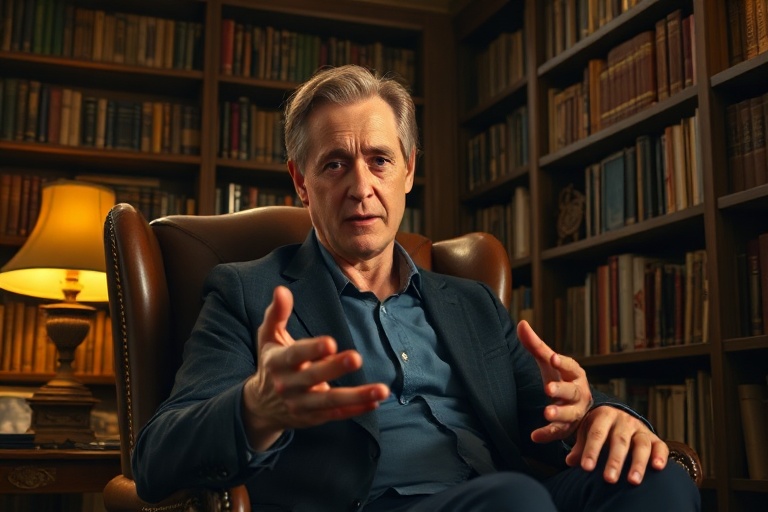
Jordan Peterson: Psychologist and Cultural Thinker Explained
Jordan Peterson emerged in the late 2010s as one of the most polarizing yet influential public intellectuals of his generation. A clinical psychologist and former University of Toronto professor, Peterson’s rise to prominence began with his vocal opposition to Canada’s Bill C-16, which added gender identity and expression to protected categories under anti-discrimination law. His refusal to use preferred pronouns in protest sparked national debates about free speech and compelled speech legislation, catapulting him from academic obscurity to global recognition.
Peterson’s influence extends far beyond political activism. With over 4 million subscribers on YouTube and millions of book sales, his work has reshaped conversations about personal responsibility, meaning, and the psychological underpinnings of modern culture. His 2018 book 12 Rules for Life: An Antidote to Chaos became an international bestseller, offering a self-help framework that blends Jungian psychology, biblical narratives, and practical advice for navigating life’s challenges. The book’s accessibility and bold claims about human nature ensured its place in both academic discussions and mainstream culture.
The Intellectual Foundations of Peterson’s Thought
Peterson’s academic background deeply informs his public persona. Before his rise to fame, he spent years studying and teaching at Harvard and the University of Toronto, focusing on psychopharmacology, abnormal psychology, and personality psychology. His research on the psychology of religious belief and the role of narratives in human cognition laid the groundwork for his later public interventions. Peterson often references Carl Jung, Aleksandr Solzhenitsyn, and Friedrich Nietzsche in his lectures, arguing that these thinkers offer essential insights into the human condition that modern society has overlooked.
One of Peterson’s most cited concepts is the “lobster hierarchy” theory, drawn from his observations of lobster serotonin levels and their correlation with social dominance. In his view, hierarchical structures are not merely social constructs but biologically ingrained patterns that reflect deeper psychological realities. Critics argue this perspective oversimplifies human behavior, but Peterson uses it to emphasize personal responsibility in navigating social structures. His lectures frequently return to the idea that individuals must take responsibility for their lives, regardless of external constraints—a message that resonated deeply with audiences during periods of economic uncertainty and cultural upheaval.
Peterson’s approach to psychology is fundamentally narrative-driven. He believes that humans organize their experiences through stories, and that the loss of meaningful narratives in modern life contributes to widespread disorientation and mental health crises. This perspective informs his critique of postmodernism, which he argues fragments truth into relativistic claims that undermine collective meaning. His opposition to postmodernism became a cornerstone of his public persona, positioning him as a defender of objective truth against what he describes as ideological encroachment into academic and cultural spaces.
The Cultural Impact of Peterson’s Online Presence
Peterson’s YouTube channel, which features long-form lectures and commentary, has become a central hub for his intellectual output. His lectures on personality typology, biblical stories, and political theory attract millions of views, often sparking intense debates in the comment sections. Unlike many modern commentators who favor short, viral content, Peterson’s preference for detailed, structured arguments has cultivated a dedicated audience that values depth over brevity. His lectures on the psychological significance of the Bible, for example, have been viewed millions of times, demonstrating how traditional texts can provide frameworks for understanding contemporary dilemmas.
Peterson’s online presence is not without controversy. His critics accuse him of promoting regressive ideas, particularly regarding gender roles and hierarchy. His 2016 lecture series “Maps of Meaning,” which explores the psychological structure of myths and narratives, has been both praised for its interdisciplinary approach and criticized for its selective interpretation of psychological and historical data. Despite these criticisms, Peterson’s ability to articulate complex ideas in accessible language has made him a sought-after speaker at universities and conferences worldwide.
His debates with figures such as Slavoj Žižek and Cathy Newman have further cemented his status as a provocative thinker. The Newman debate, in particular, went viral for its clash between Peterson’s measured, analytical style and Newman’s confrontational interviewing technique. The exchange highlighted Peterson’s ability to remain composed under pressure, a trait that has endeared him to supporters and frustrated detractors. These debates are often dissected online, with Peterson’s responses analyzed for their rhetorical precision and logical consistency.
The Role of Peterson’s Online Community
Peterson’s online community, often referred to as the “Intellectual Dark Web,” includes a loose network of thinkers who challenge mainstream narratives across political and cultural spectrums. While Peterson rejects the label, his association with figures like Joe Rogan, Sam Harris, and Bret Weinstein has reinforced his role as a central figure in this movement. His podcast appearances, including frequent visits to the Dave’s Locker podcasts category, have introduced his ideas to broader audiences who might not engage with academic lectures.
The community that has formed around Peterson is characterized by its emphasis on free speech, personal responsibility, and skepticism of ideological conformity. This ethos has attracted individuals who feel alienated by mainstream political and cultural institutions, creating a space where alternative viewpoints can be explored without immediate censure. However, the community’s insularity has also led to accusations of echo chambers, where dissenting voices are marginalized or dismissed outright.
Peterson’s Influence on Mental Health and Self-Help Discourse
Peterson’s 2018 book 12 Rules for Life is perhaps his most direct contribution to contemporary self-help discourse. The book offers a mix of psychological insight, philosophical reflection, and practical advice, structured around twelve principles such as “Stand up straight with your shoulders back” and “Tell the truth—or, at least, don’t lie.” Each rule is illustrated with examples from Peterson’s clinical practice, personal life, and cultural analysis, creating a narrative that feels both intimate and universal.
The book’s success reflects a broader cultural hunger for frameworks that address meaning in an era of increasing uncertainty. Peterson’s emphasis on personal responsibility resonates with readers who feel overwhelmed by systemic challenges and are searching for actionable steps to improve their lives. His approach contrasts with traditional self-help genres by grounding its advice in psychological research and mythological archetypes, offering a more nuanced alternative to simplistic motivational rhetoric.
Peterson’s influence on mental health discourse extends beyond his books. His lectures on anxiety, depression, and motivation have been widely shared on social media, often providing solace to individuals struggling with mental health challenges. His message—that individuals can take control of their lives by confronting chaos and assuming responsibility—has been particularly impactful for younger audiences navigating the pressures of modern life. However, critics argue that his advice can be overly prescriptive, ignoring the structural factors that contribute to mental health issues, such as economic inequality and social isolation.
The Future of Peterson’s Intellectual Legacy
As Peterson continues to evolve as a public figure, his role in shaping contemporary intellectual discourse remains significant. His recent work, including the 2021 follow-up Beyond Order: 12 More Rules for Life, reinforces his focus on balancing chaos and order, suggesting that his ideas are still developing in response to new cultural challenges. His foray into politics, including his brief consideration of a presidential run in 2024, indicates a willingness to engage more directly with institutional power structures.
Peterson’s legacy will likely be defined by his ability to bridge the gap between academic psychology and public discourse. While his ideas remain contentious, their impact on conversations about free speech, personal responsibility, and cultural narratives is undeniable. His work has inspired a generation of thinkers to engage more critically with the ideas shaping their world, even as it has provoked equally critical responses. As society continues to grapple with questions of meaning, identity, and truth, Peterson’s contributions offer both a challenge and a framework for navigating an increasingly complex landscape.
For those interested in exploring similar intellectual discussions, the Analysis and Culture sections on Dave’s Locker provide a curated selection of articles that delve into the intersections of psychology, society, and public discourse.