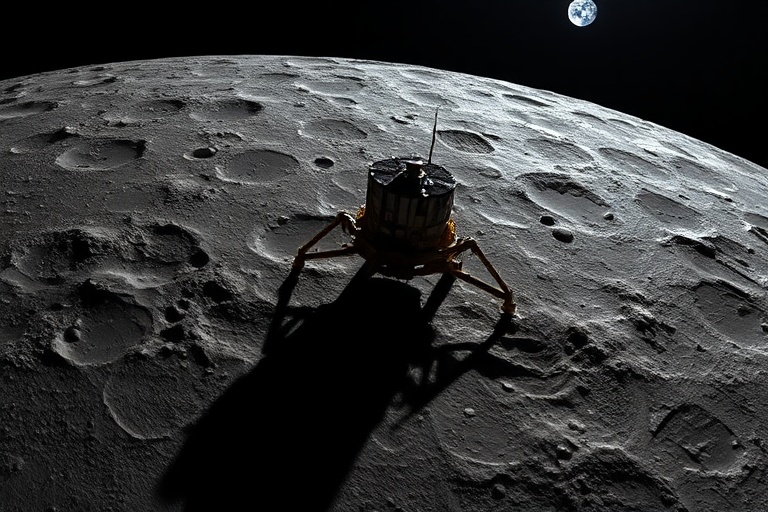
Lunar Impact Flashes and NASA’s Artemis: What They Reveal About the Moon
Lunar Impact Flashes: NASA’s Artemis Mission and the Global Quest to Understand Them
The Artemis program isn’t just about returning humans to the Moon—it’s also about uncovering some of its most mysterious phenomena. Among these are lunar impact flashes, brief but brilliant bursts of light caused by meteoroids colliding with the Moon’s surface. These flashes, often lasting less than a second, have fascinated astronomers for decades. Now, with Artemis poised to establish a sustainable human presence on the Moon, scientists see an unprecedented opportunity to study these events in greater detail.
Unlike Earth, the Moon lacks an atmosphere to burn up incoming space debris. Every day, countless meteoroids strike its surface, creating impact flashes visible from telescopes on Earth. NASA’s Artemis missions aim to leverage this natural phenomenon to better understand both the Moon’s environment and the broader solar system. By monitoring these flashes, researchers hope to map the frequency and size of meteoroid impacts—a critical factor for future lunar habitats and infrastructure.
The Science Behind Lunar Impact Flashes
Lunar impact flashes occur when a meteoroid—typically a fragment of an asteroid or comet—hits the Moon at speeds exceeding 20 kilometers per second. The collision releases an enormous amount of kinetic energy, vaporizing the meteoroid and a portion of the lunar surface. This creates a temporary plasma, which emits light detectable by telescopes. The flashes can be as bright as a sixth-magnitude star, though most require high-sensitivity cameras to observe.
NASA’s Lunar Impact Monitoring Program, which began in earnest in 2005, has recorded thousands of these events. The data suggests that the Moon experiences far more impacts than previously estimated. One study found that the number of meteoroids striking the Moon’s surface could be up to 100 times higher than earlier models predicted. This revelation has significant implications for the safety of future lunar missions, including those under the Artemis banner.
To track these flashes, astronomers use a network of telescopes equipped with high-speed cameras. The most prominent observatories involved include:
- NASA’s Marshall Space Flight Center in Alabama, which operates the Meteoroid Environment Office.
- Spain’s MIDAS (Moon Impacts Detection and Analysis System), a collaboration between the University of Huelva and the Institute of Astrophysics of Andalusia.
- Turkey’s Ondokuz Mayıs University Observatory, which has contributed valuable data on mid-sized impacts.
The global effort to document lunar impacts reflects a growing recognition that the Moon is not a static, unchanging world but a dynamic one shaped by constant bombardment. This shift in perspective aligns with the Artemis program’s broader goals of redefining our relationship with Earth’s nearest neighbor.
Why Lunar Impact Flashes Matter for Artemis and Beyond
The Artemis missions will return humans to the Moon for the first time since 1972, but this time with a focus on long-term exploration. Understanding lunar impact flashes is crucial for several reasons:
- Habitat Safety: Future lunar bases will need to withstand meteoroid strikes. Even small impacts can damage equipment or pose risks to astronauts. By studying impact rates, engineers can design more resilient structures.
- Resource Utilization: The Moon’s surface is rich in resources like water ice and helium-3, but mining operations could be disrupted by frequent impacts. Monitoring these events helps plan safer extraction methods.
- Planetary Defense: The Moon serves as a natural laboratory for studying how impacts affect rocky bodies. Insights gained here could inform strategies for protecting Earth from similar threats.
- Scientific Discovery: Each impact flash offers a glimpse into the composition of meteoroids and the lunar surface. Some flashes reveal traces of rare minerals, shedding light on the Moon’s geological history.
NASA’s Lunar Reconnaissance Orbiter (LRO) has already mapped many of the craters left by these impacts, but ground-based observations remain essential for real-time tracking. The Artemis program’s planned Lunar Gateway space station could eventually host dedicated impact-monitoring instruments, further integrating this research into human exploration strategies.
The global space community is taking notice. In 2022, the International Astronomical Union (IAU) recognized the importance of lunar impact studies by establishing a working group dedicated to the topic. This collaborative approach mirrors the Artemis Accords, a set of principles for peaceful and cooperative space exploration signed by over 40 countries.
Cultural and Historical Perspectives on Lunar Impacts
Humanity’s fascination with the Moon stretches back millennia, but our understanding of lunar impacts is surprisingly recent. Ancient cultures often saw the Moon as a divine or unchanging entity, with few records of transient lunar phenomena. It wasn’t until the 17th century, when Galileo Galilei turned his telescope toward the Moon, that astronomers began to suspect its surface was scarred by collisions.
The first recorded observation of a lunar impact flash came in 1953, when amateur astronomer Leon Stuart photographed a bright spot near the lunar crater Pallas. Decades later, NASA’s Apollo missions confirmed the Moon’s surface was indeed shaped by impacts, but it took the advent of high-speed imaging in the 21st century to study these events in real time.
Today, lunar impact research has taken on new cultural significance. Social media platforms like Twitter and Reddit frequently share videos of captured flashes, turning these cosmic events into viral moments. In Japan, amateur astronomers have formed clubs dedicated to lunar observation, blending traditional stargazing with modern technology. Meanwhile, in India, the Indian Space Research Organisation (ISRO) has integrated impact monitoring into its broader lunar exploration plans, reflecting a growing interest in the Moon across Asia.
This global engagement underscores a broader trend: the democratization of space science. No longer the exclusive domain of superpowers, lunar impact research is now a collaborative effort involving scientists, citizen astronomers, and even high school students. Programs like NASA’s Lunar Impact Monitoring allow amateur astronomers to contribute data, fostering a sense of shared discovery.
The Future: What Artemis Could Uncover About Lunar Impacts
As NASA prepares for the Artemis 2 mission—the first crewed lunar flyby since 1972—and the eventual Artemis 3 landing, the stakes for impact research have never been higher. The missions will deploy new instruments designed to study lunar seismology, surface composition, and, crucially, impact events. One such tool is the Lunar Surface Innovation Consortium’s proposed Impact Flash Detector, a compact sensor that could be placed on future landers.
The data collected could revolutionize our understanding of the solar system’s early history. Many scientists believe that the Moon’s impacts are remnants of the Late Heavy Bombardment, a period about 4 billion years ago when the inner planets were pummeled by asteroids and comets. By analyzing the frequency and size of modern impacts, researchers hope to reconstruct this violent era and its role in shaping Earth’s habitability.
Beyond science, the study of lunar impacts carries philosophical weight. It reminds us that the Moon is not a distant, static relic but a dynamic world—one that continues to evolve. For cultures around the globe, the Moon has always been a symbol of mystery and wonder. Artemis offers a chance to deepen that connection, blending ancient curiosity with cutting-edge discovery.
As we stand on the brink of a new era of lunar exploration, the flashes on the Moon’s surface serve as a reminder of the universe’s dynamism. They challenge us to look beyond our planet, to see the cosmos not as a distant abstraction but as a living, changing frontier.