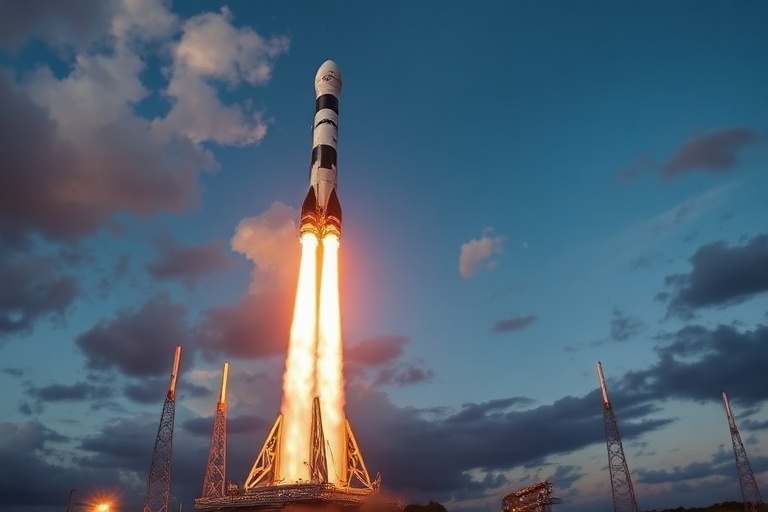
The successful launch of SpaceX’s Starship rocket on its fourth test flight marks a pivotal moment in the evolution of space exploration. Unlike traditional rockets, Starship is designed to be fully reusable, promising to slash the cost of space travel while increasing payload capacity. This innovation isn’t just a technical achievement—it represents a cultural shift in how humanity views its place among the stars.
From the dusty launchpads of Boca Chica, Texas, to the boardrooms of global aerospace firms, Starship’s development has become a symbol of what private enterprise can achieve when unshackled from bureaucratic constraints. The rocket’s journey reflects broader trends in technology, economics, and even geopolitics, as nations and corporations race to secure their positions in the new space economy.
The Technical Breakthroughs Behind Starship
Starship’s most revolutionary feature is its fully reusable design. While traditional rockets are discarded after launch, Starship is built to return to Earth intact, dramatically reducing the cost per mission. This approach aligns with SpaceX’s long-standing goal of making space travel as routine as air travel.
The rocket consists of two main components: the Super Heavy booster and the Starship spacecraft. Together, they stand nearly 400 feet tall, making them the tallest and most powerful launch vehicle ever built. The Super Heavy booster generates over 16 million pounds of thrust at liftoff, using 33 Raptor engines—a feat of engineering that pushes the boundaries of propulsion technology.
During its fourth test flight, Starship achieved several milestones that previous attempts had missed:
- Successful stage separation: The Super Heavy booster successfully detached from the Starship spacecraft, a critical step that had failed in earlier tests.
- Controlled reentry: Both the booster and the spacecraft executed controlled descents, with the booster performing a soft splashdown in the Gulf of Mexico and the spacecraft surviving reentry heat.
- Data collection: Engineers gathered invaluable data on thermal protection, structural integrity, and flight dynamics, which will inform future iterations.
These achievements underscore SpaceX’s iterative approach to development. Rather than waiting for perfection, the company embraces rapid prototyping, learning from each failure and adapting quickly—a methodology borrowed from Silicon Valley but applied to rocket science.
A Global Perspective: Who Stands to Gain?
The implications of Starship’s success extend far beyond the confines of Boca Chica. For the United States, Starship reinforces its leadership in space exploration, particularly as it competes with China’s rapidly advancing space program. NASA’s Artemis missions, which aim to return humans to the Moon, rely heavily on Starship as a lunar lander. A fully operational Starship could accelerate the timeline for establishing a sustainable human presence on the Moon.
Meanwhile, countries like India and Japan are watching closely, recognizing that participation in the new space economy could yield economic and strategic benefits. India’s Chandrayaan missions and Japan’s SLIM lunar lander demonstrate growing ambitions, but Starship’s scale and cost-efficiency present a formidable challenge to newcomers.
In Europe, the reaction is more nuanced. While the European Space Agency (ESA) has made strides with its Ariane rockets, the continent’s reliance on Russian and American launch services has left it vulnerable. Starship’s potential to dominate the commercial satellite market could further marginalize Europe unless it accelerates its own reusable rocket programs.
For the private sector, Starship opens doors to industries that were once the stuff of science fiction. Companies in technology and science are already exploring applications such as space-based manufacturing, asteroid mining, and even intercontinental travel via suborbital flights. The rocket’s ability to carry heavy payloads could also revolutionize the deployment of large-scale satellite constellations, enabling global internet coverage and advanced Earth observation.
Cultural and Economic Impact
Starship’s development has also sparked a cultural renaissance in space exploration. Social media platforms are flooded with amateur astronomers tracking its flights, while artists and filmmakers draw inspiration from its sleek, futuristic design. The rocket has become a symbol of human ingenuity, featured in documentaries, video games, and even fashion collaborations.
Economically, the rocket industry is undergoing a transformation. Traditional aerospace giants like Boeing and Lockheed Martin face competition not just from SpaceX but from a new generation of startups. Companies like Relativity Space and Rocket Lab are pushing the envelope with 3D-printed rockets and smaller, more agile launch vehicles. This competition is driving down costs and accelerating innovation across the sector.
However, the rise of Starship also raises questions about sustainability. The environmental impact of frequent rocket launches, particularly the carbon footprint of methane-fueled engines, has drawn criticism from environmental groups. SpaceX has responded by emphasizing the long-term benefits of space-based solar power and asteroid mining, which could reduce Earth’s reliance on fossil fuels. Yet, the debate highlights the need for regulatory frameworks to govern the commercial space industry as it matures.
The Road Ahead: Challenges and Opportunities
Despite its recent successes, Starship still faces significant hurdles. Regulatory approvals, technical refinements, and public acceptance are all critical to its future. The Federal Aviation Administration (FAA) has imposed strict environmental and safety requirements, and SpaceX must navigate these while maintaining its rapid development pace.
One of the most pressing challenges is reliability. While Starship’s fourth test flight was a step forward, it was not without issues. The spacecraft experienced some heat shield damage during reentry, and the booster’s splashdown, while controlled, was not perfect. These problems underscore the complexity of spaceflight and the need for continued testing.
Yet, the opportunities far outweigh the challenges. Starship could democratize access to space, enabling smaller countries and companies to participate in missions that were once the domain of superpowers. It could also pave the way for Mars colonization, with SpaceX’s ambitious plans to send humans to the Red Planet within the next decade.
As Starship continues to evolve, it will shape the future of space exploration in ways we are only beginning to understand. From inspiring the next generation of scientists to enabling breakthroughs in technology and medicine, its impact will be felt across industries and cultures. The fourth test flight was a milestone, but it is merely the beginning of a much larger journey.
The question is no longer whether humanity will become a multi-planetary species, but how soon—and Starship could be the vehicle that gets us there.