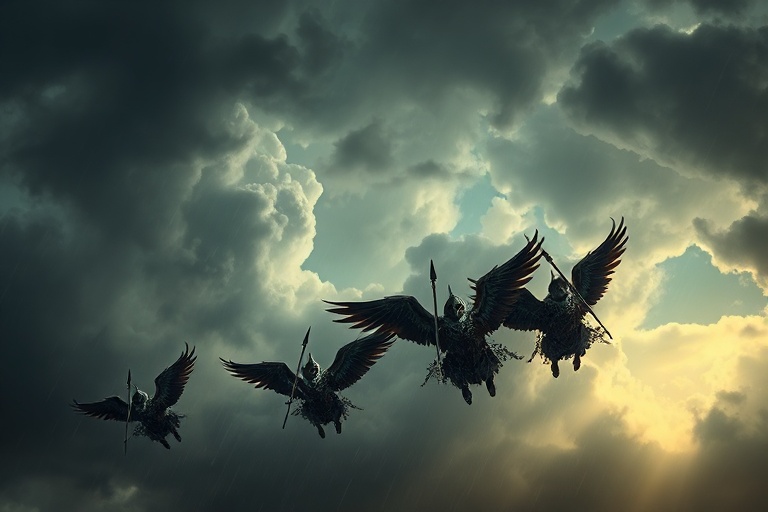
From the storm-lashed coasts of Norway to the typhoon-ravaged islands of the Pacific, the clash between mythical forces and natural fury has shaped human imagination for millennia. The image of the valkyries—Norse warrior maidens who guide the slain to Valhalla—riding through storms has long symbolized the unpredictable power of nature. Meanwhile, the relentless force of storms themselves has inspired awe, fear, and reverence across cultures worldwide. This collision of myth and meteorology offers a fascinating lens through which to examine humanity’s relationship with the natural world.
The Mythological Roots of the Valkyries
The valkyries originate from Old Norse mythology, where they serve as Odin’s shieldmaidens. Their name, derived from the Old Norse words for “chooser of the slain,” reflects their role in selecting warriors worthy of ascending to Valhalla. These figures appear in texts like the Poetic Edda and Prose Edda, where they are described as both beautiful and terrifying, often clad in armor and riding through the skies. The mythological connection between valkyries and storms likely stems from the dramatic Nordic climate, where violent winds and rain were common.
Norse sagas frequently depict valkyries as storm-riders. In the Völsunga Saga, for example, the valkyrie Brynhildr is trapped in a ring of fire, a metaphorical storm that mirrors the harsh realities of Viking life. This imagery was not merely poetic; it reflected the lived experience of Norse people, for whom storms were both a literal and symbolic force. The valkyries, then, were not just mythological figures but embodiments of nature’s duality—both destructive and life-giving.
Cultural Variations of Storm Deities
While the valkyries are uniquely Norse, the idea of storm deities transcends cultures. In Greek mythology, Zeus wields lightning as a weapon, while in Hindu tradition, the storm god Indra rides his elephant Airavata through thunderclouds. These figures often serve as intermediaries between the divine and the natural world, much like the valkyries. The shared theme across these cultures underscores a universal human fascination with the power of storms—a force that inspires both terror and reverence.
The valkyries, however, occupy a unique space in this pantheon. Unlike gods who control storms, they are often depicted as riding through them, suggesting a deeper integration with nature’s chaos. This distinction highlights the Norse worldview, where the boundary between the divine and the natural was fluid.
The Science Behind Storms: A Global Phenomenon
Storms are among the most powerful natural phenomena on Earth, capable of reshaping landscapes and human societies in a matter of hours. From hurricanes in the Atlantic to cyclones in the Indian Ocean and typhoons in the Pacific, these meteorological events are governed by complex atmospheric dynamics. The energy released by a single hurricane can exceed the global electricity consumption for months, illustrating their sheer scale.
Climate change has intensified these storms, making them more frequent and unpredictable. According to the Intergovernmental Panel on Climate Change (IPCC), rising global temperatures are likely to increase the intensity of tropical cyclones, posing greater risks to coastal communities. This scientific reality adds a new layer to the ancient mythos of storm deities, as modern societies grapple with the consequences of a warming planet.
Historical Storms and Their Cultural Impact
Throughout history, storms have left indelible marks on human civilization. The Great Galveston Hurricane of 1900, for instance, remains the deadliest natural disaster in U.S. history, killing an estimated 8,000 people. In Europe, the Baltic Sea Storm of 1872 devastated coastal communities in Denmark, Germany, and Sweden, leading to significant changes in maritime safety regulations.
These events often become embedded in cultural memory, shaping local folklore and traditions. In Japan, the Typhoon of 1281, which destroyed the Mongol invasion fleet of Kublai Khan, is credited with inspiring the creation of kamikaze (“divine wind”) mythology. Similarly, the valkyries’ association with storms in Norse culture reflects a broader pattern of mythologizing natural disasters to explain their unpredictability.
The Valkyries in Modern Media and Pop Culture
The valkyries have transcended their mythological origins to become enduring symbols in modern media. Their portrayal has evolved from terrifying warrior maidens to complex characters in film, literature, and video games. One of the most iconic modern interpretations is Richard Wagner’s opera The Ring of the Nibelung, where the valkyries, particularly Brünnhilde, play central roles. Wagner’s music and staging transformed these figures into dramatic archetypes, influencing countless adaptations.
In contemporary pop culture, the valkyries appear in various forms:
- Marvel Comics and the MCU: The valkyries, particularly Brunnhilde, appear as powerful warriors in the Entertainment universe, blending Norse mythology with superhero tropes.
- Video Games: Titles like God of War (2018) and Assassin’s Creed Valhalla feature valkyries as bosses or mythical entities, often tied to storm-like environments.
- Literature: Modern fantasy authors like Neil Gaiman and J.R.R. Tolkien have drawn inspiration from Norse mythology, reimagining valkyries in new contexts.
These adaptations often emphasize the valkyries’ connection to storms, using dramatic weather as a backdrop for their battles. This continuity with ancient myth highlights the enduring appeal of these figures—a blend of strength, mystery, and raw power.
Climate Change and the New Storm Narrative
The intersection of mythology and modern science has taken on new significance in the era of climate change. As storms grow more intense, the ancient metaphor of storm deities has acquired a literal urgency. The valkyries, once symbols of nature’s capriciousness, now serve as a reminder of humanity’s vulnerability in the face of environmental forces.
This shift is evident in contemporary discourse. Climate activists and artists alike have co-opted mythological imagery to convey the scale of the crisis. For example, the Extinction Rebellion movement has used storm and warrior imagery to evoke a sense of impending doom, much like the valkyries’ role in guiding the slain to their fate.
Yet, there is also hope in this narrative. The valkyries were not merely harbingers of doom; they were also protectors, guiding warriors to a better afterlife. In this light, the modern storm narrative could also be one of resilience and adaptation. As societies face the challenges of climate change, the valkyries’ myth offers a reminder of humanity’s capacity to endure and overcome.
Global Responses to the Storm Crisis
Around the world, communities are developing innovative strategies to mitigate the impact of increasingly severe storms. In the Philippines, for instance, local governments have invested in early warning systems and resilient infrastructure to protect against typhoons. Similarly, in the Caribbean, coral reef restoration projects aim to reduce coastal erosion caused by hurricanes.
These efforts reflect a growing recognition that the “new normal” of storm activity requires both technological and cultural adaptation. The valkyries’ myth, with its emphasis on navigating chaos, resonates in these contexts. Whether through ancient storytelling or modern science, the challenge remains the same: how to live with the storms that shape our world.
“The valkyries remind us that storms are not just forces of destruction but also agents of change. They clear the way for new beginnings, much like the aftermath of a hurricane reveals both devastation and renewal.”
Conclusion: Myth and Reality in the Age of Storms
The valkyries vs. storm narrative is more than a clash of myth and meteorology; it is a reflection of humanity’s enduring relationship with nature. From the sagas of the Vikings to the warnings of climate scientists, this story has evolved but never lost its power. The valkyries, with their dual roles as guides and warriors, embody the paradox of storms—simultaneously destructive and transformative.
As we face an era of increasing environmental uncertainty, the lessons of these ancient myths remain relevant. They remind us to respect nature’s power while also recognizing our capacity to adapt and thrive. Whether through art, science, or storytelling, the dialogue between myth and reality continues to shape our understanding of the world.
In the end, the valkyries and the storms they ride are not just relics of the past. They are living metaphors, urging us to confront the challenges of our time with courage and wisdom. The question is not whether we will face the storms, but how we will navigate them.