Vietnam War: Causes, Conflict, and Lasting Global Impact
The Vietnam War remains one of the most complex and divisive conflicts of the 20th century. Spanning nearly two decades, from 1955 to 1975, it reshaped global politics, left deep scars on American society, and redefined warfare itself. Unlike conventional conflicts, Vietnam was a war of ideologies, fought not just on battlefields but in living rooms across the United States, where nightly news broadcasts brought the brutality of combat into homes.
The Roots of the Conflict: Colonialism and Cold War Tensions
To understand the Vietnam War, we must first examine its origins. Vietnam had been under French colonial rule for nearly a century until World War II, when Japan briefly occupied the region. After Japan’s surrender in 1945, Vietnamese leader Ho Chi Minh declared independence, quoting the U.S. Declaration of Independence in his proclamation. However, France sought to reclaim its former colony, leading to the First Indochina War (1946–1954).
The conflict was never just about colonialism. It became a battleground in the Cold War, with the United States and Soviet Union backing opposing sides. Ho Chi Minh’s communist Viet Minh received support from China and the USSR, while the U.S. backed the French, pouring in billions of dollars. The decisive battle at Dien Bien Phu in 1954 forced France to withdraw, but it also set the stage for Vietnam’s division into North and South at the Geneva Conference.
- Colonial Legacy: France’s exploitative policies left Vietnam economically and politically fractured.
- Cold War Proxy: The U.S. saw Vietnam as a test of containment policy against communism.
- Division of Vietnam: The 1954 Geneva Accords split the country at the 17th parallel, creating a communist North and a U.S.-backed South.
The War Intensifies: Escalation and Controversy
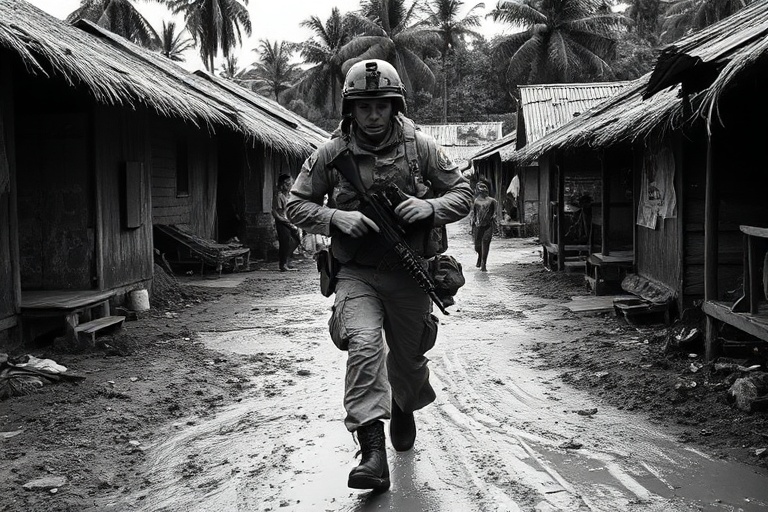
By the early 1960s, the conflict in Vietnam had escalated into a full-scale war. The U.S. initially sent military advisors to support South Vietnam, but after the Gulf of Tonkin incident in 1964—a disputed naval confrontation—the Johnson administration secured congressional approval for large-scale troop deployments. By 1968, over half a million American soldiers were stationed in Vietnam.
What began as a counterinsurgency effort against communist guerrillas (the Viet Cong) became a brutal, protracted war. The U.S. military relied heavily on aerial bombing campaigns, including napalm and Agent Orange, which devastated Vietnam’s landscape and population. Meanwhile, the Viet Cong and North Vietnamese Army (NVA) employed guerrilla tactics, blending into civilian populations and launching surprise attacks.
The war’s brutality was undeniable. Iconic images like the execution of a Viet Cong suspect in Saigon (1968) and the napalm victim Phan Thi Kim Phuc (1972) shocked the world. These moments crystallized the war’s moral ambiguity, turning global public opinion against U.S. involvement.
At home, the war fueled a growing anti-war movement. Protests erupted on college campuses, and figures like Muhammad Ali and Jane Fonda became vocal critics. The 1968 Tet Offensive—a massive surprise attack by North Vietnam—was a turning point. Though a military defeat for the North, it shattered American confidence, proving that victory was far from certain.
Key Turning Points and the Fall of Saigon
Several pivotal events defined the war’s trajectory. The My Lai Massacre (1968), where U.S. soldiers killed hundreds of unarmed civilians, became a symbol of wartime atrocities. Meanwhile, the Nixon administration pursued “Vietnamization”—shifting combat responsibilities to South Vietnamese forces while withdrawing American troops. However, this strategy coincided with expanded bombing campaigns in Laos and Cambodia, destabilizing the region.
The Paris Peace Accords in 1973 promised a ceasefire and U.S. withdrawal, but fighting continued. In 1975, North Vietnam launched a final offensive, capturing Saigon on April 30. The fall of the city marked the end of the war and the reunification of Vietnam under communist rule. The U.S. had withdrawn in 1973, but the war’s legacy lingered—2.7 million Americans served, 58,000 died, and countless others carried physical and psychological scars.
- Gulf of Tonkin Resolution (1964): Gave President Johnson broad war powers.
- Tet Offensive (1968): Undermined U.S. morale and media support for the war.
- My Lai Massacre (1968): Exposed the darker side of U.S. military operations.
- Paris Peace Accords (1973): Officially ended U.S. involvement but did not bring peace.
- Fall of Saigon (1975): Marked the war’s conclusion and Vietnam’s reunification.
Broader Implications: A War That Changed Everything
The Vietnam War’s impact extended far beyond Southeast Asia. For the United States, it exposed the limits of military power and shattered the post-World War II consensus on foreign intervention. The war eroded trust in government, leading to reforms like the War Powers Act (1973), which restricted presidential authority to deploy troops without congressional approval. It also fueled the growth of investigative journalism, as reporters like Seymour Hersh uncovered atrocities and government deceit.
Vietnam’s consequences were equally profound. The country suffered immense human and economic losses—estimates suggest three million Vietnamese died, and decades of reconstruction followed. The war also reshaped global diplomacy. China and the U.S., once bitter Cold War rivals, began exploring détente, culminating in Nixon’s historic 1972 visit to Beijing. Meanwhile, Vietnam’s communist government sought alliances with the USSR, further entrenching Cold War divisions.
Culturally, the war left an indelible mark. Films like Apocalypse Now and Platoon explored its psychological toll, while literature such as Tim O’Brien’s The Things They Carried captured its emotional weight. Music, too, reflected the era—songs like Creedence Clearwater Revival’s “Fortunate Son” became anthems for a disillusioned generation.
Today, Vietnam’s relationship with the U.S. has evolved dramatically. Once enemies, the two nations now collaborate on trade, security, and environmental issues. Yet the war’s scars remain visible—in Agent Orange hotspots, unexploded ordnance, and the memories of those who lived through it.
As we reflect on this conflict, it serves as a cautionary tale about the unintended consequences of war. It challenges us to ask: How do nations learn from such painful histories? And how can diplomacy and cooperation prevent similar tragedies in the future?
For further reading on the geopolitical shifts of the era, visit our Politics section. To explore how the war influenced American culture, check out our Entertainment archives.