Trump Gold Statue: Art, Controversy, and Cultural Impact Explored
Published on
The Rise of the Trump Gold Statue
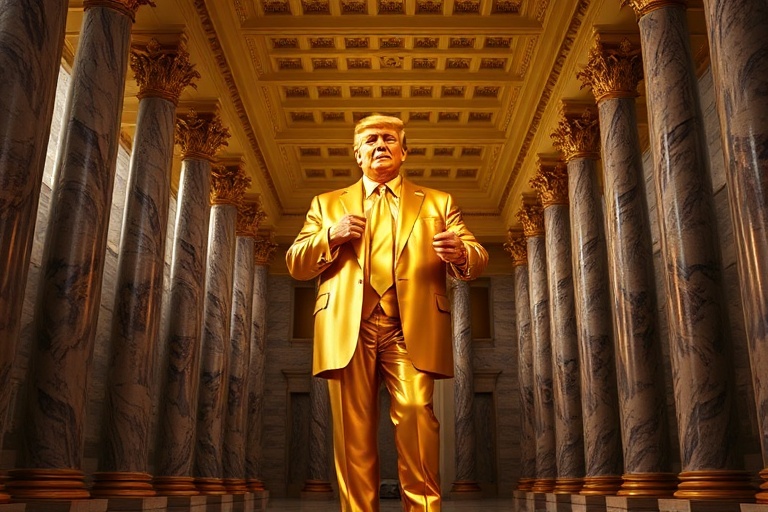
In late 2023, a 10-foot-tall gold statue of former President Donald Trump sparked immediate debate across social media and news outlets. The statue, created by artist Tommy Zegan, features Trump in a classic pose with his right arm raised, draped in a golden robe reminiscent of a superhero or a classical deity. Unlike traditional presidential statues, this piece diverged sharply from the usual marble or bronze depictions, opting instead for a gleaming, almost surreal metallic finish.
The choice of gold wasn’t accidental. Gold symbolizes wealth, power, and permanence—qualities often associated with Trump’s public persona. The artist has stated that the piece was intended to explore themes of legacy, ambition, and the intersection of politics and art. Yet, the statue’s exaggerated features and opulent material immediately set it apart from more conventional political art.
Within days of its public unveiling in Miami, the statue became an instant talking point. Critics argued that the piece exaggerated Trump’s larger-than-life image, while supporters saw it as a celebration of his influence. The debate over whether political art should glorify or critique its subjects was reignited, proving that art remains a powerful medium for political expression.
Why This Statue Stands Out in Political Art
Political art has long played a role in shaping public perception, from Soviet-era propaganda posters to the satirical cartoons of modern American publications. The Trump gold statue, however, occupies a unique space. Unlike traditional monuments that aim for dignity and historical accuracy, this piece leans into caricature and excess. Its gold material alone challenges viewers to consider what it means to memorialize a figure in such an unapologetically extravagant way.
Several key factors contribute to its distinctiveness:
- Material choice: Gold is rare and valuable, often reserved for trophies, awards, or religious icons. Its use here frames Trump as a kind of secular deity.
- Hyperbolic representation: The statue exaggerates Trump’s physical features—his hair, his posture—turning him into a larger-than-life figure.
- Location and context: Placed in Miami, a city known for its wealth and political symbolism, the statue’s presence feels deliberate, almost performative.
- Digital virality: The statue’s striking appearance made it a perfect subject for memes, viral videos, and online discourse, spreading far beyond traditional art circles.
This isn’t the first time Trump has been immortalized in art, but it might be the first time he’s been rendered in solid gold. Previous depictions often focused on critique or satire, such as Maurizio Cattelan’s 2019 sculpture “Trump,” a golden toilet titled “America.” The gold statue, however, takes a different approach—one that doesn’t mock so much as it monumentalizes.
Public Reaction and Broader Implications
The statue’s unveiling was met with a swift and polarized response. Supporters praised it as a bold tribute to a polarizing figure, while critics dismissed it as propaganda disguised as art. Social media platforms exploded with reactions—some calling it “the most Trump thing ever,” others labeling it “a grotesque glorification of narcissism.”
This divide reflects deeper cultural tensions. In an era where public figures are often reduced to memes and soundbites, art that attempts to elevate them—whether critically or celebratorily—becomes a lightning rod. The gold statue forces a confrontation: Is it possible to create political art that doesn’t feel like an endorsement or an attack? Or does all political art inherently take a side?
Beyond the immediate reactions, the statue raises questions about the role of art in politics. Should art serve as a mirror, reflecting society’s values back at it? Or can it shape those values, nudging public perception in one direction or another? The gold statue doesn’t offer easy answers, but it does highlight how art and politics continue to collide in unpredictable ways.
For artists, the statue presents both an opportunity and a challenge. It demonstrates how material, scale, and symbolism can amplify a message—or drown it out entirely. For the public, it’s a reminder that art isn’t just decoration; it’s a conversation starter, a provocation, and sometimes, a controversy waiting to happen.
The Future of Political Art in the Age of Virality
As the Trump gold statue continues to circulate online, it offers a glimpse into the future of political art. The line between art and meme culture is blurring, with viral moments often carrying more cultural weight than traditional exhibitions. Artists are increasingly aware that their work might never be seen in a gallery—it might only exist as a tweet, a TikTok, or a headline.
This shift has implications for how political messages are crafted and consumed. Art that’s designed for the algorithm must be bold, instantly recognizable, and shareable. The Trump gold statue fits this mold perfectly. Its exaggerated features and gleaming surface make it eye-catching, even in a crowded social media feed. It’s art made for the digital age—unapologetic, provocative, and impossible to ignore.
Yet, this raises concerns about depth and nuance. Can art that prioritizes virality still challenge viewers intellectually? Or does it risk becoming little more than a fleeting spectacle? The Trump gold statue’s legacy may depend on how these questions are answered. If it sparks deeper conversations about power, representation, and art’s role in society, it will have succeeded beyond its physical form. If it’s remembered only as a meme, it will fade as quickly as the next viral trend.
Regardless of its long-term impact, the statue serves as a case study in how art and politics intersect in the 21st century. It’s a reminder that art isn’t just for museums or critics—it’s for all of us, and its power lies in how we choose to engage with it.
Conclusion
The Trump gold statue is more than just a provocative piece of art—it’s a cultural artifact that captures the contradictions of our time. It glorifies while it critiques, it monumentalizes while it mocks, and it forces us to confront the blurred lines between art, politics, and public perception. Whether you see it as a masterpiece or a misfire, its impact is undeniable. In an era where every image can go viral, the statue stands as a testament to art’s enduring power to provoke, inspire, and divide.
Explore More on Dave’s Locker
Interested in political art, cultural debates, or the intersection of media and power? Check out these related categories: