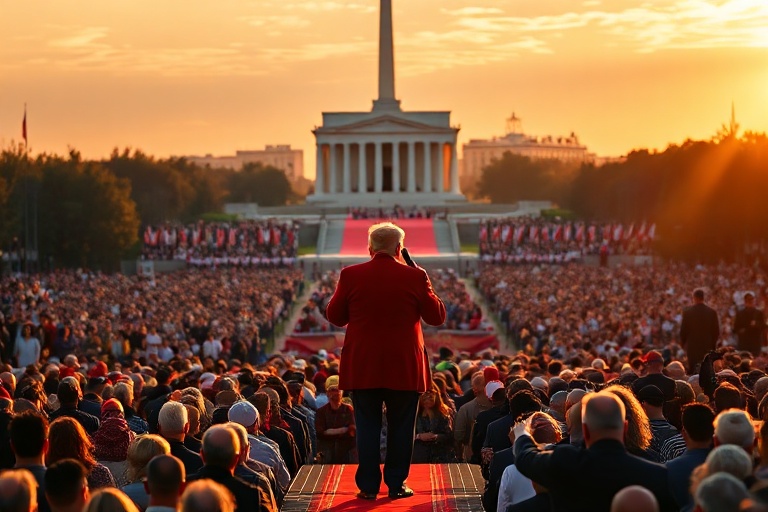
The National Mall in Washington, D.C., has long served as a stage for the nation’s most defining moments—from presidential inaugurations to civil rights marches. On a recent Saturday, it became the backdrop for another historic gathering: a prayer event organized by supporters of former President Donald Trump. The event, which drew tens of thousands of attendees, was framed as a moment of spiritual renewal and national unity, yet it unfolded against the backdrop of deep political divisions.
Organizers described the event as a non-partisan call for prayer, healing, and reflection, emphasizing themes of faith and patriotism. Speakers included religious leaders, veterans, and members of the Trump family. The choice of location—the steps of the Lincoln Memorial—added symbolic weight, evoking the legacy of a president who championed unity during one of the nation’s most turbulent periods.
The Symbolism of the National Mall
The National Mall is more than just a public space; it is a living museum of American democracy. Its monuments and memorials honor the nation’s founding principles, its struggles for equality, and its enduring quest for justice. By hosting a major event there, organizers tapped into a well of collective memory, positioning the prayer gathering as part of a broader narrative about America’s moral and spiritual future.
For many attendees, the event was a chance to reaffirm their faith in a time of uncertainty. Polls show that a significant portion of Americans believe the country is facing a crisis of morality and values. The prayer event offered a counter-narrative, one where faith could serve as a unifying force rather than a dividing line. Yet, critics argue that the event blurred the line between religion and politics, raising questions about the role of faith in public life.
Globally, the event was met with mixed reactions. In countries with strong secular traditions, such as France or Germany, the blending of politics and prayer might be seen as unusual. Meanwhile, in nations where religion plays a central role in public discourse, the event resonated more deeply. For example, in Brazil, where evangelical Christianity has grown rapidly, some political leaders drew parallels between the National Mall gathering and their own efforts to integrate faith into governance.
A Global Lens on Faith and Politics
The intersection of religion and politics is not unique to the United States. Around the world, leaders have leveraged faith to mobilize supporters, justify policies, or unite divided populations. In India, Prime Minister Narendra Modi has championed Hindu nationalism, framing his policies as a revival of the nation’s spiritual heritage. Similarly, in Israel, religious Zionism has become a powerful political force, shaping the country’s approach to settlement expansion and peace negotiations.
What sets the National Mall prayer event apart is its explicit appeal to a broad, interfaith audience. Organizers sought to distance the event from partisan politics, though the association with Trump inevitably tied it to his political brand. This tension between faith and partisanship is a recurring theme in modern democracies, where religious identity often intersects with national identity.
In Europe, where secularism is deeply ingrained, such events are rare. The continent’s history of religious conflict has led to a strong separation of church and state. However, recent years have seen a rise in populist movements that invoke Christian values as a way to define national identity. This trend mirrors the dynamics at play in the U.S., where debates over religious freedom and cultural identity often dominate political discourse.
Media Coverage and Public Perception
News outlets around the world covered the event, though their framing varied significantly. In the U.S., conservative media outlets highlighted the event as a powerful demonstration of faith and patriotism, while liberal outlets questioned its non-partisan claims and pointed to the event’s alignment with Trump’s political base. Internationally, coverage often focused on the broader trend of religion’s increasing role in politics, with some outlets drawing comparisons to similar movements in other countries.
Social media amplified these divisions. Supporters shared images of the crowd filling the National Mall, framing the event as a historic moment of spiritual renewal. Critics, meanwhile, pointed to the event’s political undertones, arguing that it was less about prayer and more about rallying Trump’s base ahead of the 2024 election. The debate over the event’s true purpose reflected a larger struggle within American society: the tension between faith as a personal conviction and faith as a political tool.
Public perception of the event was similarly divided. Polls conducted after the gathering showed that while a majority of Republicans viewed it positively, Democrats were more skeptical. Independents fell somewhere in between, with many expressing ambivalence about the event’s political implications. This polarization underscores a broader challenge for faith-based movements in the U.S.: how to remain relevant in a society where religion is increasingly seen as a partisan issue.
The Road Ahead: Faith in a Divided Nation
The National Mall prayer event may have been a momentary spectacle, but its legacy will likely extend beyond a single day. For organizers, the challenge will be to sustain the momentum of the gathering and translate its themes of unity and reflection into tangible outcomes. For critics, the event serves as a reminder of the need to guard against the politicization of faith, ensuring that religion remains a force for good rather than division.
As the 2024 election approaches, the role of faith in politics is likely to become even more prominent. Whether this will lead to greater polarization or a renewed sense of common purpose remains to be seen. What is clear, however, is that the National Mall prayer event has become a touchstone in the ongoing debate about the place of religion in American public life.
For those interested in exploring this topic further, our Politics section offers in-depth analysis of faith and governance, while our Culture section examines the broader implications of religious movements in contemporary society.
Key Takeaways from the National Mall Prayer Event
- The event drew tens of thousands of attendees, positioning faith as a unifying force.
- Organizers framed the gathering as non-partisan, though its association with Trump tied it to political debates.
- Globally, the event sparked discussions about the role of religion in public life and its intersection with politics.
- Media coverage reflected deep divisions, with conservative and liberal outlets offering starkly different interpretations.
- The event highlighted the ongoing challenge of balancing faith and partisanship in a polarized society.