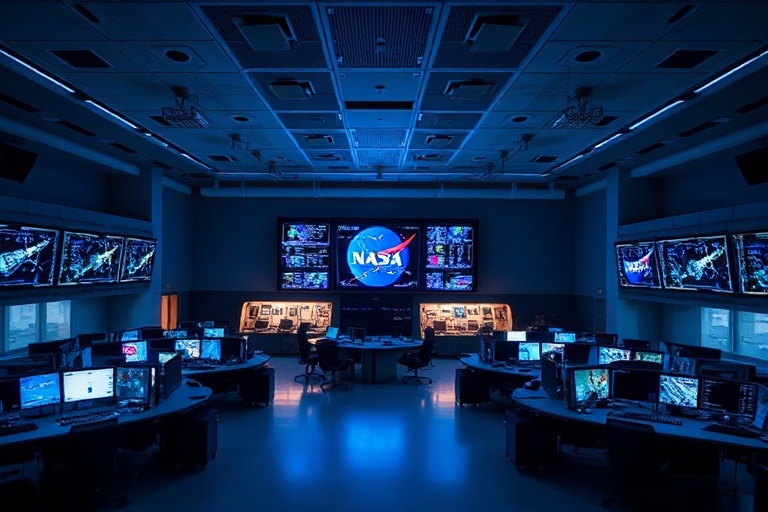
Goddard Space Flight Center: The Heart of NASA’s Space Missions
The Goddard Space Flight Center, located in Greenbelt, Maryland, stands as a testament to humanity’s relentless pursuit of cosmic understanding. Established on May 1, 1959, just months after NASA’s inception, Goddard became the agency’s first space flight center. Named after Dr. Robert H. Goddard, the pioneering American rocket scientist, this facility has played a pivotal role in nearly every major American space mission since the early days of the Space Race.
The Visionary Behind the Name: Dr. Robert H. Goddard
Before Goddard became synonymous with space exploration, it was the name of a man whose groundbreaking work laid the foundation for modern rocketry. Dr. Robert Hutchings Goddard launched the world’s first liquid-fueled rocket on March 16, 1926, in Auburn, Massachusetts. Though his achievements were initially met with skepticism—including a New York Times editorial that ridiculed his theories—history would prove him right.
Goddard’s contributions extended beyond the first liquid-fueled rocket. He developed the mathematical theories behind rocket propulsion, explored multi-stage rockets, and even patented a design for a two-stage rocket in 1914. His work inspired generations of scientists, including the German rocket engineers who later developed the V-2 rocket during World War II. Today, the center bearing his name continues to push the boundaries of what’s possible in space science.
Key Innovations from Robert H. Goddard
- First liquid-fueled rocket launch: Proved that rockets could operate in the vacuum of space.
- Gyroscopic stabilization: Developed systems to control rocket orientation in flight.
- Multi-stage rocket theory: Demonstrated that separating rocket stages increased efficiency.
- Practical applications: Explored using rockets for upper-atmosphere research and even weather observation.
Goddard’s Role in NASA’s Early Years and the Space Race
When NASA was formed in 1958, it inherited a Cold War space program that was still in its infancy. Goddard Space Flight Center was tasked with designing, building, and operating the first American satellites. The center’s first major project, the Explorer 1, launched on January 31, 1958, just months after the Soviet Union’s Sputnik 1. This success marked America’s entry into the Space Race and demonstrated Goddard’s capability to deliver under pressure.
Throughout the 1960s, Goddard became the nerve center for NASA’s unmanned missions. While the Manned Spacecraft Center (now Johnson Space Center) focused on the Apollo program, Goddard handled the scientific payloads, communications, and tracking systems that made moon landings possible. The center developed the tracking and data relay satellite systems that remain critical to all NASA missions today.
Critical Contributions During the Space Race
- TIROS Program: Launched the first weather satellites in 1960, revolutionizing meteorology.
- Lunar Orbiter missions: Mapped the moon’s surface to prepare for Apollo landings.
- Nimbus satellites: Advanced Earth observation technology for environmental monitoring.
- Tracking networks: Established ground stations worldwide to maintain contact with spacecraft.
Modern Missions and Scientific Breakthroughs
Today, Goddard Space Flight Center remains at the forefront of space exploration, managing missions that study Earth, the solar system, and the universe beyond. One of its most ambitious current projects is the James Webb Space Telescope, launched in December 2021. As the successor to the Hubble Space Telescope, Webb is designed to observe the universe in infrared light, revealing the first galaxies formed after the Big Bang and studying the atmospheres of exoplanets for signs of habitability.
The center also leads missions to study Earth’s climate system. The Thermosphere, Ionosphere, Mesosphere Energetics and Dynamics (TIMED) mission, launched in 2001, continues to provide data on the least understood layer of Earth’s atmosphere. Meanwhile, the Global Precipitation Measurement (GPM) mission offers unprecedented insights into Earth’s water cycle, helping scientists understand the mechanics behind extreme weather events.
Notable Current and Recent Missions
- James Webb Space Telescope: Exploring the universe’s first light and searching for exoplanet biosignatures.
- Landsat program: Providing continuous Earth observation since 1972 to monitor environmental changes.
- OSIRIS-REx: Successfully returned a sample from asteroid Bennu in 2023, the first American mission of its kind.
- Parker Solar Probe: Flying through the sun’s atmosphere to study solar wind and coronal heating.
The Unsung Heroes: Goddard’s Workforce and Collaborations
Behind every successful Goddard mission is a diverse team of scientists, engineers, and technicians. The center employs approximately 10,000 civil servants and contractors, representing a wide range of disciplines from astrophysics to mechanical engineering. One of Goddard’s unique strengths is its collaborative approach, partnering with international agencies like the European Space Agency, Japan’s JAXA, and Canada’s CSA.
Goddard also plays a crucial role in education and public engagement. The center’s visitor center offers interactive exhibits, while its scientists frequently participate in outreach programs to inspire the next generation of STEM professionals. The NASA Internship Program, managed in part by Goddard, provides students with hands-on experience in space science and engineering.
Key Partnerships and Collaborations
- International Space Station: Goddard contributes to ISS missions through Earth observation and technology demonstrations.
- NOAA: Collaborates on weather and climate satellites like GOES-R and JPSS.
- University partnerships: Works with institutions like the University of Maryland and Johns Hopkins Applied Physics Laboratory.
- Commercial space industry: Partners with companies like SpaceX and Blue Origin for launch services.
The Future of Goddard and Space Exploration
As NASA sets its sights on returning humans to the moon through the Artemis program and eventually sending astronauts to Mars, Goddard’s role will only grow more critical. The center is already developing technologies for lunar surface operations, including communications systems and scientific instruments that will study the moon’s environment.
Looking further ahead, Goddard is contributing to the Mars Sample Return mission, which aims to bring Martian soil and rock samples back to Earth for detailed analysis. This mission represents one of the most complex robotic spaceflight endeavors ever attempted and will provide unprecedented insights into the Red Planet’s geology and potential for past life.
Beyond planetary science, Goddard continues to innovate in astrophysics. The Nancy Grace Roman Space Telescope, scheduled for launch in 2027, will study dark energy, exoplanets, and infrared astrophysics. This mission will build on Webb’s discoveries and help answer fundamental questions about the universe’s expansion and structure.
Upcoming Missions and Technologies in Development
- Lunar Gateway: Goddard is developing communications and navigation systems for NASA’s lunar outpost.
- Dragonfly mission: A rotorcraft lander to explore Titan, Saturn’s largest moon, launching in 2028.
- PACE mission: The Plankton, Aerosol, Cloud, ocean Ecosystem satellite will study Earth’s ocean and atmosphere.
- Next-generation weather satellites: Improving hurricane tracking and climate modeling capabilities.
Conclusion: Goddard’s Enduring Legacy
From its humble beginnings as America’s first space flight center to its current status as a global leader in space science, Goddard Space Flight Center has consistently demonstrated the power of innovation and collaboration. The center’s contributions—from the first American satellites to the most advanced space telescopes—have not only expanded our understanding of the universe but have also improved life on Earth through applications in weather forecasting, communications, and environmental monitoring.
As we stand on the precipice of a new era in space exploration, Goddard remains a vital partner in humanity’s quest to explore the cosmos. Whether it’s unraveling the mysteries of distant galaxies, monitoring the health of our home planet, or paving the way for human settlement on other worlds, the center continues to write new chapters in the story of space exploration. For those who look to the stars and wonder what’s possible, Goddard serves as a reminder that the future is not just something we imagine—it’s something we build.