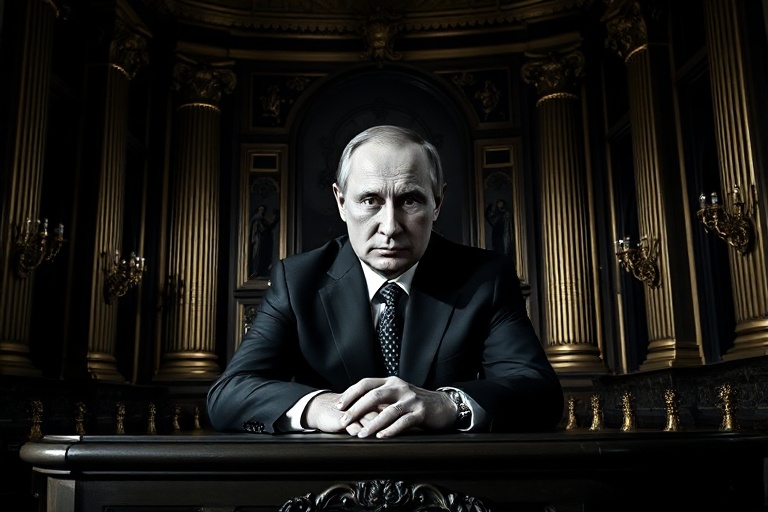
The Shadow Behind the Kremlin: Unraveling the Legend of the “Wizard”
In the corridors of power that stretch beneath the Kremlin’s red walls, whispers persist of a figure shrouded in mystery. Known only as the “Wizard,” this enigmatic strategist has been credited with everything from predicting the collapse of the Soviet Union to orchestrating the rise of modern Russia. But who—or what—is the Wizard of the Kremlin? Is this a myth spun by conspiracy theorists, or does a real architect of influence lurk in the shadows of Russian politics?
The term “Wizard” emerged in the late 1990s, a period marked by economic turmoil, political instability, and the chaotic transition from Soviet rule to a fledgling market economy. During this time, a small group of advisors and consultants gained reputations for their uncanny ability to navigate Russia’s treacherous political landscape. Among them, a few names began to stand out—not for their public profiles, but for their behind-the-scenes impact. Figures like Anatoly Chubais, Boris Nemtsov, and later, consultants such as Gleb Pavlovsky, were often cited in whispers as the architects of Russia’s post-Soviet transformation.
But the title “Wizard” was not bestowed lightly. It was reserved for those who seemed to possess an almost supernatural understanding of power dynamics, capable of manipulating events from the shadows. The most enduring legend, however, centers on a single, unidentified individual who allegedly advised Boris Yeltsin during his presidency and later played a pivotal role in Vladimir Putin’s ascent.
The Origins of the Myth
The myth of the Kremlin’s Wizard took hold in the 1990s, a decade when Russia’s political and economic systems were in freefall. The country faced hyperinflation, plummeting living standards, and the humiliation of a financial crisis in 1998 that wiped out savings overnight. Amid this chaos, a select few advisors appeared to operate with an almost clairvoyant precision, steering policies that would later be credited with stabilizing—or at least reshaping—the nation.
One of the earliest references to the Wizard comes from journalists and political analysts who observed the inner workings of the Kremlin during Yeltsin’s tenure. In particular, the role of economic reformers like Chubais, who privatized state assets in the controversial “loans-for-shares” scheme, was often described as magical in its execution. While Chubais himself was a public figure, the idea of a more shadowy, untouchable strategist persisted in the background.
By the time Vladimir Putin rose to power in 2000, the legend had evolved. The Wizard was now seen as a puppet master, pulling strings to ensure Putin’s consolidation of authority. This period saw the rise of political technologists—experts in media manipulation, electoral strategy, and psychological warfare—who operated outside traditional political structures. Among them, Gleb Pavlovsky, founder of the influential think tank Foundation for Effective Politics, was often described as a modern-day Merlin, crafting narratives that shaped public perception.
Who Could the Wizard Be?
The identity of the Wizard remains one of Russia’s most closely guarded secrets. However, several theories have emerged over the years, each pointing to different figures who may have held the title—or at least embodied its myth.
Anatoly Chubais is frequently cited as a prime candidate. As the architect of Russia’s privatization reforms, Chubais was instrumental in dismantling the Soviet economy and paving the way for a new capitalist elite. His methods were controversial, to say the least, and his influence extended far beyond economics. Some believe he played a key role in grooming Putin as Yeltsin’s successor, ensuring a smooth transition of power.
Vladislav Surkov, a former deputy chief of staff under Putin, is another figure often associated with the title. Surkov, a playwright by training, became known for his role in crafting Putin’s image as a strong, decisive leader. He pioneered the use of “managed democracy,” a system in which elections and political processes were carefully controlled to maintain power. Surkov’s behind-the-scenes maneuvering earned him the nickname “the puppet master,” a title that aligns closely with the Wizard myth.
Vladimir Yakunin, a former KGB officer and longtime ally of Putin, is also rumored to be the Wizard. Yakunin, who served as president of Russian Railways, was a key figure in Putin’s inner circle during the 2000s. His influence extended into the Orthodox Church and nationalist movements, making him a central player in the cultural and political consolidation of Putin’s rule.
Other theories point to foreign advisors or consultants, particularly those from the West who worked with Russian oligarchs and government officials in the 1990s. The involvement of figures like American political consultants in Russian elections has long been a subject of speculation, with some suggesting that these operatives played a role in shaping the country’s political future.
The Methods of the Wizard
The Wizard’s supposed methods are as varied as the legends themselves. At its core, the myth revolves around the idea of a strategist who operates outside the constraints of conventional politics, using psychological manipulation, media control, and economic leverage to achieve their goals.
One of the most enduring aspects of the Wizard myth is the idea of narrative control. In a country where state-controlled media dominates the information landscape, the ability to shape public perception is a form of power. The Wizard is said to have mastered this art, crafting stories that justify policies, demonize opponents, and maintain the illusion of stability. This was particularly evident during the 2000s, when Putin’s government tightly controlled the narrative around issues like the Second Chechen War, the Yukos affair, and the annexation of Crimea.
Another key method attributed to the Wizard is economic influence. The loans-for-shares privatization scheme of the 1990s transferred vast wealth into the hands of a small group of oligarchs, many of whom later became key supporters of Putin’s regime. This economic restructuring not only concentrated power in the hands of a few but also created a system of patronage that ensured loyalty to the Kremlin. The Wizard, in this telling, was the unseen hand behind these transactions, ensuring that the right people held the right levers of power.
Finally, the Wizard is often credited with strategic foresight—the ability to anticipate and manipulate events before they unfold. This includes everything from predicting the 1998 financial crisis to preparing for the 2014 annexation of Crimea. In this view, the Wizard is less a single individual and more a system, a network of advisors, technologists, and operatives who work in concert to shape Russia’s future.
Why the Myth Endures
The legend of the Wizard of the Kremlin persists because it speaks to a fundamental truth about power: that much of it operates in the shadows. In a system where formal institutions are often secondary to informal networks, the idea of a master strategist pulling the strings is both compelling and plausible.
For many Russians, the Wizard myth offers a way to make sense of the country’s turbulent history. It provides a narrative in which chaos is not random but carefully orchestrated, and where the seemingly inexplicable—such as the sudden rise of a previously unknown politician—can be explained by the machinations of a hidden hand. This narrative is particularly appealing in a country where trust in institutions is low, and where conspiracy theories often fill the void left by official opacity.
For outsiders, the myth of the Kremlin’s Wizard serves as a cautionary tale about the dangers of unchecked power. It highlights the risks of a political system in which decisions are made behind closed doors, by individuals whose influence is impossible to trace. This lack of transparency not only undermines democracy but also creates an environment in which corruption and abuse of power can flourish unchecked.
The enduring appeal of the Wizard myth also reflects the broader fascination with Russia’s political culture. From the tsars to the commissars to the modern-day siloviki, the idea of a hidden hand guiding the nation’s destiny is a recurring theme. It is a story that blends history, politics, and folklore, offering a lens through which to view the country’s complex and often contradictory trajectory.
Conclusion: Myth or Reality?
Whether the Wizard of the Kremlin is a real person, a composite of several figures, or simply a convenient myth, the legend endures because it captures something essential about the way power operates in Russia. It speaks to the country’s history of secrecy, its tradition of strongman leadership, and its ongoing struggle to balance modernity with authoritarianism.
What is clear is that the Wizard, in whatever form, represents a challenge to the idea of transparent governance. In a world where information is power, the ability to control the narrative—and to do so without accountability—is a form of magic in itself. Whether this magic is wielded for good or ill is a question that will continue to shape Russia’s future.
For those seeking to understand the Kremlin’s inner workings, the myth of the Wizard offers a starting point. But it is also a reminder of the dangers of unchecked power and the importance of demanding transparency in all its forms.