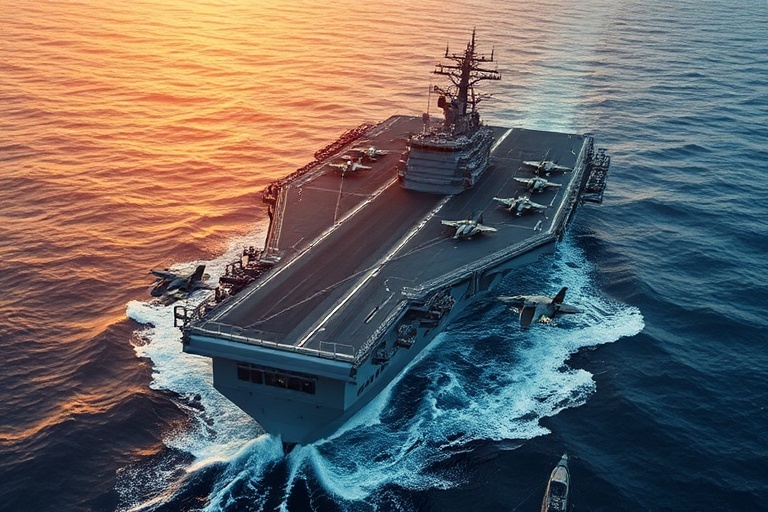
aircraft carrier
The aircraft carrier remains one of the most formidable symbols of military might and technological sophistication in the modern world. These massive vessels, often described as floating cities, serve as mobile airbases capable of projecting power across oceans without the need for land-based infrastructure. Their presence on the high seas underscores geopolitical influence, technological advancement, and strategic flexibility in an era where naval dominance shapes international relations.
More than just warships, aircraft carriers represent decades of innovation in engineering, aerospace, and naval strategy. From their origins in the early 20th century to today’s nuclear-powered giants like the USS Gerald R. Ford, these vessels have evolved into central pillars of naval operations for the United States, China, Russia, the United Kingdom, France, and India. Their construction and deployment often spark international dialogue, reflecting shifting power balances and military ambitions.
The Evolution of Aircraft Carriers: From Wooden Decks to Nuclear Power
The first aircraft carriers emerged from the need to extend air power over water. During World War I, the British converted merchant ships into makeshift carriers by installing wooden flight decks. These early experiments proved the concept viable, leading to purpose-built carriers like HMS Argus, launched in 1918. By World War II, carriers had become decisive weapons, culminating in battles such as Midway, where U.S. and Japanese fleets clashed using carrier-based aircraft.
Post-war advancements transformed carriers into technological marvels. The introduction of jet aircraft demanded longer, stronger decks and advanced catapult systems. The U.S. Navy’s Forrestal-class carriers in the 1950s marked the shift to supercarriers, while nuclear propulsion arrived with USS Enterprise in 1961. Today, the Nimitz and Ford classes can operate for over 20 years without refueling, carrying up to 75 aircraft and 4,500 personnel.
China’s rapid carrier program reflects a strategic shift. The Type 003 Fujian, launched in 2022, is China’s first domestically built carrier with electromagnetic catapults—a leap beyond its ski-jump predecessors. This development signals Beijing’s intent to challenge U.S. naval dominance in the Pacific, particularly in the South China Sea.
Global Players: Who Operates Aircraft Carriers and Why It Matters
The number of nations operating aircraft carriers remains small, underscoring their status as symbols of great power. The United States leads with 11 active carriers, forming the backbone of its naval strategy. These carriers enable power projection from the Mediterranean to the South China Sea, supporting allies and deterring adversaries.
The United Kingdom, once a pioneer of carrier aviation, is reviving its fleet with the HMS Queen Elizabeth and HMS Prince of Wales. These carriers, designed for short-takeoff and vertical-landing (STOVL) operations, reflect Britain’s renewed focus on global maritime engagement. Meanwhile, France fields the Charles de Gaulle, its sole nuclear-powered carrier, asserting European naval presence in the Mediterranean and Indian Ocean.
India operates two carriers, INS Vikramaditya and INS Vikrant, positioning itself as a regional naval power in the Indian Ocean. Japan, constrained by its pacifist constitution, operates “helicopter destroyers” like the JS Izumo, which could be retrofitted for fixed-wing aircraft. South Korea and Spain also maintain smaller carriers, while Italy and Thailand operate limited-capability vessels.
Russia, despite its naval ambitions, currently has only one carrier, Admiral Kuznetsov—a ship plagued by mechanical issues and accidents. Its operational limitations highlight the challenges of maintaining carrier fleets without sustained investment.
A Look at the World’s Largest Aircraft Carriers (by displacement)
- USS Gerald R. Ford (USA) – 100,000 tons
- USS Nimitz-class (USA) – 97,000 tons
- Admiral Kuznetsov (Russia) – 58,600 tons
- Charles de Gaulle (France) – 42,500 tons
- HMS Queen Elizabeth (UK) – 65,000 tons
- Type 003 Fujian (China) – 80,000 tons (estimated)
- INS Vikrant (India) – 43,000 tons
Cultural and Geopolitical Impact: More Than Just a Ship
Aircraft carriers resonate deeply in national psyche and global media. Their launches are state events, broadcast with patriotic fervor. In China, carrier development is framed as a symbol of rejuvenation and technological self-reliance. In the U.S., carriers like the USS Nimitz are icons of American naval power, often featured in films, documentaries, and military recruitment campaigns.
Geopolitically, the deployment of a carrier group sends a clear message. During the 2022 Russia-Ukraine war, the U.S. deployed the USS Harry S. Truman to the Mediterranean, signaling support for NATO allies. Similarly, China’s carriers conduct drills near Taiwan, asserting sovereignty claims. These movements are not merely military exercises; they are calculated signals in a broader diplomatic and strategic game.
Carriers also play a role in humanitarian missions. The USS Carl Vinson was deployed to deliver aid after the 2004 Indian Ocean tsunami, and the USS Abraham Lincoln supported earthquake relief in Pakistan in 2005. Their ability to respond rapidly to crises—without requiring host nation approval—makes them uniquely valuable tools of soft power.
The Future of Aircraft Carriers: Unmanned Systems and Next-Gen Designs
The future of carrier aviation is being shaped by unmanned systems, directed energy weapons, and artificial intelligence. The U.S. Navy’s MQ-25 Stingray, an unmanned aerial refueling tanker, is already being integrated into carrier operations. This drone will extend the range of F-35 and F/A-18 jets, reducing the need for manned missions.
Electromagnetic Aircraft Launch Systems (EMALS) on the USS Gerald R. Ford improve efficiency and reduce maintenance compared to steam catapults. These systems allow for smoother launches of heavier drones and next-generation aircraft. Meanwhile, directed energy weapons like lasers are being tested for defense against missiles and drones.
China’s Type 003 carrier features integrated electric propulsion and advanced radar systems, pointing toward future “networked” naval operations. Experts suggest that future carriers may operate as part of larger, AI-driven task forces, coordinating with submarines, destroyers, and satellites in real time.
Environmental concerns are also influencing design. Nuclear propulsion remains dominant, but some nations are exploring hybrid or alternative power sources. The U.S. Navy has tested biofuels on carrier groups, aiming to reduce dependence on fossil fuels—a nod to both sustainability and operational resilience.
As technology advances, the aircraft carrier’s role may evolve. While some analysts question their vulnerability to hypersonic missiles and submarine threats, their symbolic and strategic value ensures they will remain central to naval doctrine for decades to come.
Conclusion: Floating Sovereignty in a Changing World
Aircraft carriers are more than platforms for aircraft—they are instruments of national will, technological achievement, and global influence. In an era marked by rising tensions in the Indo-Pacific, the Arctic, and the Eastern Mediterranean, their presence ensures that naval power remains a decisive factor in international relations.
From the wooden decks of World War I to the AI-integrated supercarriers of today, these floating cities have continually adapted. They embody the intersection of engineering, strategy, and culture, serving as both tools of war and symbols of peace. As nations invest in next-generation carriers and unmanned systems, the aircraft carrier’s legacy as a pillar of global power is far from over.
For defense analysts, history enthusiasts, and global observers alike, the aircraft carrier remains a compelling subject—one that tells a story of human ambition, technological progress, and the enduring quest to command the seas.
Explore more on military technology and global defense strategies on Dave’s Locker Technology.
Learn about historical naval battles and their impact on modern warfare on our History page.