Astana: Kazakhstan’s Modern Capital at the Crossroads of Europe and Asia
Nestled along the Ishim River in northern Kazakhstan, Astana has transformed from a modest provincial town into one of the world’s most striking capital cities in just over two decades. Since Kazakhstan declared independence from the Soviet Union in 1991, Astana—renamed Nur-Sultan from 2019 to 2022 before reverting to Astana—has been reimagined as a symbol of national ambition, modernity, and cultural synthesis. It stands not only as a political hub but as an architectural marvel, a center of diplomacy, and a living experiment in urban planning.
The city’s rapid evolution reflects Kazakhstan’s broader geopolitical and economic strategies. Positioned at the crossroads of Europe and Asia, Astana has become a key player in regional connectivity, hosting major international summits like the Congress of Leaders of World and Traditional Religions and the Astana International Forum. Its skyline, dominated by futuristic structures designed by global architects, tells a story of deliberate nation-building—one where tradition meets innovation under a single, unified vision.
The Vision Behind Astana’s Transformation
Astana’s rebirth was not accidental. Following independence, Kazakhstan needed a capital that could represent its sovereignty on the world stage. The decision to relocate the capital from Almaty, the country’s largest city, to Astana in 1997 was bold and strategic. Almaty, surrounded by mountains and prone to earthquakes, was geographically vulnerable. Astana, though remote and climatically harsh, offered vast open space, central location, and symbolic neutrality—free from historical associations tied to imperial or Soviet legacies.
President Nursultan Nazarbayev envisioned a city that would embody Kazakhstan’s future: stable, forward-looking, and self-confident. Under his leadership, Astana became a canvas for ambitious urban design. The city’s master plan, developed with input from international architects and planners, prioritized wide boulevards, green spaces, and futuristic public buildings. This vision extended beyond aesthetics. Astana was designed to foster economic development, attract foreign investment, and project Kazakhstan’s image as a modern, tolerant, and open nation.
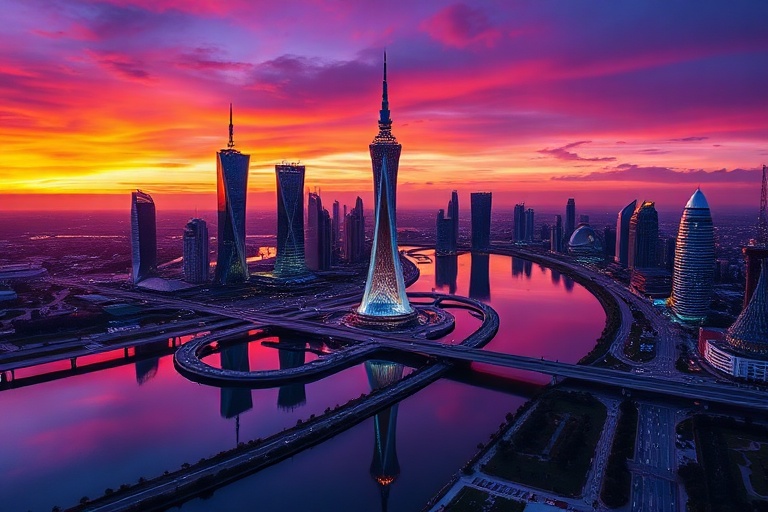
Today, the skyline of Astana is a testament to that vision. The Bayterek Tower, with its golden egg cradled in a glass hand, symbolizes growth and prosperity. The Khan Shatyr Entertainment Center, designed by Norman Foster, resembles a vast white tent—a nod to Kazakhstan’s nomadic heritage. The Palace of Peace and Reconciliation, a pyramid of glass and steel, hosts global dialogues on faith and culture. Each structure is not just functional but ideologically resonant, reinforcing a narrative of unity, peace, and progress.
Astana as a Diplomatic and Economic Hub
Astana’s significance extends far beyond its modern skyline. As Kazakhstan’s political and administrative heart, it serves as the venue for high-stakes international negotiations. The city has hosted the Eurasian Economic Union summits, the Conference on Interaction and Confidence-Building Measures in Asia (CICA), and multiple rounds of talks on Syria. Its neutral status and well-developed infrastructure make it an ideal mediator in regional conflicts.
Economically, Astana functions as a magnet for investment and talent. The Astana International Financial Centre (AIFC), launched in 2018, operates under English common law and offers tax incentives to attract global businesses, particularly in fintech, energy, and logistics. The AIFC’s presence has positioned Astana as a financial gateway between Europe and Asia, competing with Dubai and Singapore for influence in the Eurasian economic space.
The city is also a center for innovation. The EXPO 2017 exhibition, themed “Future Energy,” brought together over 100 countries and millions of visitors, showcasing Kazakhstan’s commitment to sustainable development and green technology. The legacy of EXPO lives on in the Nur Alem sphere and the development of the EXPO City district, now a hub for tech startups and research centers.
Despite its relatively small population of around 1.3 million, Astana punches above its weight. It is a city where embassies, multinational corporations, and cultural institutions coexist alongside traditional Kazakh communities. This blend creates a unique atmosphere—one of cosmopolitan energy tempered by Central Asian warmth and hospitality.
Cultural Identity and Social Dynamics in a New Capital
Astana is more than a political or economic center; it is a cultural crossroads. The city’s population is diverse, with Kazakhs forming the majority, followed by Russians, Koreans, Tatars, Uzbeks, and Ukrainians. This multicultural fabric is reflected in the city’s festivals, cuisine, and arts scene. The annual Astana Opera, the Tselinograd Film Festival, and the Eurasia Film Festival draw international artists, reinforcing the city’s role as a cultural bridge between continents.
Yet, Astana’s rapid modernization has not been without challenges. Critics argue that the city’s futuristic architecture sometimes overshadows the preservation of Kazakh heritage. While traditional motifs appear in buildings like the Hazrat Sultan Mosque, critics point out that Astana’s identity is still being negotiated—between global modernity and local tradition, between Soviet-era infrastructure and post-independence ambition.
Socially, Astana faces issues common to rapidly growing cities: housing demand, traffic congestion, and rising living costs. The government has responded with large-scale housing projects like the Khan Yelis microdistrict, designed to create sustainable, community-oriented neighborhoods. Still, balancing growth with livability remains an ongoing challenge.
The city’s youthful energy is palpable. Home to Nazarbayev University, Astana Medical University, and numerous vocational colleges, the city attracts students from across Central Asia. This intellectual hub fosters a generation of young professionals who see Astana not just as a capital, but as a place to build careers and shape the nation’s future.
What’s Next for Astana?
Looking forward, Astana faces both opportunities and responsibilities. As Kazakhstan pursues reforms under President Kassym-Jomart Tokayev, Astana’s role as a stabilizing force will be tested. The government’s decentralization policies aim to strengthen regional development, reducing reliance on the capital. Yet, Astana remains indispensable as a symbol of national unity and progress.
The city is also preparing for another global spotlight: Astana will co-host the 2023 IIHF Ice Hockey World Championship and is bidding to host major sporting and cultural events in the coming decade. These events are not just about tourism—they are about reinforcing Kazakhstan’s place in the global community.
Environmentally, Astana is working to adapt to its harsh climate. Winters are long and bitter, summers short but intense. Urban planners are incorporating green technologies, such as solar-powered streetlights and energy-efficient buildings, to reduce the city’s carbon footprint. The goal is to make Astana a model of sustainable urban living in a continental climate.
Perhaps most importantly, Astana is learning to balance its global aspirations with local realities. The city’s identity is still being written. Will it remain a showcase of state-led modernity, or will it evolve into a truly organic, inclusive metropolis? The answer may well define Kazakhstan’s next chapter.
Key Takeaways About Astana
- Rapid Transformation: From a small town to a futuristic capital in 25 years, driven by deliberate state policy.
- Geopolitical Role: Hosts major international summits and serves as a neutral ground for diplomacy in Central Asia.
- Economic Engine: Home to the Astana International Financial Centre, attracting global investment and fostering innovation.
- Cultural Fusion: A blend of Kazakh, Russian, and international influences, reflected in architecture, food, and arts.
- Challenges Ahead: Balancing rapid growth with sustainability, heritage preservation, and social equity.
Astana is more than a capital. It is a statement—a declaration that a nation, once part of a vast empire, now stands on its own with confidence and creativity. In its gleaming towers and wide avenues, one can read the ambitions of a people who have chosen not just to inhabit a city, but to redefine what a capital can be in the 21st century.
As Kazakhstan continues to navigate its path between tradition and modernity, between East and West, Astana remains its most visible testament to the future it is building—one skyscraper, one dialogue, one innovation at a time.
“Astana is not just a city. It is a project—a living, breathing testament to what a nation can become when it dares to dream in steel and glass, and in the hearts of its people.” — Adapted from remarks by Kazakhstan’s First President, Nursultan Nazarbayev
For travelers, investors, and observers alike, Astana offers a compelling case study in nation-building. It challenges the idea that modernity must come at the cost of identity, and proves that a capital can be both a symbol and a home. In doing so, it invites the world to look beyond stereotypes and see Kazakhstan for what it truly is: a nation on the rise, with its heart beating strong in Astana.
Explore more about Kazakhstan’s global connections and cultural depth on Dave’s Locker Travel and dive into economic trends shaping Central Asia at Dave’s Locker Business.