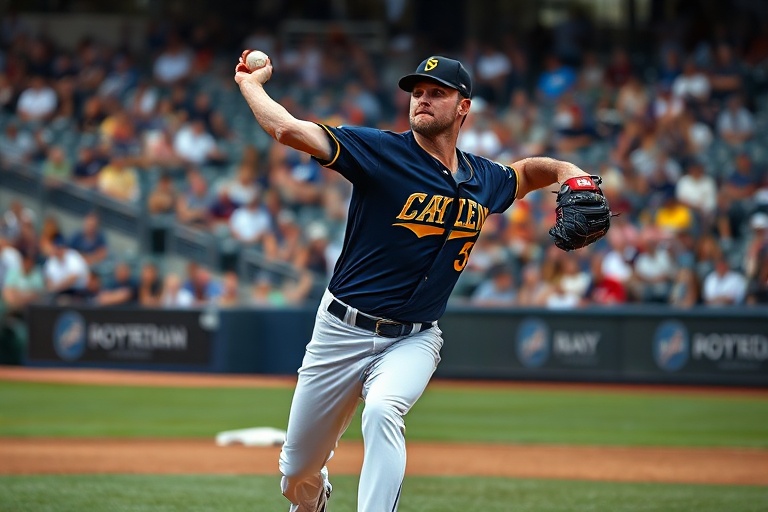
Eric Lauer has quietly emerged as one of baseball’s most intriguing pitchers, defying early career expectations to become a cornerstone of the Milwaukee Brewers’ rotation. Once a highly touted prospect whose development seemed stalled, Lauer has reinvented himself through mechanical adjustments, pitch sequencing, and a renewed focus on command. His trajectory offers a case study in adaptation—one that extends beyond individual performance to influence broader trends in player development and team strategy.
The Early Years: From Prospect Hype to MLB Reality
Selected 25th overall by the San Diego Padres in the 2016 MLB Draft, Lauer arrived in the majors with the kind of pedigree that commands attention. A left-handed starter with a four-pitch mix and a mid-90s fastball, he was projected as a future frontline arm. Yet his first few seasons were uneven, marked by inconsistency and a tendency to allow too many hard-contact plays. By 2019, questions lingered about his long-term role—whether he’d remain a starter or slide into relief.
Lauer’s breakthrough began in earnest during the pandemic-shortened 2020 season. Working with new pitching coach Ruben Niebla, he refined his slider, tightened his fastball command, and embraced a more aggressive approach against left-handed hitters. The results were immediate: a 3.19 ERA in 2021, followed by a 2.40 mark in 2022, despite a shoulder injury that sidelined him for part of the latter year. Those performances didn’t just stabilize his career—they redefined what he could offer.
Mechanical Evolution: The Pitching Overhaul
Lauer’s transformation wasn’t cosmetic. It was rooted in measurable changes:
- Lower Release Point: By dropping his arm angle slightly, Lauer increased deception, making his pitches harder to pick up out of his hand. The adjustment disrupted hitters’ timing without sacrificing velocity.
- Slider Optimization: Once a secondary pitch, his slider became his most effective weapon, generating whiffs at a career-high 38% rate in 2023. The pitch’s movement profile—tunneling with his fastball—created deception that neutralized left-handed hitters.
- Fastball Command: Lauer’s four-seamer, once hit hard when left up in the zone, became a precision tool. He located it down and away to righties and up-and-in to lefties, using it to set up his offspeed pitches.
These tweaks weren’t revolutionary, but they were surgical. They reflect a growing trend in MLB: pitchers no longer need to overpower hitters to succeed. Instead, they leverage analytics, biomechanics, and pitch design to exploit weaknesses.
Milwaukee’s Calculated Bet and Its Ripple Effects
In December 2022, the Brewers acquired Lauer in a trade with the Padres, sending outfielder Hunter Renfroe in exchange. The deal was met with cautious optimism. Lauer wasn’t a household name, but Milwaukee’s front office saw potential in his newfound consistency. The gamble paid off. In 2023, Lauer posted a 3.22 ERA over 175 innings, striking out 160 batters while walking just 48—career bests in both strikeout-to-walk ratio and WHIP (1.13).
The acquisition underscored a shift in how teams value pitchers. Gone are the days when velocity alone dictated contracts. Clubs now prioritize pitchers who can limit damage through sequencing, location, and pitch mix. Lauer’s success has made him a prototype for the modern mid-rotation starter: durable, adaptable, and analytically sound.
The Broader Implications for Pitching Development
Lauer’s career arc highlights three key trends reshaping baseball:
- Analytics-Driven Refinements: Teams increasingly rely on TrackMan and Rapsodo data to identify micro-adjustments. Lauer’s slider gains, for instance, were tied to optimizing spin efficiency, a metric that correlates with swing-and-miss rates.
- Pitch Design as a Lifeline: For pitchers without elite velocity, pitch design has become a survival tool. Lauer’s ability to manipulate his slider’s shape and tunnel with his fastball demonstrates how marginal gains can add up to significant run prevention.
- Organizational Patience: The Brewers’ willingness to wait out Lauer’s development reflects a broader industry trend. Clubs are more willing to invest in young arms through trial and error, provided there’s tangible progress.
These shifts aren’t limited to Lauer alone. They’re part of a league-wide evolution where pitchers are treated less like fixed assets and more like adjustable tools. The result is a pitching landscape where control, command, and adaptability often outweigh raw stuff.
What’s Next for Eric Lauer?
At 28, Lauer is entering his prime. The Brewers have locked him in with a five-year, $85 million contract extension signed in 2023, signaling their commitment to building around him. The next phase of his career will test whether his 2023 performance was a fluke or the start of something sustainable.
Several factors will determine his trajectory:
- Durability: Can he maintain his innings load without succumbing to injury? His 2022 shoulder strain was a reminder of the fragility of pitchers.
- Adaptability: How will hitters adjust to his pitch mix as scouting reports become more comprehensive? Lauer’s reliance on his slider may invite counter-strategies.
- Team Context: The Brewers’ offense ranked 12th in MLB in 2023. If Milwaukee improves its lineup, Lauer could benefit from more run support and lower pressure to be perfect every start.
For now, Lauer remains a compelling figure—not because of his draft pedigree or his flashy stats, but because of how he got here. His story is a testament to the value of incremental improvement in a sport obsessed with the next big thing. It’s also a blueprint for how pitching success is increasingly defined.
“Eric represents the kind of pitcher who thrives in today’s game: one who blends old-school fundamentals with modern analytics. His resurgence isn’t just about him—it’s about how the game is changing.” — Baseball Prospectus analyst
As the 2024 season approaches, all eyes will be on Lauer. Not because he’s a superstar, but because his journey embodies the new metrics of pitching success. In a league where home runs dominate headlines, Lauer’s ability to limit damage through precision is a quiet revolution—one that might just redefine what it means to be a great starting pitcher.
For more on pitching development and MLB trends, visit Dave’s Locker Sports.
Explore deeper analyses of player transformations at Dave’s Locker Analysis.