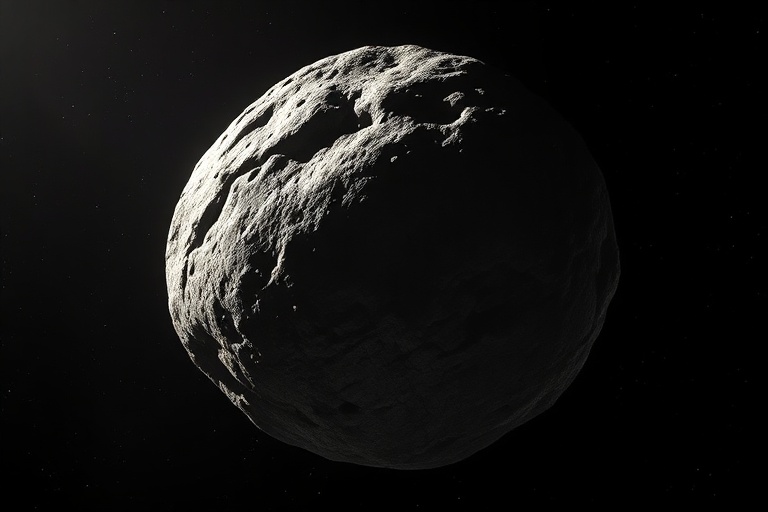
Asteroids: Ancient Rocks Holding Earth’s Past and Future
“`html
Understanding Asteroids: The Solar System’s Ancient Relics
Asteroids are rocky remnants from the early formation of our solar system, dating back over 4.6 billion years. These celestial objects, often referred to as minor planets, vary in size from tiny pebbles to massive bodies hundreds of miles in diameter. Unlike planets, asteroids lack the gravitational strength to form a spherical shape, leaving them irregular and fragmented. They primarily orbit the Sun in the asteroid belt, a region located between Mars and Jupiter, though some follow eccentric paths that bring them closer to Earth.
Scientists classify asteroids based on their composition, which provides clues about their origins. The three main types are:
- C-type (carbonaceous): These make up about 75% of known asteroids and are rich in carbon compounds. They are dark and difficult to observe, often found in the outer regions of the asteroid belt.
- S-type (silicaceous): Comprising about 17% of asteroids, these are composed of silicate minerals and nickel-iron. They are brighter and more reflective, commonly found in the inner asteroid belt.
- M-type (metallic): These asteroids are primarily made of metals like nickel and iron. They are relatively rare and often found in the middle regions of the asteroid belt.
Understanding these classifications helps researchers piece together the history of our solar system and the processes that shaped the planets we see today.
The Threat and Opportunity of Near-Earth Objects
While most asteroids remain safely tucked away in the asteroid belt, a subset known as Near-Earth Objects (NEOs) pose a unique challenge and opportunity. NEOs are asteroids or comets whose orbits bring them within 1.3 astronomical units (AU) of the Sun, meaning they can come within 0.3 AU of Earth’s orbit. NASA’s Center for Near-Earth Object Studies (CNEOS) tracks thousands of these objects, assessing their potential risk of impact.
The most infamous NEO in recent memory is the Chelyabinsk meteor, which exploded over Russia in 2013. The meteor, estimated to be about 20 meters in diameter, released energy equivalent to 500 kilotons of TNT, injuring over 1,500 people and causing significant property damage. Events like these underscore the importance of tracking and studying NEOs to mitigate future risks.
However, NEOs aren’t just a threat—they also hold potential for scientific discovery and even economic benefit. Some asteroids contain valuable metals like platinum, gold, and rare earth elements, sparking interest from companies and governments alike. For instance, the asteroid 16 Psyche is thought to be composed almost entirely of metal, with an estimated value of $10,000 quadrillion. While mining an asteroid remains a distant goal, the technology to study and potentially harness these resources is advancing rapidly.
Planetary Defense: Protecting Earth from Cosmic Hazards
In response to the potential threat posed by NEOs, space agencies worldwide are developing strategies for planetary defense. NASA’s Double Asteroid Redirection Test (DART) mission, launched in 2021, marked a significant milestone in this effort. The mission successfully demonstrated that a spacecraft could alter an asteroid’s trajectory by colliding with it, a technique known as kinetic impactor deflection.
Other proposed methods include gravity tractors, where a spacecraft flies alongside an asteroid for an extended period, using its gravitational pull to gradually change the asteroid’s path. Nuclear deflection, though controversial, remains a last-resort option for larger, more imminent threats. These strategies highlight the growing importance of international collaboration in space exploration and defense.
As technology advances, so too does our ability to detect and respond to potential asteroid impacts. Projects like the Vera C. Rubin Observatory, set to begin operations in 2025, will dramatically improve our ability to spot and track NEOs, giving us more time to prepare for any potential threats.
The Role of Asteroids in Shaping Earth’s History
Asteroids have played a pivotal role in the history of our planet, both as agents of destruction and as sources of life. The most catastrophic event in Earth’s history, the Cretaceous-Paleogene (K-Pg) extinction event 66 million years ago, is widely believed to have been caused by the impact of a massive asteroid. The Chicxulub impactor, estimated to be 10-15 kilometers in diameter, struck what is now the Yucatán Peninsula in Mexico, releasing energy equivalent to billions of atomic bombs. The resulting global climate disruption led to the extinction of 75% of all species, including the non-avian dinosaurs.
Yet, asteroids may also have contributed to the origin of life on Earth. Some scientists theorize that carbonaceous chondrite asteroids, which contain significant amounts of water and organic compounds, delivered the building blocks of life to our planet during its early formation. This theory is supported by the discovery of amino acids and other organic molecules in meteorites found on Earth.
Beyond their impact on biology, asteroids have influenced Earth’s geology and climate in profound ways. The formation of large impact craters, such as the Vredefort Crater in South Africa, has shaped the planet’s surface and left lasting geological features. These events remind us of the dynamic and often violent processes that have shaped our world over billions of years.
Exploring Asteroids: Missions and Future Prospects
The study of asteroids has evolved from mere observation to active exploration, with several groundbreaking missions providing unprecedented insights into these ancient relics. NASA’s Dawn spacecraft, launched in 2007, visited the protoplanets Vesta and Ceres, two of the largest objects in the asteroid belt. These missions revealed that Vesta has a layered structure similar to Earth’s, while Ceres harbors a subsurface ocean and bright salt deposits, hinting at ongoing geological activity.
Japan’s Hayabusa2 mission, which returned to Earth in 2020, collected samples from the asteroid Ryugu, providing scientists with pristine material from the early solar system. Similarly, NASA’s OSIRIS-REx mission successfully collected samples from the asteroid Bennu in 2020 and is scheduled to return them to Earth in 2023. These missions are crucial for understanding the composition and structure of asteroids, as well as their potential role in the delivery of water and organic molecules to Earth.
The future of asteroid exploration looks even more promising, with several missions planned for the coming decade. NASA’s Psyche mission, set to launch in 2023, will explore the metal-rich asteroid 16 Psyche, offering insights into the building blocks of planetary cores. Meanwhile, the European Space Agency’s Hera mission will study the binary asteroid system Didymos, building on the success of NASA’s DART mission.
These missions are not just about scientific discovery—they also pave the way for future human exploration and potential resource utilization. As technology advances, the dream of mining asteroids for valuable metals and water to support deep-space missions becomes increasingly feasible. The knowledge gained from these missions will be instrumental in shaping the next era of space exploration.
Conclusion: The Enduring Legacy of Asteroids
Asteroids are more than just relics of the past—they are active participants in the ongoing story of our solar system. From their role in shaping Earth’s history to their potential to unlock the secrets of life’s origins, these ancient rocks hold answers to some of the most profound questions in science. At the same time, their unpredictable orbits remind us of the dynamic and sometimes hazardous nature of the cosmos.
As we continue to explore and study asteroids, we not only deepen our understanding of the universe but also develop the tools to protect our planet and harness the resources they offer. Whether through groundbreaking missions or innovative planetary defense strategies, the legacy of asteroids is far from over. They remain a testament to the enduring curiosity and ingenuity of humanity as we reach for the stars.
The study of asteroids is a reminder that our solar system is a place of constant change and discovery. By unraveling the mysteries of these ancient objects, we gain not only scientific knowledge but also a greater appreciation for the intricate and interconnected systems that make life on Earth possible.