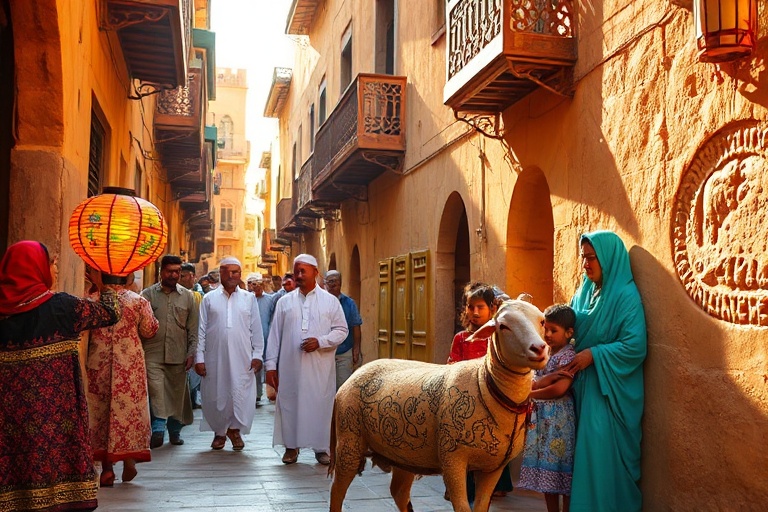
eid al adha 2026
As the Islamic lunar calendar shifts each year, Eid al-Adha arrives on a different date in the Gregorian calendar. In 2026, this significant religious holiday will be observed from the evening of June 26 to the evening of June 27, marking one of the most important periods in the Islamic faith. Unlike fixed-date holidays, Eid al-Adha’s timing depends on the sighting of the moon, which determines when the Hajj pilgrimage concludes and the festival begins.
The holiday commemorates the willingness of the Prophet Ibrahim (Abraham) to sacrifice his son as an act of obedience to God, before being intervened by a divine command providing a ram for sacrifice instead. This narrative, shared across Islamic, Christian, and Jewish traditions, underscores themes of faith, devotion, and divine mercy. For over a billion Muslims worldwide, Eid al-Adha is both a spiritual observance and a time for family, charity, and community.
The Significance of Eid al-Adha in Islamic Tradition
Eid al-Adha, often called the “Festival of Sacrifice,” is the second of two major Islamic holidays, following Eid al-Fitr. While Eid al-Fitr celebrates the end of Ramadan, Eid al-Adha coincides with the conclusion of Hajj, the annual pilgrimage to Mecca that every able-bodied and financially capable Muslim is obligated to perform at least once in their lifetime.
The rituals of Eid al-Adha are deeply rooted in scripture and tradition. On the first morning of the holiday, Muslims attend special congregational prayers known as Salat al-Eid, often held in mosques, open fields, or large halls. These prayers are followed by a sermon and supplications for peace and prosperity. The day is marked by the act of Qurbani, or the ritual sacrifice of an animal—typically a sheep, goat, cow, or camel—whose meat is divided into three parts: one for family, one for friends and neighbors, and one for the poor and needy.
This act of sharing meat symbolizes generosity and compassion, reinforcing the Islamic principle of caring for those less fortunate. It also connects worshippers directly to the story of Ibrahim, whose ultimate submission to God’s will is mirrored in the believer’s willingness to give up something valuable in devotion.
“And when they had both submitted [to the command of Allah] and he put him down upon his forehead, We called to him, ‘O Ibrahim, You have already fulfilled the vision. Indeed, We thus reward the doers of good.’” — Quran 37:103-105
Global Observances: From Mecca to Main Street
Eid al-Adha is celebrated across continents, from the deserts of Arabia to the urban centers of Europe, Asia, and the Americas. In Saudi Arabia, where Hajj takes place, millions of pilgrims gather in Mecca and Medina, creating a scene of profound unity. The city becomes a sea of white-robed pilgrims circling the Kaaba, the holiest site in Islam, while millions more observe the holiday from afar.
In Muslim-majority countries like Indonesia, Pakistan, Bangladesh, and Malaysia, Eid al-Adha is a public holiday marked by festive gatherings, family visits, and communal meals. In Indonesia, known for its diverse cultural expressions, the holiday is celebrated with regional traditions such as the ketupat (rice dumplings) and the Idul Adha prayer in open fields called lapangan. In Pakistan, the day begins with early morning prayers, followed by the sacrifice of animals in designated slaughterhouses, with meat distributed widely through community networks.
In non-Muslim-majority countries, Muslim communities adapt their celebrations to local contexts. In the United Kingdom, for example, Eid al-Adha is increasingly recognized in public life, with major cities hosting large prayer gatherings in stadiums and public parks. In Canada and the United States, mosques and Islamic centers organize prayer services, potlucks, and charity drives, often inviting neighbors of other faiths to join in the spirit of fellowship.
Technology has also transformed how Eid is observed globally. Live streams of Hajj rituals and Eid prayers in Mecca allow Muslims in remote locations to participate virtually. Social media platforms fill with festive greetings, recipe sharing, and calls for charitable donations, creating a digital tapestry of global Muslim identity.
Key Observances Around the World
- Saudi Arabia: Hajj culminates in Eid prayers at Masjid al-Haram in Mecca, with animal sacrifices coordinated through licensed organizations.
- Turkey: Known as Kurban Bayramı, families gather for special meals featuring dishes like kavurma (roasted meat) and exchange visits with relatives.
- India & Pakistan: Qurbani is performed after Eid prayers, with meat distributed to the poor through local charities and mosques.
- South Africa: Muslim communities in Cape Town and Johannesburg host large prayer gatherings and cultural festivals, reflecting the country’s multicultural fabric.
- Australia: Eid prayers are held in major cities, with multicultural food festivals showcasing halal cuisine from diverse backgrounds.
Charity and Community: The Heart of Eid al-Adha
Charity, or sadaqah, is a central pillar of Eid al-Adha. The act of Qurbani is not merely ritualistic; it is an obligation that ensures no Muslim goes without food during the holiday. In many countries, charitable organizations set up slaughter points and distribution centers to ensure the meat reaches vulnerable populations efficiently.
In 2026, global humanitarian organizations are preparing to scale up their efforts, anticipating increased demand due to economic challenges in regions like Yemen, Syria, and Afghanistan. Campaigns such as “Adopt a Family” and “Feed the Needy” are launched weeks in advance, allowing donors worldwide to contribute financially or through meat donations.
This emphasis on charity reflects a broader Islamic ethos of social justice. The Quran emphasizes the importance of feeding the poor, stating, “And they give food in spite of love for it to the needy, the orphan, and the captive” (Quran 76:8). During Eid, this principle becomes a lived reality, as communities mobilize to support one another.
Preparing for Eid: A Cultural and Spiritual Journey
In the weeks leading up to Eid al-Adha, Muslims around the world engage in spiritual preparation. This includes increased acts of worship, charitable giving, and self-reflection. Families clean and decorate their homes, purchase new clothes, and prepare traditional sweets such as ma’amoul (date-filled cookies) in the Middle East or sheer khurma (vermicelli pudding) in South Asia.
In some cultures, the days before Eid are marked by the custom of henna application, especially among women and children. In Morocco, for instance, intricate henna designs are applied as symbols of joy and protection. In Somalia, families prepare canjeero (fermented flatbread) and maraq (soup) for communal meals.
For pilgrims returning from Hajj, the days leading up to Eid are a time of reflection and storytelling. They share experiences of spiritual renewal, the challenges of the journey, and the blessings of completing one of Islam’s Five Pillars. These narratives travel back to communities, reinforcing the global bonds of faith.
As Eid al-Adha 2026 approaches, Muslims worldwide will unite in prayer, sacrifice, and generosity, transcending geographical and cultural boundaries. The holiday serves as a reminder of shared values—faith, compassion, and solidarity—that resonate far beyond the Muslim world.
Whether in the bustling streets of Cairo, the quiet neighborhoods of Detroit, or the remote villages of Bangladesh, the spirit of Eid al-Adha will be felt. It is a time to give thanks, to give back, and to give together—echoing a tradition as old as humanity itself.
Looking Ahead: Eid in a Changing World
As climate change and geopolitical tensions affect global food security, the principles of Eid al-Adha—sustainability, sharing, and collective responsibility—gain new relevance. Organizations are increasingly advocating for ethical animal welfare practices and sustainable Qurbani programs that minimize environmental impact.
Moreover, interfaith dialogue continues to grow, with many communities inviting neighbors to learn about Eid traditions through shared meals and educational events. These interactions foster mutual understanding and strengthen social cohesion in increasingly diverse societies.
For Muslims, Eid al-Adha remains a beacon of hope and renewal. It is a moment to pause, reflect, and reconnect—not just with family, but with the broader human family. In 2026, as the world faces new challenges, the message of Eid will be more important than ever: that sacrifice, when rooted in love and justice, leads to healing and wholeness.
As the sun sets on June 27, 2026, marking the end of Eid al-Adha, Muslims will carry the blessings of the holiday into the year ahead—carrying forward the spirit of faith, generosity, and unity that defines this sacred time.
Related Coverage
Explore more about Islamic traditions and global religious observances on Culture.
Learn about the history and significance of Hajj in our Religion section.