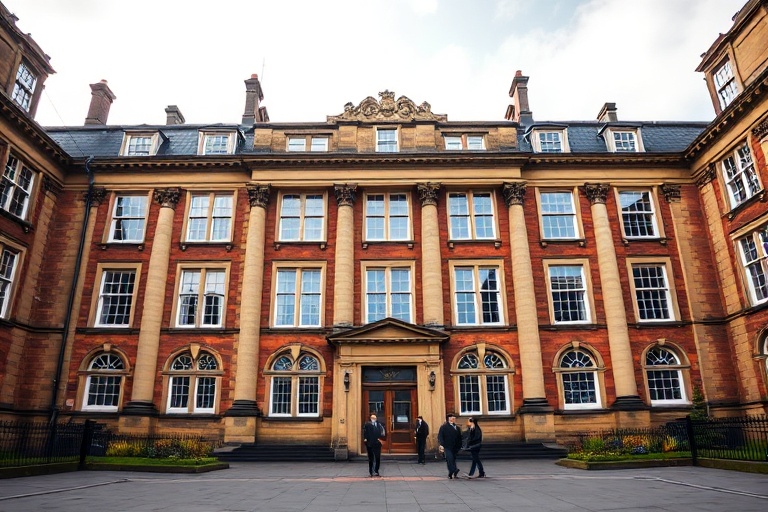
Founded in the heart of Glasgow in 1641, Hutchesons’ Grammar School stands as one of Scotland’s oldest and most prestigious educational institutions. Its origins trace back to the bequest of two wealthy merchants, George Hutcheson and his brother Thomas, who left funds in their wills to establish a school for “the education and instruction of youth.” Over nearly four centuries, the school has evolved from a modest foundation into a globally recognized center of academic excellence, producing generations of influential alumni across diverse fields.
What began as a philanthropic endeavor in the 17th century has grown into an institution that reflects Scotland’s broader educational traditions—balancing rigorous scholarship with a commitment to accessibility. While many historic schools in Europe were initially reserved for elite classes, Hutchesons’ from its earliest days admitted students based on merit rather than wealth, a principle that remains central to its identity today. This ethos has allowed the school to nurture talent across social boundaries, contributing to Scotland’s reputation as a pioneer in public education.
A Historical Foundation Rooted in Community and Charity
The Hutcheson brothers were prominent figures in Glasgow during a period of economic and cultural transformation. George Hutcheson, a successful merchant and magistrate, and Thomas, a shipowner and trader, both recognized the need for accessible education in a rapidly growing city. Their bequest stipulated that the school should serve “the children of honest poor parents” as well as those able to pay fees—a rare dual-purpose model at the time.
The original school was located near the Trongate, a key commercial hub in medieval Glasgow. By 1788, it moved to a purpose-built building in the city center, designed by architect William Hamilton. This new facility featured a grand classical façade and accommodated hundreds of students. The school’s motto, Virtus in Arduis (“Courage in Difficulties”), was adopted early and continues to guide its educational philosophy.
In the 19th century, Hutchesons’ expanded its curriculum beyond the traditional classical subjects to include modern languages, science, and mathematics—a reflection of the industrial age’s demands. This adaptability helped the school maintain its relevance during a time when education systems across Britain were being reshaped by social reform and technological change.
Educational Philosophy: Tradition Meets Modernity
Hutchesons’ Grammar School has long been celebrated for its academic rigor, but its approach to education extends beyond examination results. The school emphasizes character development, leadership, and service to the community—values deeply embedded in Scotland’s civic culture. The house system, introduced in the early 20th century, fosters teamwork and healthy competition, mirroring the residential college systems found in elite institutions like Eton or Westminster, yet with a distinctly Scottish emphasis on collective achievement.
In recent decades, Hutchesons’ has embraced progressive educational trends while retaining its historic identity. Digital literacy is integrated into the curriculum from the junior years, preparing students for a globally connected world. Environmental sustainability has also become a priority, with the school implementing eco-friendly initiatives such as solar panel installations and a comprehensive recycling program. These modern adaptations reflect a broader shift in independent schools worldwide, where tradition and innovation coexist.
The school’s pastoral care system is another cornerstone of its philosophy. Recognizing that academic success depends on emotional and social well-being, Hutchesons’ employs a network of tutors, counselors, and mentors. This holistic approach has been particularly praised in an era when mental health in education has become a global concern.
Global Influence and Alumni of Distinction
Hutchesons’ alumni—known as “Old Hutchesonians”—include some of Scotland’s most celebrated figures. Among them are scientists, artists, politicians, and athletes who have left indelible marks on both national and international stages. The school’s network of former students has fostered lifelong connections, creating a global community that extends far beyond Glasgow.
Notable graduates include:
- John Logie Baird (1888–1946) – Pioneer of television technology, credited with inventing the first working television system.
- Tom Weir (1914–2006) – Renowned mountaineer and writer, known for his exploration of the Scottish Highlands and beyond.
- Alasdair Cochrane – Philosopher and academic specializing in animal ethics, currently Professor of Political Theory at the University of Sheffield.
- Sir Harry Burns – Former Chief Medical Officer for Scotland, renowned for his work on public health and social determinants of health.
- Kirsty Wark – Acclaimed journalist and presenter, best known for her work on BBC’s Newsnight and cultural programs.
The diversity of these alumni highlights the school’s ability to nurture talent across disciplines. From the arts to the sciences, from exploration to public service, Hutchesons’ has produced individuals who have shaped global conversations. This legacy has contributed to Scotland’s soft power, reinforcing the country’s image as a hub of intellectual and creative energy.
Challenges and the Future: Adapting Without Losing Identity
Like many historic institutions, Hutchesons’ faces modern challenges. Declining birth rates in Scotland have led to increased competition among independent schools for students. Economic pressures have also made tuition fees a barrier for some families, despite the school’s bursary programs. In response, Hutchesons’ has expanded its financial aid offerings, ensuring that socioeconomic background does not limit access to its education.
Another challenge is maintaining a balance between tradition and innovation. While the school’s historic buildings and customs are cherished, there is a need to modernize infrastructure and teaching methods. Recent investments in STEM facilities, including a state-of-the-art science center, demonstrate the school’s commitment to staying at the forefront of educational technology.
Looking ahead, Hutchesons’ Grammar School appears well-positioned to continue its legacy. Its global alumni network, strong academic reputation, and commitment to inclusive excellence provide a solid foundation. The school is also exploring international partnerships, particularly in Asia and North America, where there is growing interest in British-style independent education.
As Scotland navigates its post-independence political landscape and redefines its role within the United Kingdom and Europe, institutions like Hutchesons’ play a subtle but vital role in shaping civic identity. They serve as living links to the past while preparing students to engage with a rapidly changing world.
Conclusion: A Living Legacy in a Changing World
Hutchesons’ Grammar School is more than a relic of the 17th century; it is a dynamic institution that has continuously evolved while preserving its core values. Its story mirrors Scotland’s own journey—balancing tradition with progress, community with excellence, and local roots with global reach.
In an era where education systems are increasingly standardized, Hutchesons’ offers a reminder of the enduring power of individualized learning and character development. It stands as a testament to the vision of its founders, the resilience of its community, and the potential of every student who walks through its doors.
As it approaches its 400th anniversary, Hutchesons’ Grammar School remains not just a school, but a living institution—one that continues to inspire, challenge, and adapt in the pursuit of knowledge and virtue.