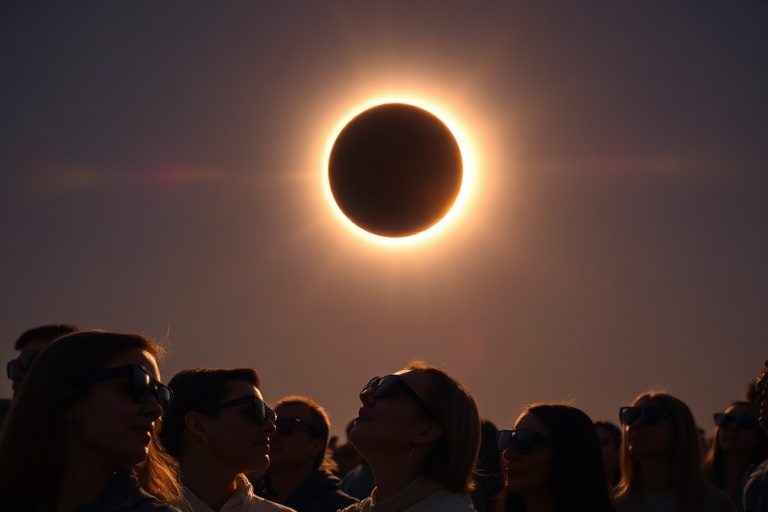
The Fascinating World of Solar Eclipses: Types and Significance
Understanding Solar Eclipses
A solar eclipse occurs when the Moon passes between the Earth and the Sun, blocking the Sun’s light either partially or completely. This astronomical phenomenon can be awe-inspiring, drawing attention from scientists and the general public alike. Eclipses have been observed for centuries, often steeped in mythology and superstition. Today, however, they are appreciated for their scientific significance and beauty.
Types of Solar Eclipses
There are three primary types of solar eclipses, each with distinct characteristics:
- Total Solar Eclipse: This occurs when the Moon completely covers the Sun, casting a shadow on Earth. Observers in the path of totality experience a dramatic drop in light and temperature.
- Partial Solar Eclipse: In this case, only a portion of the Sun is obscured by the Moon. Observers outside the path of totality will witness this type of eclipse.
- Annular Solar Eclipse: This happens when the Moon is too far from Earth to completely cover the Sun. As a result, a ring of sunlight is visible around the Moon.
Significance of Solar Eclipses
Solar eclipses hold great importance in both scientific research and cultural contexts. From the perspective of astronomy, they provide unique opportunities to study the Sun’s corona and solar atmosphere. Scientists can gather data regarding solar flares and other phenomena that could impact Earth’s weather and satellites.
Culturally, solar eclipses have inspired countless myths and legends. In many ancient civilizations, they were seen as omens or messages from the divine. Even today, many communities celebrate eclipses with festivals and gatherings, emphasizing the human connection to celestial events.
Upcoming Solar Eclipses and Their Implications
As we look forward to upcoming solar eclipses, it is essential to consider their implications on various fronts:
- Scientific Research: Each eclipse offers a chance for researchers to observe the Sun in ways that are not possible under normal circumstances. This can lead to significant advancements in solar physics.
- Public Engagement: Eclipses can spark interest in astronomy and science among the general public. Educational programs and viewing events can promote awareness of celestial phenomena.
- Technological Advancements: The technology developed for observing eclipses often spills over into other fields, providing benefits in areas such as imaging and data analysis.
For more information on upcoming celestial events, you can visit our Science category page. For a broader look at the implications of solar events, check our News category.
Conclusion
Solar eclipses are not merely spectacular visual events; they are significant occurrences that offer insights into the workings of our solar system. From their scientific implications to their cultural significance, eclipses continue to captivate people worldwide. As we prepare for future eclipses, it is essential to appreciate their multifaceted nature and the excitement they bring to both the scientific community and the general public.