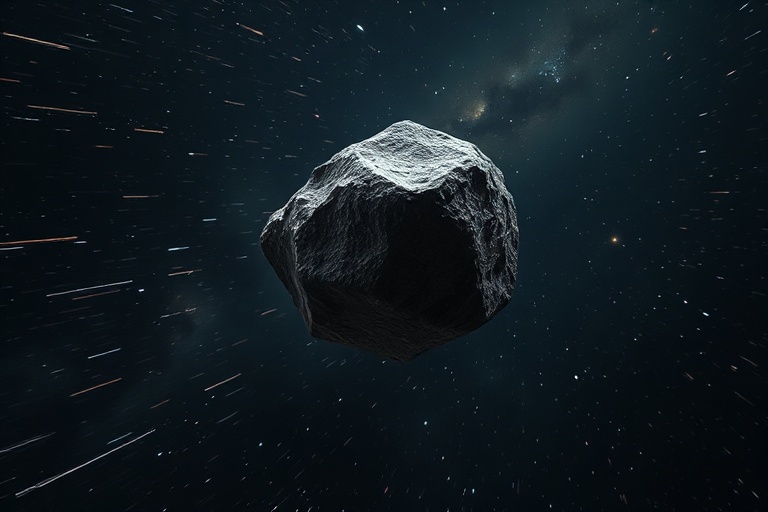
Asteroid 2026 JH2: Tracking a Near-Earth Space Rock
“`html
Discovery and Initial Observations
Asteroid 2026 JH2 first appeared on astronomers’ radar in March 2026, detected by the Pan-STARRS telescope in Hawaii. Initial calculations placed it within the Apollo group of near-Earth objects, a classification that includes some of the most closely monitored space rocks due to their orbits crossing Earth’s path. Early observations suggested a diameter of approximately 300 meters, making it large enough to cause regional damage if an impact were to occur.
NASA’s Center for Near-Earth Object Studies (CNEOS) quickly classified 2026 JH2 as a “Potentially Hazardous Asteroid” (PHA). This designation isn’t meant to incite panic but rather to prioritize tracking efforts. The asteroid’s orbit brings it within 0.05 astronomical units (about 4.6 million miles) of Earth, a proximity that warrants continuous observation. While this distance seems vast, it’s close enough in cosmic terms to justify the attention.
Global Monitoring and Scientific Collaboration
The international response to asteroid 2026 JH2 highlights the growing cooperation among space agencies. Observatories in Europe, Asia, and the Americas have contributed data to refine its trajectory. The European Space Agency’s Near-Earth Object Coordination Centre (NEOCC) and China’s Purple Mountain Observatory have both played key roles in tracking its movements.
Scientists use a combination of optical telescopes and radar systems to monitor 2026 JH2. Radar observations, conducted by facilities like NASA’s Goldstone Deep Space Communications Complex, provide precise measurements of its size, shape, and rotation. These details help researchers assess whether the asteroid could fragment upon entering Earth’s atmosphere or if it might survive to strike the surface.
Key Observatories Tracking 2026 JH2
- Pan-STARRS (Hawaii, USA): Initial discovery and ongoing tracking
- Goldstone Observatory (California, USA): Radar measurements and shape analysis
- NEOCC (Italy): Coordination of European observation efforts
- Purple Mountain Observatory (China): Optical tracking and data sharing
- Siding Spring Observatory (Australia): Southern hemisphere observations
Cultural Impact and Public Awareness
The announcement of asteroid 2026 JH2’s discovery coincided with a renewed global interest in planetary defense. Films, documentaries, and social media discussions have amplified public awareness about near-Earth objects. While Hollywood has often dramatized asteroid impacts, organizations like NASA and the ESA have worked to provide accurate, reassuring information about the actual risks posed by 2026 JH2.
In Japan, where asteroid monitoring has been a focus since the 2013 Chelyabinsk event, media outlets have covered 2026 JH2 extensively. The country’s space agency, JAXA, has been particularly active in sharing updates with the public. Meanwhile, in Europe, museums and science centers have incorporated the asteroid into educational programs, using it as a case study for discussing space exploration and planetary protection.
Public Engagement Initiatives
- NASA’s Asteroid Watch: Regular updates and educational resources on their website
- ESA’s Space Safety Programme: Public webinars and Q&A sessions with scientists
- JAXA’s Hayabusa2 Extension: Social media campaigns highlighting asteroid research
- Local Astronomy Clubs: Star parties and observation events worldwide
Future Trajectory and Mitigation Strategies
Current projections indicate that asteroid 2026 JH2 will make its closest approach to Earth in June 2028. While the probability of impact remains low—estimated at less than 1 in 10,000—scientists continue to refine their calculations as new data becomes available. The asteroid’s orbit is influenced by gravitational interactions with Mars and Jupiter, which can alter its path over time.
In preparation for potential future threats, several space agencies are developing mitigation strategies. NASA’s DART mission, which successfully altered the orbit of a small asteroid in 2022, has provided valuable data. The ESA’s Hera mission, launched in 2024, is studying the aftermath of the DART impact to better understand deflection techniques. These efforts are part of a broader planetary defense strategy that includes 2026 JH2 as a test case.
One promising approach involves using kinetic impactors to change an asteroid’s trajectory. Another concept, still in theoretical stages, involves gravity tractors—spacecraft that would fly alongside an asteroid, using their gravitational pull to gradually alter its path. While 2026 JH2 doesn’t pose an immediate threat, studying it helps scientists prepare for more dangerous objects that may be discovered in the future.
Potential Deflection Techniques Being Studied
- Kinetic Impactors: High-speed spacecraft collisions to alter trajectory
- Gravity Tractors: Spacecraft maintaining position near the asteroid to exert gravitational pull
- Nuclear Explosives: Last-resort option for large, threatening asteroids
- Laser Ablation: Using focused lasers to vaporize surface material and create thrust
- Solar Sails: Attaching reflective sails to the asteroid to harness solar radiation pressure
Conclusion: A Reminder of Our Place in the Universe
Asteroid 2026 JH2 serves as a reminder of both the wonders and the potential dangers of our solar system. While its discovery has generated scientific interest and public curiosity, it also underscores the importance of continued investment in space exploration and planetary defense. The global collaboration surrounding this object demonstrates humanity’s growing ability to work together on existential challenges.
For now, the asteroid remains a subject of careful observation rather than concern. Its study has advanced our understanding of near-Earth objects and improved our preparedness for future threats. As technology advances, so too will our ability to detect, track, and potentially deflect dangerous asteroids. In the meantime, 2026 JH2 offers a fascinating glimpse into the dynamic and sometimes unpredictable nature of our cosmic neighborhood.
For those interested in following space exploration and planetary defense efforts, Dave’s Locker’s Science section provides regular updates on similar topics. The ongoing monitoring of 2026 JH2 is just one chapter in humanity’s expanding relationship with the cosmos.