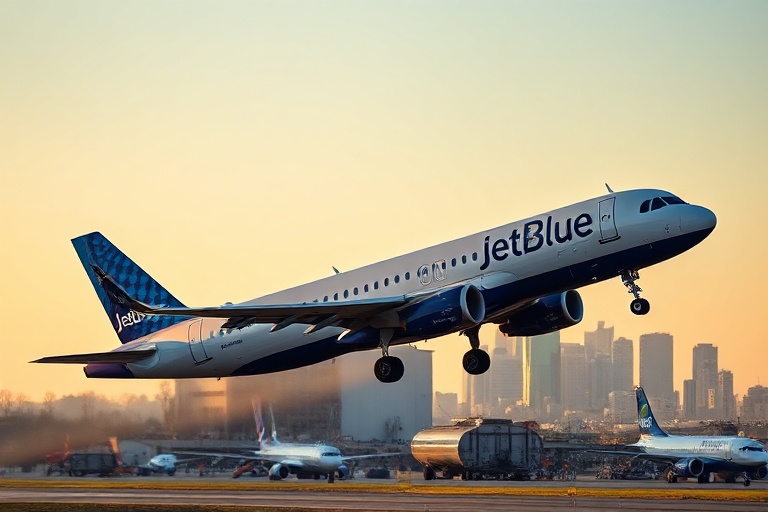
JetBlue Airways: A Fresh Approach to Air Travel in a Changing World
JetBlue Airways has spent over two decades redefining what passengers expect from a domestic airline. Founded in 1998 with a single route between New York and Fort Lauderdale, the carrier quickly distinguished itself through a commitment to comfort, technology, and customer service. Unlike legacy carriers burdened by outdated operational models, JetBlue embraced a modern philosophy—offering free snacks, leather seats, and satellite TV at a time when such amenities were rare in economy class.
Based in New York’s John F. Kennedy International Airport, JetBlue now serves over 100 destinations across the United States, Mexico, the Caribbean, Central America, and South America. Its growth reflects broader shifts in global aviation: the rise of low-cost, high-service carriers challenging traditional hub-and-spoke systems. JetBlue’s story is not just one of business strategy, but of cultural adaptation—balancing affordability with experience in an industry often criticized for nickel-and-diming travelers.
A Culture of Innovation: How JetBlue Redefined Passenger Experience
From its inception, JetBlue positioned itself as an underdog with a mission to improve air travel. The airline was one of the first to introduce in-flight entertainment systems at every seat, including DirecTV programming and SiriusXM radio. This wasn’t merely a perk—it was a statement. In an era when most airlines charged for headphones and barely functional screens, JetBlue made entertainment standard.
The airline also pioneered the use of Embraer E-Jets and Airbus A320 family aircraft, which allowed for quieter cabins, better fuel efficiency, and more consistent service. These choices weren’t just operational—they shaped passenger expectations. Today, even legacy carriers have adopted many of these features, a testament to JetBlue’s influence.
JetBlue’s culture extends beyond the cabin. The airline became known for its customer-first policies, including a 24-hour grace period for flight changes and a transparent fee structure. While other airlines began unbundling services—charging for everything from pillows to water—JetBlue maintained a more holistic view of value. This approach resonated strongly with millennial and Gen Z travelers, who prioritize experience over pure cost savings.
Global Expansion and Strategic Partnerships: Beyond the U.S. Horizon
JetBlue’s international ambitions grew steadily. In 2007, it launched service to Puerto Rico, marking its first non-U.S. destination. Over the years, it expanded into Mexico and the Caribbean, becoming a preferred carrier for leisure travelers heading to beach destinations like Cancún, Punta Cana, and the Bahamas. These routes weren’t just about geography—they reflected cultural ties. With large diaspora communities across the U.S., JetBlue tapped into a natural demand for accessible, affordable travel to cultural homelands.
In 2020, JetBlue took a major step toward global integration by joining the transatlantic market. It launched routes to London from New York and Boston, directly competing with established carriers like British Airways and Virgin Atlantic. This move was more than a business decision—it was a cultural bridge. By offering nonstop flights to Europe, JetBlue enabled easier access for American travelers seeking culture, education, and business opportunities abroad.
JetBlue’s international strategy also includes partnerships. In 2022, it announced an expanded partnership with American Airlines, allowing for codeshare agreements and seamless connections across both networks. While this raised eyebrows among industry observers wary of consolidation, it also signaled JetBlue’s ambition to be a full-service global player without fully merging into a legacy conglomerate.
Challenges and Controversies: Navigating Industry Turmoil
JetBlue’s journey hasn’t been without turbulence. The COVID-19 pandemic devastated the airline industry, forcing JetBlue to ground nearly its entire fleet in early 2020. Unlike some competitors, it avoided mass layoffs and instead focused on preserving jobs and liquidity. This decision reflected its employee-centric culture, where pilots and flight attendants are treated as partners rather than costs.
Yet operational challenges persisted. In early 2023, JetBlue encountered widespread flight cancellations and delays, attributed to staffing shortages and outdated crew scheduling systems. The disruptions sparked frustration among travelers and raised questions about whether JetBlue’s rapid growth had outpaced its operational maturity. The airline responded by investing in technology upgrades and workforce training, but the incident highlighted the fragility of even the most customer-focused carriers in a volatile industry.
JetBlue also faced regulatory hurdles. Its proposed acquisition of Spirit Airlines—a deal aimed at expanding its low-cost segment—was blocked by the U.S. Department of Justice in early 2024. The rejection underscored the increasing scrutiny of airline consolidation and the challenges of balancing growth with antitrust concerns. While JetBlue vowed to appeal, the setback forced a reevaluation of its expansion strategy.
JetBlue in the Cultural Landscape: More Than Just a Flight
JetBlue’s influence extends beyond balance sheets and flight schedules. It has become a cultural fixture in cities where it operates. In New York, for example, JetBlue’s blue-and-white livery is a familiar sight at JFK and LaGuardia, symbolizing accessible travel for a diverse population. In Boston, it’s associated with affordable trips to vacation spots, reinforcing its role as a gateway to leisure and exploration.
The airline has also played a role in shaping travel trends. During the pandemic, JetBlue was among the first to offer free COVID-19 testing for passengers on certain routes, aligning with a growing demand for safety and transparency. Its “Blue Horizons” program, which offers free flights to students and teachers, reflects a commitment to education and community engagement—values that resonate in a society increasingly focused on equity and access.
JetBlue’s story intersects with broader themes in modern travel: the tension between affordability and sustainability, the demand for digital integration, and the importance of cultural connection. As climate concerns grow, JetBlue has committed to achieving net-zero emissions by 2040, investing in sustainable aviation fuel and more efficient aircraft. This positions it not just as a transportation provider, but as a participant in global conversations about the future of mobility.
What’s Next for JetBlue?
JetBlue’s future hinges on several key factors. First is fleet modernization. The airline is gradually retiring older aircraft in favor of the Airbus A220, which offers 20% better fuel efficiency and a quieter cabin. This transition is essential not only for cost control but also for meeting environmental goals and passenger expectations.
Second is route expansion. JetBlue continues to eye new markets in Latin America and potentially Asia, though regulatory and logistical challenges remain. Third is technology. The airline is rolling out digital tools to streamline booking, check-in, and customer service, responding to a generation of travelers who expect seamless, app-based experiences.
Finally, JetBlue must navigate the evolving competitive landscape. Ultra-low-cost carriers like Spirit and Frontier are pushing prices down, while legacy airlines are improving their service models. JetBlue’s challenge is to remain distinctive—not just the cheapest, not just the most comfortable, but a reliable choice that aligns with modern values of transparency, sustainability, and community.
As global travel rebounds post-pandemic, JetBlue stands at a crossroads. It is no longer the scrappy startup that disrupted the industry in the late 1990s, but it remains one of the few airlines that still feels like a disruptor. Its success will depend on whether it can preserve its identity while scaling up—whether it can be both a global carrier and a beloved brand.
For travelers, JetBlue represents something simple yet increasingly rare: a flight that doesn’t feel like a compromise. In a world where air travel is often reduced to a transaction, JetBlue still offers an experience. And in an era where convenience often trumps connection, that matters more than ever.
Whether you’re flying from New York to San Juan or Boston to London, JetBlue invites you to travel not just to a place, but with a sense of possibility. That’s a promise worth remembering the next time you book a flight.