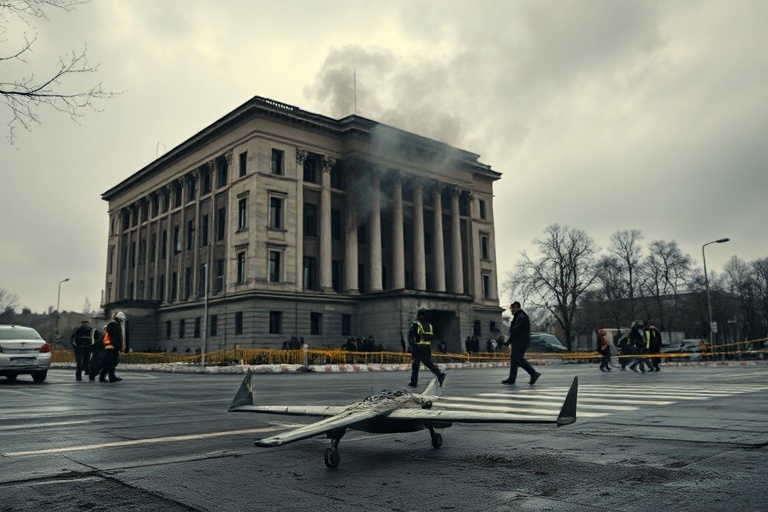
The recent drone strikes on Moscow represent a significant escalation in the ongoing conflict between Ukraine and Russia. These attacks, which have targeted both civilian and military infrastructure, mark a dramatic shift in Ukraine’s military strategy. While drone strikes have occurred sporadically since the invasion began, the direct targeting of Russia’s capital signals a new phase in the war.
On multiple occasions in May and June 2024, Ukrainian drones penetrated Russian airspace, reaching as far as the Moscow region. The strikes caused minor damage to buildings and disrupted daily life in the city. Russian authorities reported intercepting several drones, but some managed to bypass defenses, landing in residential areas. The Kremlin responded with warnings of severe retaliation, though no immediate countermeasures have been publicly confirmed.
The Evolution of Ukraine’s Drone Warfare Capabilities
Ukraine’s drone program has undergone rapid development since Russia’s full-scale invasion in 2022. Initially reliant on commercial drones repurposed for military use, Ukraine has since established domestic production lines for both first-person-view (FPV) drones and long-range models capable of striking deep into Russian territory.
Key advancements include:
- Range Expansion: Early drones had limited range, but newer models can travel over 1,000 kilometers, reaching Moscow from launch sites in western Ukraine.
- Precision Strikes: Ukrainian engineers have integrated GPS and inertial navigation systems to improve accuracy, reducing collateral damage.
- Swarm Tactics: Recent operations have involved coordinated drone swarms to overwhelm Russian air defenses.
- Domestic Production: Factories in Kyiv and Lviv now produce thousands of drones monthly, reducing dependence on foreign supplies.
The shift toward long-range strikes reflects Ukraine’s determination to project force beyond its borders. Analysts suggest this strategy aims to disrupt Russian logistics, undermine public morale, and force Moscow to divert resources from the front lines. The Kremlin, however, has dismissed these strikes as “terrorist attacks” rather than legitimate military operations.
Moscow’s Response: Security Measures and Political Narratives
Russia’s response to the drone strikes has been a mix of military posturing and propaganda. The Kremlin has framed the attacks as an act of desperation by a failing Ukrainian regime, while simultaneously tightening security in Moscow. Authorities have deployed additional air defense systems, including the S-400 and S-500 missile systems, and expanded electronic warfare capabilities to disrupt drone navigation.
Public reactions in Moscow have been mixed. While some residents express frustration over the perceived vulnerability of the city, others downplay the threat, arguing that the damage has been minimal. Russian state media has largely ignored the strikes or attributed them to “Ukrainian provocations,” portraying them as isolated incidents rather than a sustained campaign.
The government has also taken steps to control the narrative. Social media platforms have been pressured to remove footage of the strikes, and independent journalists reporting on the incidents face legal repercussions. This crackdown on information reflects a broader strategy to maintain the illusion of stability in the face of escalating attacks.
Strategic Implications: What This Means for the War
The drone strikes on Moscow carry significant strategic implications for both sides. For Ukraine, these attacks demonstrate an ability to challenge Russia’s sense of security, potentially forcing Moscow to allocate more resources to domestic defense. This could dilute Russian military efforts in Ukraine, particularly if air defense systems are redeployed to protect cities.
For Russia, the strikes undermine the narrative of invincibility that the Kremlin has cultivated since the invasion began. The ability of Ukrainian drones to penetrate deep into Russian territory exposes vulnerabilities in the country’s air defense network. This could erode public confidence in the government’s ability to protect its citizens, particularly if the strikes continue or escalate.
Internationally, the strikes have drawn mixed reactions. Western allies have largely avoided direct criticism of Ukraine’s use of long-range drones, framing the strikes as a response to Russian aggression. However, some analysts warn that escalating attacks on Russian soil could provoke a disproportionate response, potentially drawing NATO more directly into the conflict.
The Human Cost: Civilian Impact and Displacement
While the damage from the drone strikes has been relatively minor compared to the devastation in Ukraine, the psychological impact on Moscow’s residents cannot be understated. The constant threat of sudden attacks has created a climate of fear, particularly among those living in the outskirts of the city where interception systems are less effective.
Evacuations have been limited, but some families have relocated to safer areas or left the country altogether. The psychological toll is exacerbated by the uncertainty of when or where the next strike might occur. Schools and businesses have adjusted their routines, with air raid drills becoming a regular occurrence.
The Kremlin has sought to downplay the human cost, emphasizing the military nature of the targets and dismissing civilian casualties as “collateral damage.” However, reports from independent media suggest that some residential areas have sustained damage, and families are grappling with the emotional aftermath of living in a city under siege.
As the conflict continues, the humanitarian impact of these strikes will likely grow, particularly if they become more frequent or intense. The international community will face increasing pressure to address the civilian toll of the war, both in Ukraine and within Russia.
Looking Ahead: What Comes Next?
The drone strikes on Moscow represent a critical juncture in the war, with potential ramifications for both military strategy and geopolitics. Ukraine’s ability to strike deep into Russian territory has forced Moscow to confront its vulnerabilities, while also raising the stakes for further escalation.
Several scenarios could unfold in the coming months. Ukraine may continue or even intensify its drone campaign, targeting key infrastructure such as power grids, military bases, or transportation hubs. Russia, in turn, could respond with more aggressive military actions, including deeper strikes into Ukrainian territory or cyberattacks on critical infrastructure.
Diplomatic efforts to end the war remain stalled, with both sides entrenched in their positions. The drone strikes complicate any potential negotiations, as they reinforce the perception that neither side is willing to compromise. The international community, particularly NATO and the EU, will play a crucial role in shaping the trajectory of the conflict, balancing support for Ukraine with the risk of broader escalation.
The coming weeks and months will reveal whether these strikes are a tactical maneuver or the beginning of a new phase in the war. One thing is certain: the conflict is far from over, and the stakes have never been higher.
For more insights into the broader military strategies at play, explore our Analysis section. To understand the technological advancements driving modern warfare, visit our Technology coverage.