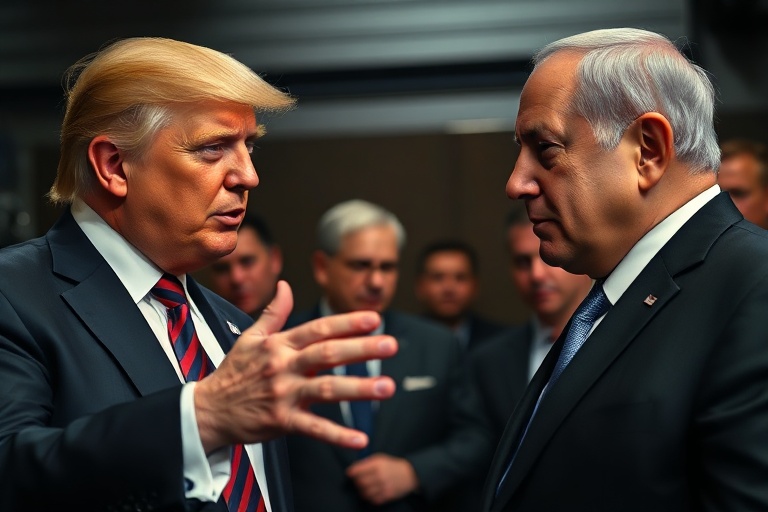
The relationship between Donald Trump and Benjamin Netanyahu stands as one of the most consequential political alliances of the 21st century. Their partnership, spanning from 2017 to 2021, reshaped Middle Eastern geopolitics and redefined U.S.-Israel relations in ways that continue to influence global diplomacy today. While their bond was often characterized by unapologetic support for hardline policies, it also sparked intense debate about the future of international cooperation and the role of personal diplomacy in shaping world events.
Their connection went beyond traditional political alliances. It reflected a shared worldview that prioritized national sovereignty, skepticism of international institutions, and a willingness to challenge established norms. This alignment not only transformed the dynamics between the United States and Israel but also sent ripples across the Middle East, Europe, and beyond.
From Personal Friendship to Political Partnership
Trump and Netanyahu’s relationship began long before either assumed national office. Their mutual admiration was evident in public statements and private conversations dating back to the 1980s. Netanyahu, then a rising political figure in Israel, found a kindred spirit in Trump, a real estate mogul with a flair for media attention and a disregard for political correctness.
When Trump won the 2016 U.S. presidential election, Netanyahu quickly recognized the opportunity. Within days of Trump’s inauguration, Netanyahu became the first foreign leader to meet with him at the White House. Their chemistry was immediate—both leaders embraced a transactional approach to diplomacy, where loyalty and personal rapport often outweighed institutional protocols. Trump’s decision to move the U.S. embassy from Tel Aviv to Jerusalem in 2018 was a direct fulfillment of a campaign promise, one that Netanyahu had long advocated for.
Their collaboration extended beyond symbolic gestures. The Trump administration brokered the Abraham Accords in 2020, a series of normalization agreements between Israel and several Arab states, including the United Arab Emirates and Bahrain. While the accords were praised by some as a historic breakthrough, critics argued they sidelined Palestinian aspirations and relied too heavily on personal diplomacy rather than comprehensive peace efforts.
The Policy Shifts That Defined Their Alliance
Their partnership was marked by several bold policy shifts that challenged the status quo. One of the most controversial was the U.S. withdrawal from the Iran nuclear deal, formally known as the Joint Comprehensive Plan of Action (JCPOA). Trump’s decision in 2018 to abandon the agreement—negotiated under the Obama administration—aligned perfectly with Netanyahu’s long-standing opposition to it. Both leaders framed the deal as a threat to Israel’s security, arguing that it failed to curtail Iran’s regional influence or its ballistic missile program.
Their stance on Iran extended beyond rhetoric. The Trump administration imposed crippling sanctions on Tehran, while Israel carried out covert operations to sabotage Iranian nuclear facilities and disrupt its supply chains. The close coordination between their governments demonstrated how personal relationships could translate into coordinated action on the global stage.
Another defining moment was their approach to the Israeli-Palestinian conflict. Unlike previous U.S. administrations that prioritized a two-state solution, Trump and Netanyahu openly embraced a one-state reality, where Israel maintained control over the West Bank while offering limited autonomy to Palestinians. The Trump administration’s “Peace to Prosperity” plan, unveiled in 2020, reflected this perspective. It proposed economic incentives for Palestinians while avoiding explicit calls for Palestinian statehood—a stark departure from decades of U.S. policy.
Their policies often faced criticism from human rights organizations and international bodies. The expansion of Israeli settlements in the West Bank, the blockade of Gaza, and the U.S. recognition of Jerusalem as Israel’s capital were all actions that drew condemnation from the United Nations and European Union. Yet, for Trump and Netanyahu, these moves were not just about policy—they were statements of defiance against what they saw as an unfair global consensus.
Cultural and Global Reactions to Their Alliance
Their partnership resonated far beyond the halls of power. In the United States, their alliance became a polarizing symbol of the Trump era. Supporters saw them as champions of conservative values, defenders of Western civilization, and unapologetic advocates for Israel’s right to exist without compromise. Opponents, however, viewed their relationship as emblematic of a dangerous retreat from multilateralism, a disregard for human rights, and a willingness to undermine democratic institutions.
Internationally, their alliance was met with a mix of fascination and frustration. In Europe, where leaders often prioritized consensus and international law, their unorthodox approach was seen as reckless. The European Union, a staunch supporter of the Iran deal and a critic of Israeli settlements, found itself increasingly at odds with both Trump and Netanyahu. Meanwhile, in the Middle East, their policies were received with cautious optimism by some Gulf states, which saw Israel as a potential partner against Iran, and with outright hostility by others, particularly Iran and its allies in Syria and Lebanon.
Their personal rapport also played a role in shaping global perceptions. Trump’s unfiltered communication style—whether on Twitter or in press conferences—often clashed with diplomatic norms. Netanyahu, a polished orator with a background in elite institutions, complemented Trump’s brashness with a more calculated demeanor. Together, they presented a united front that amplified their individual messages.
A Lasting Legacy and Unfinished Business
Their alliance ended abruptly with Trump’s defeat in the 2020 U.S. election. Netanyahu, who had relied heavily on Trump’s support, found himself in a precarious position. The Biden administration, which took office in 2021, quickly moved to restore the Iran nuclear deal and re-engage with the Palestinian Authority, signaling a shift away from the policies of the Trump era. Yet, the impact of their partnership lingered.
In Israel, Netanyahu’s political survival became a testament to the resilience of their alliance’s legacy. Despite multiple corruption trials and public protests, Netanyahu remained a dominant figure in Israeli politics, partly due to the loyalty of his base, which continued to view him as a defender of Israel’s security against external threats. Meanwhile, in the United States, Trump’s continued influence over the Republican Party ensured that his policies toward Israel and Iran remained a litmus test for conservative voters.
Looking ahead, the Trump-Netanyahu alliance raises important questions about the future of U.S.-Israel relations. Will their policies endure, or will they be seen as a temporary aberration in a long history of U.S. engagement with the Middle East? The answer may depend on whether their successors can replicate their personal chemistry and shared vision—or whether the global landscape has shifted too dramatically to allow for such bold, uncompromising diplomacy.
Regardless of the outcome, their partnership serves as a case study in how personal relationships between world leaders can shape global events. It challenges the notion that diplomacy must be slow, bureaucratic, and consensus-driven. Instead, it suggests that in an era of rapid change and increasing polarization, the power of personal alliances may be more influential than ever.
For those interested in exploring similar political dynamics, our Politics section offers deeper analysis on global leadership and international relations. To understand how these geopolitical shifts impact everyday life, Culture provides insights into the broader societal implications of such alliances.