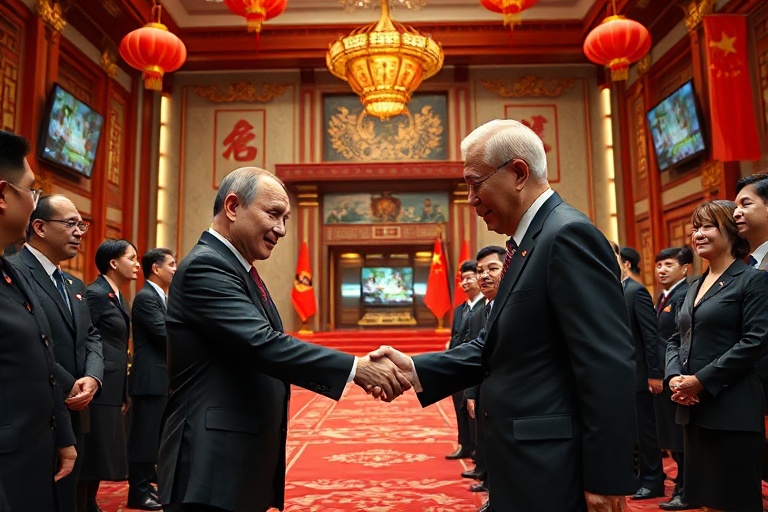
Russian President Vladimir Putin’s recent visit to China has drawn international attention, underscoring the deepening relationship between Moscow and Beijing. This meeting, held amid escalating global tensions, highlights the two nations’ shared interests in countering Western influence and economic pressures. While the visit was framed as a routine diplomatic engagement, the underlying motivations reveal much about the shifting geopolitical landscape.
Diplomatic Signals: What Putin’s Visit Achieves
The three-day state visit, which included meetings with Chinese President Xi Jinping, was meticulously orchestrated to project unity between the two powers. Beyond symbolic gestures, the discussions centered on trade, energy cooperation, and mutual support in international forums. Russia, facing severe sanctions from the West over its actions in Ukraine, is increasingly turning to China as its primary economic lifeline.
The two leaders signed multiple agreements, including a 25-year gas supply deal that further integrates their energy markets. This partnership is not merely transactional; it represents a strategic realignment as both countries seek to reduce their dependence on Western-dominated systems. For China, securing long-term energy supplies from Russia strengthens its position as a global energy consumer while diversifying its import sources.
Key Outcomes of the Summit
- Energy Collaboration: A new 25-year gas supply agreement was finalized, ensuring steady energy flows to China.
- Trade Expansion: Bilateral trade is projected to exceed $200 billion in 2024, with a focus on technology and infrastructure.
- Military Coordination: While not officially confirmed, reports suggest discussions on joint military exercises and defense technology sharing.
- Political Alignment: Both nations reaffirmed their commitment to a “multipolar world order,” countering U.S. global dominance.
The Broader Implications for Global Politics
The Putin-Xi summit occurs at a critical juncture, with global power structures undergoing rapid transformation. Russia’s isolation from the West has accelerated its pivot toward Asia, while China’s rise as an economic and military powerhouse makes it a natural partner for Moscow. This alliance challenges the existing international order, particularly in regions like Eastern Europe, Central Asia, and the Indo-Pacific.
One of the most significant consequences is the weakening of Western sanctions against Russia. By deepening economic ties with China, Moscow can circumvent restrictions on its financial and trade activities. However, this also means that Russia’s leverage in negotiations with the West diminishes, as it becomes more dependent on Beijing’s goodwill.
For China, the partnership offers strategic benefits as well. By aligning with Russia, Beijing can assert itself as a counterbalance to U.S. influence, particularly in Eurasia. This alliance also provides China with a partner in its quest for technological and military self-sufficiency, reducing its reliance on Western suppliers.
Analyzing the Risks and Limitations
Despite the apparent strength of the Russia-China relationship, underlying tensions and vulnerabilities remain. Economic interdependence does not equate to unconditional loyalty. China, for instance, has been cautious about fully endorsing Russia’s military actions in Ukraine, balancing its support to avoid alienating other global partners.
The asymmetry in their partnership also raises questions. While China is the dominant economic power, Russia offers military expertise and energy resources. This dynamic could lead to friction if Moscow perceives Beijing as exploiting its vulnerabilities. Additionally, both nations face domestic challenges—Russia’s demographic decline and China’s economic slowdown—that could weaken their long-term strategic positioning.
Another critical factor is the reaction from third parties. The United States and its allies are closely monitoring this relationship, with some analysts warning of a new Cold War-style bloc emerging. However, the situation is more nuanced, as both Russia and China maintain complex relationships with other global players, including India, Turkey, and the broader Global South.
Conclusion: A Partnership Built on Necessity, Not Ideology
The Putin-Xi summit reaffirms that Russia and China are forging a partnership rooted in mutual necessity rather than shared ideology. While this alliance offers both nations tangible benefits, it also carries significant risks. The global response to this growing entente will shape the future of international relations, determining whether it leads to a more balanced multipolar world or further fragmentation of the global order.
As the world watches, the question remains: How far will these two nations go in challenging the existing power structures, and what will be the cost of their ambitions?
For more insights into global geopolitics, visit our Politics and Analysis sections.