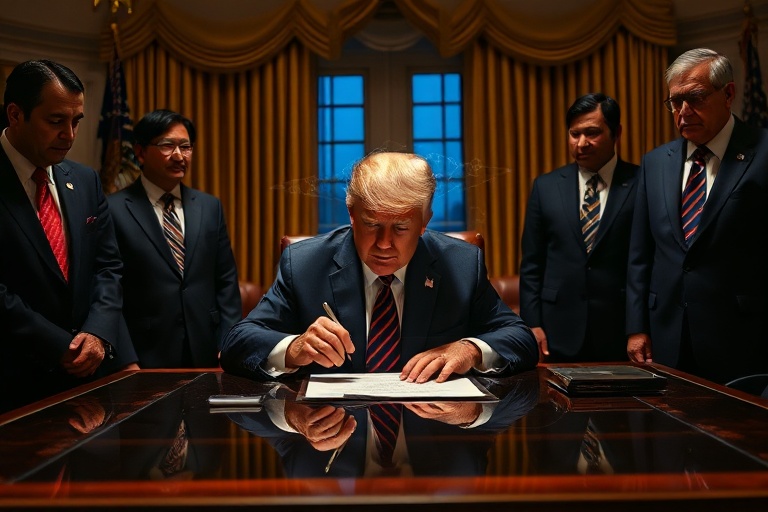
The Trump administration’s recent executive order on artificial intelligence represents a bold attempt to position the United States at the forefront of AI governance. While praised by some for its forward-thinking approach, the order has also drawn sharp criticism from global observers who question its balance between innovation and regulation. This policy shift arrives at a moment when AI technologies are evolving faster than most legal frameworks can accommodate, creating a high-stakes environment where national interests, corporate power, and ethical concerns collide.
Unlike previous U.S. tech policies that emphasized voluntary compliance and industry self-regulation, this executive order introduces a more structured approach. It mandates federal agencies to develop AI safety standards, accelerates AI research initiatives, and seeks to establish America as the global leader in AI development. Yet, as nations like China and the European Union race ahead with their own AI frameworks, the order raises critical questions about America’s ability to maintain its technological edge while addressing public concerns about accountability and transparency.
Key Provisions of the Executive Order
The executive order outlines several ambitious objectives aimed at accelerating AI adoption while managing its risks. Among the most notable provisions are:
- Mandated AI Safety Standards: Federal agencies are required to establish safety protocols for AI systems, particularly those deemed high-risk. This includes mandatory testing and evaluation before deployment.
- National AI Research Cloud: A $5 billion initiative to create a shared computing infrastructure for AI researchers across the country, designed to democratize access to cutting-edge tools.
- Workforce Development: Increased funding for STEM education and AI training programs, with a focus on preparing the next generation of technologists and policymakers.
- International AI Collaboration: A push for stronger partnerships with allied nations to develop global AI governance standards, countering China’s growing influence in the sector.
- Regulatory Sandboxes: Temporary exemptions from certain regulations to allow companies to test AI innovations in controlled environments, fostering experimentation without stifling progress.
These measures reflect a departure from the hands-off approach that has historically defined U.S. tech policy. By imposing stricter oversight while simultaneously investing in innovation, the administration seeks to strike a delicate balance—one that could either propel American AI leadership or stifle its growth under bureaucratic burdens.
Global Reactions: Praise, Skepticism, and Geopolitical Implications
The executive order has elicited a mixed response from the international community. In Europe, where AI regulation has long been a contentious issue, officials have cautiously welcomed the U.S. move as a step toward global alignment. The European Commission’s AI Act, for instance, has faced criticism for its perceived rigidity, and some policymakers see the U.S. approach as a more flexible alternative.
However, not all reactions have been favorable. Critics in Asia argue that the order’s emphasis on safety standards could disadvantage smaller AI firms, particularly in countries like Japan and South Korea, where innovation often outpaces regulation. Meanwhile, China—which has already rolled out its own AI governance guidelines—has dismissed the U.S. initiative as a protectionist measure disguised as regulation. State media outlets in Beijing have framed the order as an attempt to suppress Chinese tech firms under the guise of national security.
In the Middle East, governments are watching closely as AI reshapes industries from finance to healthcare. Countries like the UAE and Saudi Arabia have aggressively pursued AI adoption, with Dubai even appointing a Minister of AI. For these nations, the U.S. executive order signals an opportunity to collaborate with American tech giants while navigating their own regulatory challenges.
Contrasting Approaches: U.S. vs. E.U. vs. China
To better understand the significance of Trump’s AI executive order, it’s helpful to compare it with the regulatory frameworks already in place in the European Union and China:
- European Union: The EU’s AI Act categorizes AI systems by risk level, imposing strict obligations on high-risk applications like facial recognition. While comprehensive, the framework has been criticized for its complexity and potential to stifle innovation.
- China: China’s AI governance strategy is centered on state control, with a focus on promoting AI development while ensuring alignment with government priorities. The approach has led to rapid advancements but at the cost of transparency and individual freedoms.
- United States: The Trump administration’s order strikes a middle ground, emphasizing innovation through regulation rather than blanket restrictions. It avoids the EU’s rigid risk-based approach while steering clear of China’s state-driven model.
This divergence underscores a broader global debate: Should AI be regulated to mitigate risks, or should innovation take precedence? The U.S. stance suggests a preference for the former, but whether it can outpace competitors without sacrificing agility remains to be seen.
The Cultural and Ethical Dimensions of AI Governance
Beyond its geopolitical and economic implications, the executive order touches on deeply cultural and ethical questions. AI technologies increasingly influence how societies function, from hiring practices to law enforcement. In the United States, public trust in AI remains fragile, particularly after high-profile incidents involving algorithmic bias and privacy violations.
One of the order’s most contentious aspects is its treatment of facial recognition technology. While the order encourages innovation in AI, it does not explicitly ban or restrict facial recognition—a technology that has sparked widespread controversy due to its potential for misuse. Civil liberties groups argue that without clear guidelines, the order could enable unchecked surveillance, disproportionately affecting marginalized communities.
Globally, the cultural attitudes toward AI vary widely. In Japan, for example, AI is often embraced as a tool for societal improvement, with applications in elder care and disaster response. In contrast, many European countries view AI with skepticism, prioritizing privacy and human oversight. The U.S. executive order reflects this cultural tension, attempting to reconcile technological ambition with ethical responsibility.
What’s Next? Challenges and Opportunities
The success of Trump’s AI executive order will hinge on its implementation. Already, industry leaders have raised concerns about the order’s feasibility. The $5 billion investment in AI research infrastructure, while substantial, may not be enough to keep pace with China’s state-backed initiatives or the EU’s regulatory rigor. Additionally, the order’s reliance on federal agencies to develop standards could lead to bureaucratic delays, undermining its goal of accelerating innovation.
Another challenge lies in international cooperation. While the order calls for stronger ties with allies, the reality of global AI governance is far more complex. Nations with divergent political systems and economic priorities are unlikely to align easily. The proposed creation of an international AI standards body could either foster collaboration or become a forum for diplomatic disputes.
For American companies, the executive order presents both opportunities and risks. Firms like Nvidia and Google, which lead in AI development, may benefit from increased federal investment and streamlined research initiatives. However, the imposition of safety standards could impose additional compliance costs, particularly for smaller startups. Meanwhile, global competitors may see the order as a chance to gain ground in markets where U.S. firms dominate.
Ultimately, the executive order is a gamble—a bold attempt to position the U.S. as the leader of a new technological era. Its success will depend on the administration’s ability to balance regulation with innovation, address ethical concerns, and navigate the complexities of international relations. As AI continues to evolve, the policies set in motion by this order will shape not only the future of technology but the very fabric of society.
A Final Thought
In an age where AI’s influence permeates every aspect of life, governance cannot afford to lag behind innovation. The Trump administration’s executive order is a necessary step toward creating a framework that protects both progress and people. Whether it succeeds will depend on the willingness of policymakers, industry leaders, and the public to engage in a dialogue that transcends borders and ideologies.