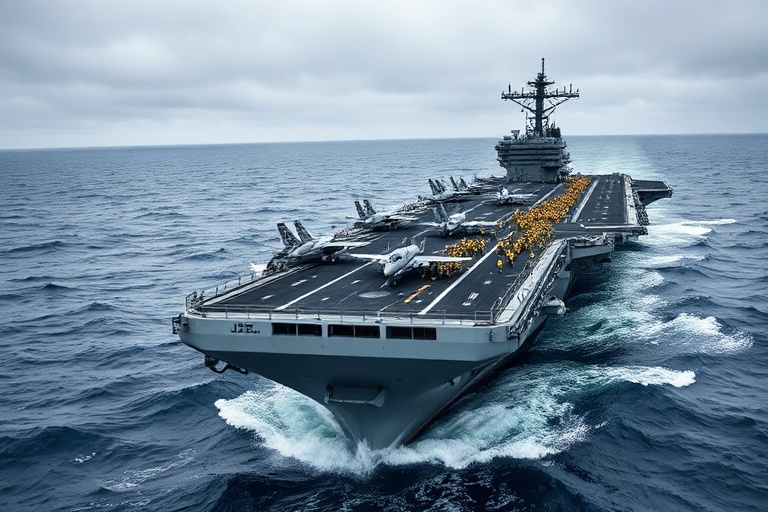
Aircraft Carriers: The Floating Fortresses Shaping Global Power
“`html
Aircraft Carriers: Floating Cities of Power Projection
The modern aircraft carrier stands as one of humanity’s most impressive feats of engineering—a mobile airfield, command center, and miniature city capable of projecting power across oceans. These floating fortresses defy simple categorization. They are simultaneously weapons of war, diplomatic tools, and symbols of national prestige. From their origins in the early 20th century to today’s nuclear-powered giants, aircraft carriers have shaped naval warfare and global politics in ways few other platforms can.
Their sheer size is staggering. The U.S. Navy’s Gerald R. Ford-class carriers, for instance, stretch over 1,100 feet long and displace nearly 100,000 tons when fully loaded. To put that in perspective, they’re longer than three football fields and carry more aircraft than some air forces operate. Yet their true significance lies not just in their scale, but in what they enable: the ability to control the skies, deter aggression, and respond rapidly to crises without relying on foreign bases.
The Evolution of a Naval Icon
The concept of a ship capable of launching and recovering aircraft emerged almost as soon as powered flight did. The first true aircraft carrier, HMS Argus, entered service with the British Royal Navy in 1918. Converted from an ocean liner, it featured a full-length flight deck that allowed biplanes to take off and land without the need for catapults or arresting gear. This innovation proved decisive in early naval aviation experiments.
World War II cemented the aircraft carrier’s role as the dominant naval platform. The Japanese attack on Pearl Harbor in 1941 demonstrated how carriers could project power without direct coastal bombardment. The subsequent Battle of Midway became a defining moment, where U.S. carriers sank four Japanese flattops in a single engagement—shifting the balance of naval power in the Pacific.
Post-war developments accelerated rapidly. The introduction of jet aircraft in the 1950s forced designers to rethink flight deck configurations. The angled deck, introduced by the British in the 1950s, allowed simultaneous launch and recovery operations, a critical improvement that persists today. Nuclear propulsion, pioneered by the U.S. USS Enterprise in 1961, eliminated the need for vulnerable fuel convoys and extended operational range to virtually unlimited distances.
Key Milestones in Carrier Development
- 1918: HMS Argus becomes the first purpose-built aircraft carrier.
- 1940: HMS Illustrious class carriers prove their worth in Mediterranean battles.
- 1950s: Introduction of angled flight decks and steam catapults.
- 1961: USS Enterprise launches as the first nuclear-powered carrier.
- 1975: USS Nimitz enters service, beginning a new class that remains in use today.
- 2017: USS Gerald R. Ford begins sea trials, featuring electromagnetic aircraft launch systems and advanced automation.
Technology and Design: Engineering Marvels
Modern aircraft carriers are marvels of integrated systems engineering. At their core, they combine aviation facilities, propulsion plants, command and control systems, and living quarters for thousands of personnel—all within a single hull. The flight deck is just the most visible component of this complex ecosystem.
Launch systems have evolved from simple gravity-assisted takeoffs to sophisticated catapults and electromagnetic launch systems (EMALS). EMALS, first deployed on the USS Gerald R. Ford, use linear induction motors to accelerate aircraft to takeoff speed in less than two seconds. This technology is more energy-efficient and gentler on airframes than traditional steam catapults, allowing for faster sortie rates and reduced maintenance.
Recovery systems have also seen significant advancements. The arresting gear system uses hydraulic or electro-mechanical cables to bring jets to a halt within 300 feet. Modern systems can handle aircraft weighing up to 50,000 pounds landing at speeds of 150 miles per hour. The integration of these systems with advanced radar and optical landing aids ensures precision even in adverse weather conditions.
Power generation is another area where carriers lead innovation. The Ford-class carriers produce three times the electrical power of their Nimitz-class predecessors, enabling future technologies like directed-energy weapons, railguns, and advanced radar systems. This surplus power supports the growing electrification of naval vessels—a trend that points toward all-electric fleets of the future.
Strategic Implications: More Than Just Ships
Aircraft carriers are often described as “100,000-ton diplomats” for their ability to project influence without firing a shot. Their presence alone can deter aggression, reassure allies, and serve as a rapid-response platform in humanitarian crises. The U.S. Navy maintains 11 carrier strike groups, each capable of deploying within days to any region of the world—a capability known as power projection.
This strategic mobility has reshaped global military thinking. Countries like China and India have invested heavily in carrier programs, recognizing that a blue-water navy capable of sustained operations is essential to great-power status. China’s first domestically built carrier, the Shandong, and its upcoming Type 003 vessels, signal Beijing’s intent to project power beyond its coastal waters. Similarly, India’s INS Vikrant, commissioned in 2022, reinforces its position as a regional naval power.
Yet the rise of anti-access/area-denial (A2/AD) systems—including hypersonic missiles, long-range bombers, and satellite surveillance—poses new challenges to carrier operations. These threats have spurred the development of “distributed lethality” strategies, where carriers operate alongside smaller, heavily armed ships to dilute risk. The U.S. Navy’s shift toward a more distributed fleet architecture reflects this evolving threat landscape.
The broader implications extend beyond military strategy. Carrier deployments often serve as diplomatic tools, enabling host nations to demonstrate partnership with the deploying country. For example, U.S. carriers frequently conduct joint exercises with allied navies, strengthening interoperability and signaling shared security commitments. In crisis scenarios, a carrier’s medical facilities, aviation assets, and logistical support can be rapidly repurposed for disaster relief or evacuation missions.
The Future: Smaller, Smarter, and More Lethal
The next generation of carriers will likely be smaller, more modular, and increasingly unmanned. Concepts like the U.S. Navy’s Light Amphibious Warship and the UK’s Queen Elizabeth class suggest a trend toward versatile platforms that can operate in contested environments without the vulnerability of massive supercarriers. These ships prioritize flexibility over sheer size, carrying a mix of crewed and uncrewed aircraft to expand mission capabilities.
Unmanned systems are poised to play a larger role. The MQ-25 Stingray, a carrier-based aerial refueling drone, already extends the range of combat aircraft launched from carriers. Future variants may include electronic warfare, surveillance, and even strike-capable drones, reducing the need for high-risk human sorties in contested airspace.
Sustainability is also becoming a priority. The U.S. Navy has committed to net-zero greenhouse gas emissions by 2050, requiring carriers to adopt alternative fuels, hybrid-electric propulsion, and energy-efficient systems. The integration of renewable energy sources—such as solar arrays or hydrogen fuel cells—could reduce operational costs and environmental impact while maintaining operational readiness.
Despite these changes, the fundamental role of the aircraft carrier remains unchanged: to provide a sovereign, mobile base of operations in international waters. As geopolitical tensions rise and technology advances, carriers will continue to evolve—adapting their size, capabilities, and tactics to meet the demands of an uncertain world.
Conclusion
Aircraft carriers represent the pinnacle of naval engineering and strategic foresight. They are not merely ships, but instruments of national power—capable of dominating oceans, deterring conflict, and responding to crises with unmatched speed and flexibility. From the early experiments of World War I to the high-tech platforms of today, carriers have consistently redefined the rules of naval warfare.
As technology progresses and global power dynamics shift, the aircraft carrier will remain a cornerstone of naval strategy. Whether through the deployment of unmanned systems, the integration of renewable energy, or the adoption of distributed operational concepts, these floating cities will continue to adapt. In an era where control of the seas is more critical than ever, the aircraft carrier stands as a testament to human ingenuity—and a reminder that even in the age of drones and hypersonic missiles, the right platform can still change the course of history.
For those interested in the intersection of technology and military strategy, stay tuned to Dave’s Locker Technology section. To explore how naval innovations influence global affairs, visit our Politics coverage, where geopolitical trends are analyzed with depth and clarity.