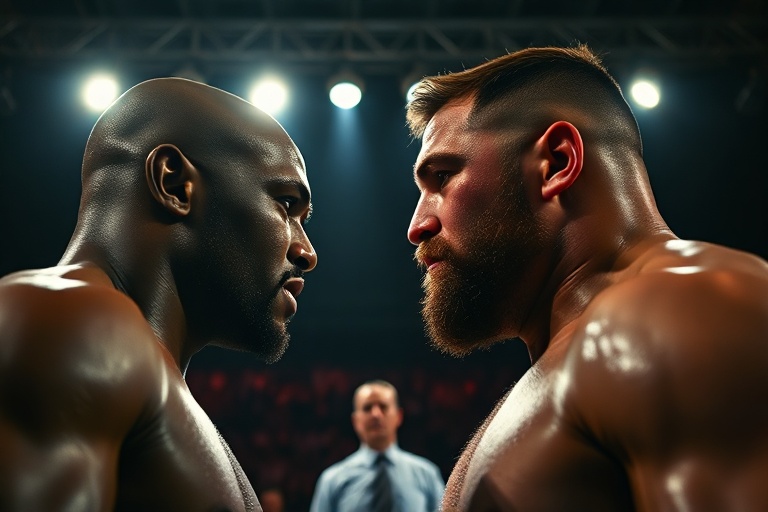
The rivalry between Anthony Joshua and Tyson Fury has captivated boxing fans for years, not through direct competition but through the contrasting paths each heavyweight has taken. Joshua, with his explosive power and Olympic pedigree, represents the traditional route to greatness. Fury, on the other hand, embodies the unorthodox, cerebral approach to the sport. Their potential showdown would be more than a fight; it would be a collision of philosophies, athleticism, and legacy.
The Contrasting Journeys of Two Champions
Anthony Joshua’s rise to the top was swift and spectacular. After winning gold at the 2012 London Olympics, he turned professional and quickly became a global sensation. His 2016 knockout of Charles Martin to claim the IBF heavyweight title marked the beginning of a dominant era. Joshua’s power, precision, and marketability made him a crossover star, appealing to audiences beyond traditional boxing fans. His 2019 fight against Andy Ruiz Jr. showcased both his vulnerabilities and his resilience, as he recaptured the unified titles in a rematch.
Tyson Fury’s path to the top was anything but conventional. The Gypsy King’s career has been defined by resilience, wit, and an unshakable belief in his abilities. After defeating Wladimir Klitschko in 2015 to claim the lineal heavyweight championship, Fury’s reign was marred by personal struggles and a two-year hiatus from the ring. His return in 2018 against Francesco Pianeta and subsequent victory over Deontay Wilder in 2019 reaffirmed his status as a force in the division. Fury’s ability to outthink and outmaneuver opponents has set him apart in an era dominated by power punchers.
The contrast between the two fighters extends beyond their in-ring styles. Joshua’s disciplined, structured approach contrasts sharply with Fury’s improvisational, almost playful demeanor. Where Joshua’s career has been marked by highs and setbacks, Fury’s has been a testament to adaptability and mental fortitude. This clash of personalities alone makes their potential fight a compelling narrative.
Styles Collide: Joshua’s Power vs. Fury’s Mastery
If Anthony Joshua and Tyson Fury were to face off, the fight would be a study in contrasts. Joshua’s style is built on precision, timing, and devastating knockout power. His jab is one of the best in the division, and his combinations—particularly his right hand—have ended many fights prematurely. Joshua’s physical attributes, including his reach and athleticism, make him a formidable opponent in any matchup. However, his tendency to rely on his power can leave him vulnerable to opponents who can outbox him, as seen in his loss to Ruiz Jr.
Fury, meanwhile, is a master of defensive boxing. His ability to slip, roll, and counter has frustrated some of the division’s most dangerous punchers. Fury’s footwork is a sight to behold; he moves with a dancer’s grace, using angles and feints to disrupt his opponents’ rhythm. His jab is underrated, but his real strength lies in his ability to make his rivals miss and then punish them with precision counterpunches. Fury’s mental game is equally impressive. He has a knack for getting inside his opponents’ heads, using psychological warfare to gain an edge before the fight even begins.
A potential Joshua vs. Fury fight would hinge on which style prevails. Could Joshua’s power overwhelm Fury’s defenses? Or would Fury’s mastery of the sweet science neutralize Joshua’s strengths? The fight’s outcome would likely be determined by Fury’s ability to avoid Joshua’s power while exploiting his own strengths—speed, movement, and ring IQ.
The Undeniable Draw: Why Fans Are Craving This Fight
The anticipation for a Joshua vs. Fury fight isn’t just about the boxing. It’s about the spectacle, the storytelling, and the chance to settle debates that have lingered for years. Fans of Joshua’s power and marketability see him as the heir to the heavyweight throne. Fury’s supporters argue that he is the true lineal champion, having defeated Klitschko and Wilder. A unification fight would bring clarity to the division and set the stage for future matchups.
Beyond the in-ring action, the fight would be a cultural event. Both fighters have massive global followings, and their personalities add layers of intrigue. Joshua’s disciplined, almost corporate approach contrasts with Fury’s rebellious, free-spirited persona. This clash of images would draw casual fans who might not typically follow boxing, further elevating the fight’s profile.
The financial stakes are equally significant. A Joshua vs. Fury fight would be one of the most lucrative in boxing history, with pay-per-view sales, sponsorships, and global broadcasting rights generating hundreds of millions. Promoters would be salivating at the prospect of a fight that could shatter records and redefine the heavyweight division.
What Would It Take for the Fight to Happen?
While the appeal of a Joshua vs. Fury fight is undeniable, the logistics are complex. Both fighters have existing promotional obligations and potential rematch clauses. Joshua is currently aligned with Eddie Hearn’s Matchroom Boxing, while Fury is promoted by Frank Warren’s Queensberry Promotions. A deal would require careful negotiation to satisfy all parties, including the sanctioning bodies and broadcasters.
Another hurdle is the fight’s location. Given the global appeal of both fighters, the bout could take place in the UK, the U.S., or even a neutral territory like Saudi Arabia or the UAE. The choice of venue would depend on financial incentives, fan accessibility, and logistical considerations.
For the fight to materialize, both fighters would need to be on the same page regarding terms. Joshua’s team would likely push for a fight that maximizes his strengths, while Fury’s camp would emphasize his ability to outthink and outmaneuver his opponent. The negotiating process could take months, if not years, but the potential rewards make it a worthwhile pursuit for all involved.
Looking Ahead: The Future of Heavyweight Boxing
A Joshua vs. Fury fight would do more than crown a single champion; it would shape the future of the heavyweight division. The winner would likely face a path toward further unification fights, potentially against Deontay Wilder or Oleksandr Usyk. The loser would need to regroup and refocus, proving their place in a division that doesn’t forgive mistakes.
For boxing fans, the fight represents an opportunity to witness two all-time greats in their prime. Joshua and Fury are both at stages in their careers where they can still deliver elite performances. Their potential clash would be a reminder of why heavyweight boxing remains the pinnacle of the sport.
Regardless of the outcome, a Joshua vs. Fury fight would be a celebration of the heavyweight division’s rich history. It would honor the traditions of the sport while pushing it into new territory. For promoters, fighters, and fans alike, the fight would be a landmark event—one that transcends the sport itself.
Until then, the anticipation will continue to build. Boxing fans will dissect every move, every statement, and every training update, hoping for the chance to see these two titans collide. The heavyweight division has waited long enough for a true unification fight. When—or if—Joshua and Fury finally step into the ring together, it will be a night to remember.
For more on heavyweight boxing, explore our Sports and Analysis sections.