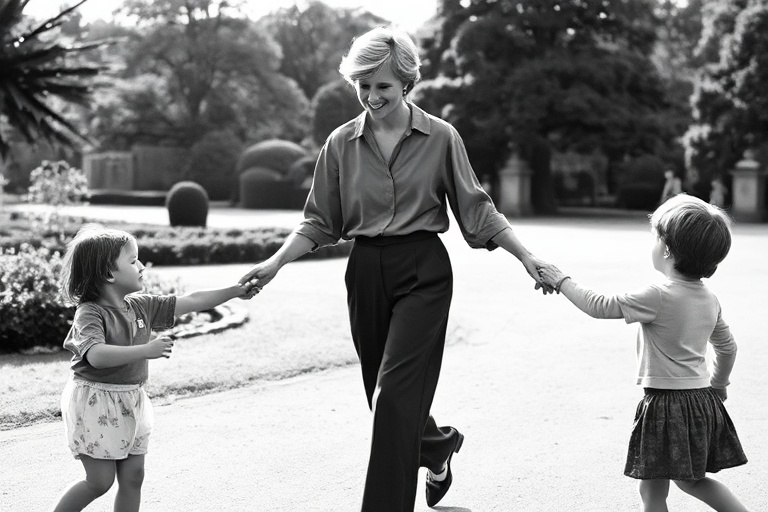
Diana Frances Spencer, who became Diana, Princess of Wales, remains one of the most influential figures of the 20th century. Born on July 1, 1961, at Park House near Sandringham in Norfolk, England, she was the third child of Edward John Spencer, Viscount Althorp, and Frances Ruth Burke Roche. Diana’s life was marked by extraordinary contrasts: from a sheltered aristocratic upbringing to global fame, from royal duty to personal struggles, and from adoration to intense scrutiny. Her legacy endures decades after her tragic death in 1997, not only as a royal figure but as a humanitarian, fashion icon, and voice for the marginalized.
The Making of a Princess
Diana’s path to royalty was not preordained. She spent much of her childhood at home in the care of nannies, attending boarding school only at the age of 13. Her early years were shaped by divorce in 1969, when her parents separated, and her father gained full custody of the children. This experience fostered in Diana a deep empathy for children in difficult family situations—a trait that would define her charitable work later in life.
Her journey took a dramatic turn in 1980 when she met Prince Charles, heir to the British throne. Their courtship was brief but intense, culminating in an engagement announced on February 24, 1981. On July 29, 1981, she married Charles in a lavish ceremony at St. Paul’s Cathedral, watched by an estimated 750 million people worldwide. The event was a global spectacle, cementing Diana’s place in the public imagination as the “People’s Princess”—a title that reflected both her warmth and her distance from traditional royal protocol.
A Marriage Under the Microscope
Despite the fairy-tale beginning, Diana’s marriage to Charles was fraught with challenges. Reports later confirmed that the relationship was strained from the start. Diana reportedly felt isolated in her new role, overwhelmed by the demands of royal life and the expectations placed upon her. The birth of her sons, Prince William in 1982 and Prince Harry in 1984, brought moments of joy, but they did little to stabilize the marriage.
By the late 1980s, the couple’s separation was an open secret. Diana’s struggles with mental health, including bulimia and depression, were well-documented in the press. Her honesty about these battles humanized her in the eyes of the public and paved the way for more open discussions about mental health in the royal family. In 1992, the couple formally separated, marking the beginning of a new chapter in Diana’s life—one defined by independence, activism, and a growing distance from the monarchy.
Beyond the Palace: Diana’s Humanitarian Legacy
While Diana’s royal status gave her a platform, it was her compassion and commitment to humanitarian causes that truly set her apart. She became a global advocate for those often overlooked by society, using her fame not for personal gain, but to amplify voices that needed to be heard.
Her involvement with the International Campaign to Ban Landmines earned her international acclaim. She visited Angola and Bosnia in 1997, walking through minefields and meeting survivors, which drew global attention to the issue. Her work with the landmine ban contributed to the Ottawa Treaty of 1997, a landmark agreement signed by 122 countries. This effort demonstrated Diana’s ability to leverage her celebrity for tangible change—a model that has since inspired countless public figures.
Diana was also a passionate advocate for people living with HIV and AIDS. In a time when fear and misinformation about the disease were rampant, she publicly challenged stigma by touching AIDS patients without gloves, a bold act that helped shift public perception. Her efforts with organizations like the National AIDS Control Organisation in India further solidified her reputation as a fearless humanitarian.
- Landmine Ban Advocacy: Visited minefields in Angola and Bosnia, meeting survivors and lobbying for the Ottawa Treaty.
- AIDS Awareness: Publicly challenged stigma by touching AIDS patients, helping reduce fear and misinformation.
- Homelessness & Poverty: Worked with shelters in London and supported organizations like Centrepoint, which aids homeless youth.
- Leprosy & Global Health: Visited leprosy hospitals in Indonesia and Nepal, drawing attention to treatable diseases.
Fashion as Power: Diana’s Unmatched Influence
Diana’s impact extended far beyond her humanitarian work. She redefined royal fashion, transforming it from stiff formality into a language of empathy and modernity. Known for her bold choices, she often wore designer gowns, but she also used clothing to convey messages—whether supporting emerging designers or making political statements through color and style.
Her 1983 tour of Australia and New Zealand with Charles showcased her growing confidence. She wore a bright pink dress by David and Elizabeth Emanuel in Sydney, a color that symbolized warmth and approachability. This moment marked the beginning of her reputation as a fashion icon whose choices resonated with both the public and the press.
Perhaps her most iconic fashion moment came in 1997, when she attended the landmine conference in Ottawa wearing a midnight blue Victor Edelstein gown paired with a sapphire and diamond choker. The dress, later auctioned for charity, became symbolic of her elegance and purpose. Diana understood the power of appearance not as vanity, but as a tool for influence—something she wielded with intention throughout her life.
The Final Years: A Princess Unbound
In her final years, Diana embraced a life of greater freedom. After her separation from Charles, she moved out of Kensington Palace and into a more modest apartment, symbolizing her desire to live authentically. She pursued relationships that brought her happiness, most notably with Dodi Al-Fayed, and planned a future that included a return to a more private life.
Her death on August 31, 1997, in a car crash in Paris while being pursued by paparazzi shocked the world. The outpouring of grief was unprecedented. Over 2.5 billion people watched her funeral, which was broadcast globally. Elton John’s rendition of “Candle in the Wind” became one of the best-selling singles of all time, with proceeds going to the Diana, Princess of Wales Memorial Fund. The public mourning revealed a collective sense of loss—not just for a princess, but for a woman who had touched millions through her kindness, courage, and authenticity.
A Legacy That Lives On
Today, Diana’s legacy endures through the institutions she supported and the causes she championed. The Diana, Princess of Wales Memorial Fund, established after her death, has raised over £100 million for causes including poverty, homelessness, and mental health. Her sons, William and Harry, have continued her work, with William’s focus on mental health through the Heads Together campaign and Harry’s advocacy for HIV awareness and landmine clearance.
Diana also left an indelible mark on fashion and pop culture. Designers like Alexander McQueen and John Galliano have cited her as an inspiration, and her influence can be seen in modern royal fashion, particularly in the style of Catherine, Princess of Wales and Meghan, Duchess of Sussex. Museums, including the V&A in London, have held exhibitions dedicated to her wardrobe, further cementing her status as a cultural icon.
Her life story continues to captivate historians, biographers, and the public alike. Documentaries, films, and books—such as the 2017 biopic Diana: Her Story and the 2020 Netflix series The Crown—have kept her memory alive, offering new generations insight into her complex, compassionate nature.
Diana, Princess of Wales, was more than a royal. She was a symbol of empathy in an often detached world, a woman who used her platform to challenge injustice, and a figure whose humanity resonated across borders. Her life reminds us that influence is not measured solely by titles or crowns, but by the lives touched and the causes advanced.
In an era where celebrity often overshadows substance, Diana’s story stands as a testament to the power of authenticity. She was a princess, a mother, a friend, and a global advocate—one whose light continues to shine long after her passing.
To learn more about influential figures in modern history, visit our Culture section.
For deeper analysis on royal legacies, explore our Analysis category.