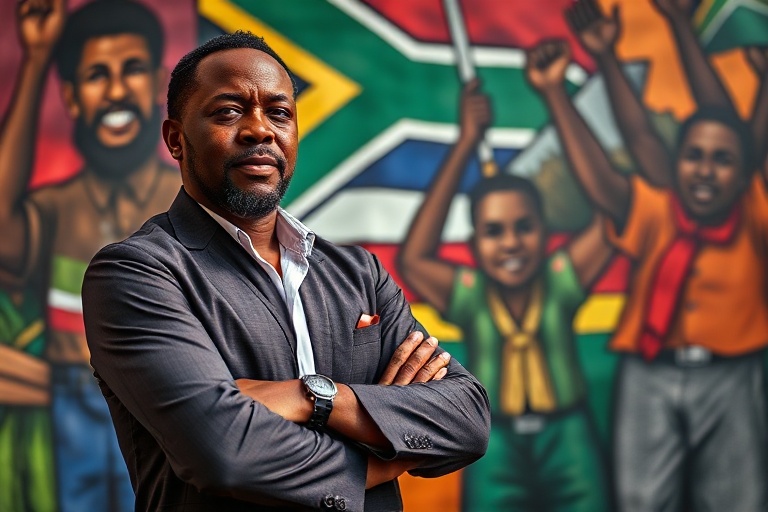
Julius Malema: South Africa’s Most Controversial Political Leader
“`html
Julius Malema: South Africa’s Polarizing Political Figure
Julius Malema has remained one of South Africa’s most controversial and influential political figures since rising to prominence in the early 2000s. As the leader of the Economic Freedom Fighters (EFF), he has consistently challenged the country’s political establishment, advocating for radical economic reforms and a decisive break from apartheid-era inequalities. His rhetoric—often provocative and unapologetic—has drawn both fierce support and sharp criticism, making him a polarizing presence in South African politics.
Born in 1981 in Seshego, Limpopo, Malema’s political journey began in the African National Congress (ANC), where he quickly ascended as a youth leader. However, his confrontational style and outspoken views eventually led to his expulsion from the party in 2012. Undeterred, he founded the EFF in 2013, positioning the party as a radical alternative to the ANC, particularly on issues of land redistribution, nationalization of key industries, and racial justice.
A Political Career Defined by Controversy
Malema’s political career has been marked by legal battles, disciplinary hearings, and public clashes with opponents. One of the most notable incidents occurred in 2010 when he was suspended from the ANC for hate speech after singing the controversial song “Shoot the Boer,” which was deemed to incite violence against white farmers. Despite the backlash, Malema defended the song as a legitimate expression of resistance against apartheid-era oppression.
His legal troubles extended beyond political rhetoric. In 2012, Malema was convicted of fraud and money laundering related to a R5 million ($350,000) tender fraud case. Although he initially appealed the conviction, the ruling underscored his reputation for operating on the fringes of legality. Critics argue that his legal entanglements reflect a pattern of defiance toward institutional norms, while supporters view them as politically motivated persecution.
The EFF, under Malema’s leadership, has grown into the third-largest political party in South Africa, winning 10.8% of the national vote in the 2019 elections. The party’s red berets, militant slogans, and confrontational tactics at parliamentary sessions have become synonymous with Malema’s brand of politics. Whether addressing land reform, corruption, or economic inequality, his messaging consistently emphasizes radical transformation over incremental change.
The EFF’s Ideological Stance and Policy Proposals
The Economic Freedom Fighters presents a starkly different vision for South Africa compared to the ruling ANC. While the ANC has largely pursued neoliberal economic policies since the end of apartheid, the EFF advocates for a socialist agenda that includes nationalizing mines and banks, expropriating land without compensation, and implementing a universal basic income grant. Malema has framed these proposals as necessary to dismantle the economic legacy of colonialism and apartheid, which he argues continues to benefit a white minority elite.
One of the EFF’s most contentious policy positions is its call for land expropriation without compensation. Malema has argued that this measure is essential to address historical injustices and empower Black South Africans who were dispossessed of land during colonial rule. The proposal has sparked intense debate, with opponents warning of economic instability and property rights violations, while supporters argue that it is a long-overdue corrective to systemic racial disparities.
The party has also been vocal on issues of corruption, particularly within the ANC. Malema has frequently accused ANC leaders of enriching themselves at the expense of the poor, positioning the EFF as a moral alternative. However, critics point out that the EFF itself has faced allegations of financial mismanagement and opaque funding sources, though these claims have not significantly dampened its support among disillusioned voters.
Key EFF Policy Proposals
- Nationalization of key industries: Mines, banks, and other strategic sectors would be placed under state control to ensure equitable distribution of wealth.
- Land redistribution without compensation: Expropriation of white-owned farms and urban land to transfer ownership to Black South Africans.
- Universal Basic Income Grant: A monthly stipend for unemployed and low-income citizens to address poverty.
- Abolition of user fees for essential services: Free healthcare, education, and housing as fundamental rights.
Public Perception and the Battle for Influence
Malema’s public image is deeply divided. To his supporters, he is a fearless champion of the poor, a leader unafraid to speak truth to power. His oratory skills, charisma, and ability to mobilize young Black South Africans have earned him a cult-like following in townships and among the economically marginalized. For many, he embodies the frustration and anger toward a political system that has failed to deliver on the promises of 1994.
Opponents, however, portray Malema as a demagogue whose rhetoric stokes racial divisions and undermines social cohesion. They argue that his policies, if implemented, could destabilize the economy and deter foreign investment. Business leaders and international observers have expressed concern over the EFF’s proposals, warning that radical economic reforms could undermine South Africa’s already fragile financial stability.
The media’s role in shaping Malema’s image has also been contentious. While some outlets amplify his most inflammatory statements, others scrutinize his business dealings and political maneuvers. His social media presence, where he frequently engages with supporters and critics alike, further amplifies his reach but also exposes him to backlash over controversial remarks.
The Future of Malema and the EFF
As South Africa approaches its next general election in 2024, the EFF’s influence continues to grow, particularly among young voters disillusioned with the ANC. Malema has positioned the party as a viable alternative, though its ability to translate rhetoric into tangible change remains unproven. The ANC, facing declining support, has increasingly adopted some of the EFF’s policy positions—such as land reform—to mitigate the party’s appeal.
Malema’s personal ambitions also remain a topic of speculation. Some analysts suggest he may be positioning himself for a future leadership role in a post-ANC South Africa, though his confrontational style may limit his ability to form broad coalitions. Others believe the EFF’s long-term success depends on its ability to move beyond protest politics and present a credible governing vision.
What is clear is that Julius Malema has reshaped South Africa’s political landscape. Whether viewed as a revolutionary or a rabble-rouser, his impact on the national conversation is undeniable. As the country grapples with persistent inequality, corruption, and economic stagnation, Malema’s message continues to resonate with those who believe the current system is irredeemably broken.
The EFF’s future—and Malema’s legacy—will depend on whether his radical agenda can translate into real-world change or remain confined to the realm of political theater. One thing is certain: in a country still grappling with the ghosts of its past, Malema’s voice will not be silenced anytime soon.
Explore more political analysis on our Politics category page or stay updated with the latest news.