patrick ewing
“`html
Patrick Ewing: The Knicks Legend Who Transformed a Franchise
Few players in NBA history have left as indelible a mark on a single franchise as Patrick Ewing did with the New York Knicks. Drafted first overall in 1985, Ewing became the cornerstone of a team that had struggled for decades. His arrival signaled a new era for the franchise, one that would see the Knicks transform from perennial underdogs to perennial contenders. Over 15 seasons in New York, Ewing embodied the grit and determination that defined the city itself, forging a legacy that endures more than two decades after his retirement.
The Making of a Franchise Savior
Ewing’s path to the NBA began in Jamaica, where he grew up playing soccer before discovering basketball in high school. His dominance on the court earned him a scholarship to Georgetown University, where he became one of the most feared collegiate players in history. Under coach John Thompson, Ewing led the Hoyas to three Final Four appearances, including a national championship in 1984. His shot-blocking prowess and rebounding ability made him a defensive anchor, while his developing offensive game hinted at the star he would become.
When the Knicks selected Ewing with the first pick of the 1985 NBA Draft, they were making a statement. The franchise had not made the playoffs in six years and had not won a championship since 1973. Ewing’s arrival changed the team’s trajectory almost immediately. In his rookie season, he averaged 20 points and 9 rebounds per game, earning All-Rookie First Team honors. The Knicks missed the playoffs that year, but the foundation was laid. By his third season, New York was back in the postseason, and Ewing was the driving force behind a resurgence that would last for years.
Defining the Knicks’ Identity
The Knicks of the late 1980s and early 1990s were defined by their physicality, their no-nonsense approach, and their refusal to back down from any opponent. Ewing was the embodiment of that mentality. Standing at 7 feet tall with a 7-foot-6 wingspan, he was a defensive force who could anchor the paint and alter shots. His offensive game evolved from a raw scorer to a polished mid-range shooter and a reliable scorer in the post. Ewing’s signature turnaround jumper became one of the most recognizable shots in basketball.
Ewing’s leadership extended beyond his on-court performance. He was the face of the franchise, a player who carried the hopes of a city that demanded excellence. In an era when the NBA was becoming more flashy and offensive-minded, Ewing represented the old-school values of defense, rebounding, and fundamental basketball. His battles with other dominant centers, such as Hakeem Olajuwon, David Robinson, and Shaquille O’Neal, became legendary, showcasing his ability to compete at the highest level.
A Playoff Run That Nearly Changed History
The pinnacle of Ewing’s career came in 1994, when the Knicks reached the NBA Finals. It was a historic run for a team that had been counted out time and time again. Led by Ewing, who averaged 18.9 points and 10.7 rebounds per game in the postseason, New York defeated the Chicago Bulls in the second round—despite Michael Jordan’s brief return to the NBA—before knocking out the Indiana Pacers in the Eastern Conference Finals. The team’s physical defense and Ewing’s clutch performances made them a formidable opponent.
In the Finals, the Knicks faced the Houston Rockets, a team led by Hakeem Olajuwon, another Hall of Fame center. The series was a grueling, defensive battle, with both teams struggling to score efficiently. Ewing battled foul trouble throughout the series, but he delivered a 25-point, 12-rebound performance in Game 7, one of the gutsiest performances of his career. Despite his efforts, the Rockets prevailed, winning the championship 90-84. The loss was heartbreaking, but it cemented Ewing’s legacy as one of the greatest players never to win a title.
The Challenges of an Era Without a Championship
Ewing’s career was marked by near-misses and heartbreak. The Knicks returned to the Finals in 1999, a lockout-shortened season, but they were swept by the San Antonio Spurs. By that point, Ewing was 36 years old, and the team’s core had begun to age. Injuries had taken a toll on his body, and the wear and tear of a long career were evident. Still, he remained a leader, providing a steadying presence for a team that relied on its defense and toughness.
Ewing’s final years in New York were bittersweet. He played through injuries, and his role shifted from dominant scorer to mentor and role player. In 2000, he was traded to the Seattle SuperSonics, a move that stunned fans who had watched him become the face of the franchise. He played one more season before retiring in 2002, finishing his career with 24,815 points, 11,607 rebounds, and 2,894 blocks. His number 33 jersey was retired by the Knicks in 2003, cementing his place in franchise history.
Ewing’s Legacy Beyond the Court
Ewing’s impact extended far beyond his playing days. After retiring, he transitioned into coaching, serving as an assistant for the Houston Rockets, Orlando Magic, and Charlotte Hornets. His knowledge of the game and his ability to connect with players made him a valuable asset. In 2017, he returned to the Knicks as an assistant coach under Jeff Hornacek, and in 2019, he was named the head coach of Georgetown University, his alma mater. The move was a full-circle moment for Ewing, who had thrived under John Thompson’s guidance and now sought to inspire the next generation of players.
Ewing’s influence on the game is also evident in the players he mentored. Many of today’s big men cite him as an inspiration, particularly for his two-way impact. Players like Alonzo Mourning, Dikembe Mutombo, and even modern stars like Bam Adebayo have pointed to Ewing as a model for how to dominate both ends of the court. His ability to blend size, skill, and toughness set a standard for centers in the NBA.
The Ewing Effect on the Knicks’ Future
Ewing’s legacy in New York is not just about what he accomplished on the court; it’s about the culture he helped create. The Knicks of the 1990s were known for their physical defense and their refusal to back down, traits that Ewing embodied. That identity has persisted in the franchise, even as the team has struggled to regain its former glory. In recent years, the Knicks have once again become a playoff contender, and Ewing’s influence can be seen in the way the team plays.
For younger fans, Ewing represents a bridge between the past and the present. His battles with Michael Jordan and other legends are part of NBA lore, and his leadership style is still studied by coaches and players alike. The Knicks’ current core, including Julius Randle and RJ Barrett, have spoken about the importance of toughness and accountability, values that Ewing instilled in the franchise.
Ewing’s journey from Jamaica to the NBA and back to New York as a coach and ambassador for the game is a testament to his dedication. His story is one of perseverance, hard work, and an unwavering commitment to excellence. For the Knicks and their fans, Patrick Ewing will always be more than a player—he is a symbol of what it means to wear the orange and blue.
Conclusion: A Legend for the Ages
Patrick Ewing’s career was defined by consistency, leadership, and an unrelenting will to win. While he never won an NBA championship, his impact on the Knicks and the league as a whole is undeniable. He transformed a franchise, inspired generations of players, and left a legacy that transcends statistics. In New York, he is remembered not just as a great player, but as a symbol of the city’s toughness and resilience.
Ewing’s story is a reminder that greatness is not always measured by championships. It is measured by the way a player elevates those around him, the way he defines a franchise, and the way he inspires future generations. For the Knicks and their fans, Patrick Ewing will always be the standard by which greatness is judged.
As the Knicks continue their quest to return to the top of the NBA, they would do well to remember the lessons of Ewing’s era. Defense wins championships. Toughness matters. And leadership is not just about skill—it’s about heart. Those are the principles that Patrick Ewing brought to the court every night, and they are the principles that will guide the franchise forward.
In the pantheon of NBA legends, Patrick Ewing stands tall—not just because of his height, but because of the legacy he left behind. He is a Hall of Famer, a franchise icon, and a true legend of the game.
—
METADATA
{
“title”: “Patrick Ewing: How the Knicks Legend Defined a Franchise”,
“metaDescription”: “From rookie sensation to franchise icon, Patrick Ewing’s 15-year Knicks career reshaped New York basketball and left a legacy of toughness and leadership.”,
“categories”: [“Sports”, “Entertainment”],
“tags”: [“Patrick Ewing”, “New York Knicks”, “NBA legends”, “Georgetown basketball”, “Hall of Fame”],
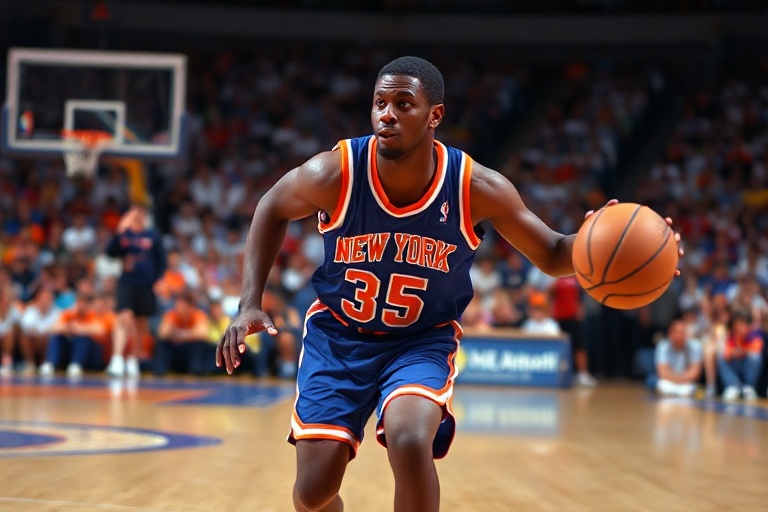
“imageDescription”: “A dynamic action shot of Patrick Ewing in a New York Knicks jersey mid-game, surrounded by teammates, with Madison Square Garden blurred in the background. The mood is intense and focused, capturing Ewing’s signature turnaround jumper or defensive stance, with a vintage 1990s NBA aesthetic.”
}
—END METADATA—
“`