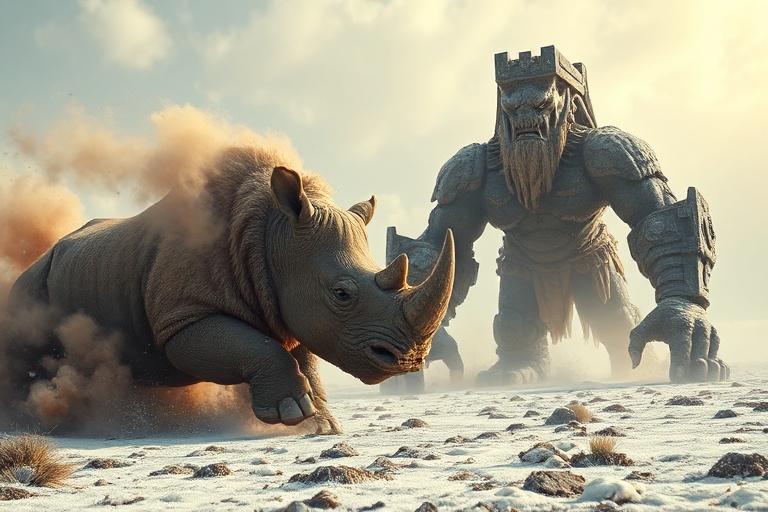
The collision between rhinos and giants isn’t just a clash of size—it’s a collision of narratives. On one side, the rhinoceros stands as a symbol of raw, untamed power, a living fossil that has survived epochs. On the other, the giant looms as a figure of legend, a construct of myth and imagination that towers over human perception. This isn’t just about animals and creatures; it’s about how we frame strength, survival, and symbolism in nature and storytelling.
But what happens when we place these two archetypes side by side? What do rhinos teach us about real power, and what do giants reveal about the power we invent? Let’s explore the deeper implications of this unlikely comparison.
The Real Rhino: Power in the Raw
Rhinoceroses are among the most formidable land mammals on Earth. With thick, armored skin, horns that can grow up to five feet long, and a top speed of 30 to 40 miles per hour, they embody endurance and resistance. Unlike mythical giants, rhinos don’t rely on magic or divine origin—they survive through biological adaptation, social structure, and sheer will.
There are five species of rhinos, each with distinct behaviors and habitats. The white rhino, for instance, is a grazer, while the Sumatran rhino is a forest-dwelling browser. Despite their differences, all rhinos share a common vulnerability: human encroachment. Poaching and habitat loss have pushed several species to the brink of extinction. Their real battle isn’t against mythical foes—it’s against extinction at our hands.
This raises a critical question: If rhinos are the embodiment of natural power, why do we struggle to protect them? The answer lies not in their strength, but in our priorities. While giants exist only in stories, rhinos face real threats every day. Their survival depends on conservation efforts, policy changes, and global awareness—none of which can be summoned with a spell or a sword.
The Mythic Giant: Power Constructed in Imagination
Giants have populated human mythology for millennia. From the Greek Titans to the Norse Jötunn, from biblical Goliath to the gentle giant of folklore, these beings represent forces beyond human control. They are often portrayed as antagonists, but they can also be protectors, teachers, or even tragic figures. Their power is not physical alone—it’s symbolic. Giants embody the unknown, the overwhelming, the forces that dwarf human understanding.
In modern storytelling, giants appear in various forms: from Tolkien’s Ents to Miyazaki’s Castle in the Sky, or even the colossal mecha of anime. These creations serve as metaphors for environmental destruction, technological hubris, or the insurmountable challenges of life. Unlike rhinos, giants don’t need to eat or sleep—they exist to challenge our perception of scale and power.
But giants also reflect our own aspirations and fears. A giant can represent human potential when harnessed for good, or our capacity for destruction when left unchecked. In this way, giants are not just creatures of myth—they are mirrors. They show us what we fear, what we desire, and what we might become.
When the Real Meets the Imagined: A Clash of Symbols
At first glance, rhinos and giants couldn’t be more different. One is a biological reality; the other, a cultural construct. Yet both serve as symbols of power in their own right. The rhino’s power is tangible—measured in muscle, horn, and speed. The giant’s power is intangible—measured in fear, awe, and narrative weight.
This contrast highlights a deeper truth about how humans perceive strength. We often glorify the mythic over the real, the imagined over the tangible. A giant in a story can inspire awe, but a rhino in the wild demands respect. The former is a creation of the mind; the latter, a creation of evolution.
This duality extends beyond individual creatures. It reflects our broader relationship with nature and myth. We create giants to explain the unexplained, to personify forces like time, death, or nature itself. But we also create rhinos—real, living giants—to remind us that power isn’t just a story. It’s alive. It breathes. It struggles.
So, which is more powerful? The answer depends on what we value. If power is measured by physical dominance and survival, the rhino wins. If power is measured by cultural impact and imaginative reach, the giant prevails. But perhaps the real lesson lies in the tension between the two—the balance between what exists and what we dream.
Broader Implications: Lessons from the Wild and the Imagined
The comparison between rhinos and giants isn’t just academic. It has real-world implications for conservation, storytelling, and even our understanding of power itself.
Consider conservation efforts. Rhinos remind us that true power lies in resilience and adaptation. Their survival depends on our ability to coexist with nature, not dominate it. This is a lesson giants can never teach—because giants are not bound by the laws of biology or ecology. They exist outside the constraints of reality.
On the other hand, giants offer something rhinos cannot: a narrative framework for understanding the world. They help us process fear, confront the unknown, and imagine possibilities beyond our limits. In this way, giants are not just stories—they are tools for empathy and understanding.
But there’s a risk in relying too heavily on myth. When we prioritize the imagined over the real, we risk neglecting the actual challenges facing our planet. Rhinos don’t need to be giants to command our attention—they need us to act.
Ultimately, the rhino and the giant represent two sides of human experience: the tangible and the intangible, the real and the imagined. Both are essential. Both demand respect. And both remind us that power, in all its forms, is something to be stewarded, not exploited.
Key Takeaways
- Rhinos are real powerhouses: Their strength lies in biology, adaptation, and survival—qualities that have sustained them for millions of years.
- Giants are symbols of power: They represent the unknown, the overwhelming, and the forces that shape human perception and storytelling.
- Conservation vs. myth: Rhinos remind us to protect what is real; giants remind us to imagine what could be.
- The balance between the two: Neither rhinos nor giants should overshadow the other. Both offer valuable lessons about power, resilience, and coexistence.
As we move forward, the challenge is to honor both the real and the imagined—to protect the rhino’s habitat while also nurturing the stories that inspire us to dream bigger. Because in the end, the greatest power isn’t found in size or myth—it’s found in the choices we make.
For more on the intersection of nature and myth, explore our Nature and Culture sections. These categories delve into stories, conservation efforts, and the cultural significance of the natural world.