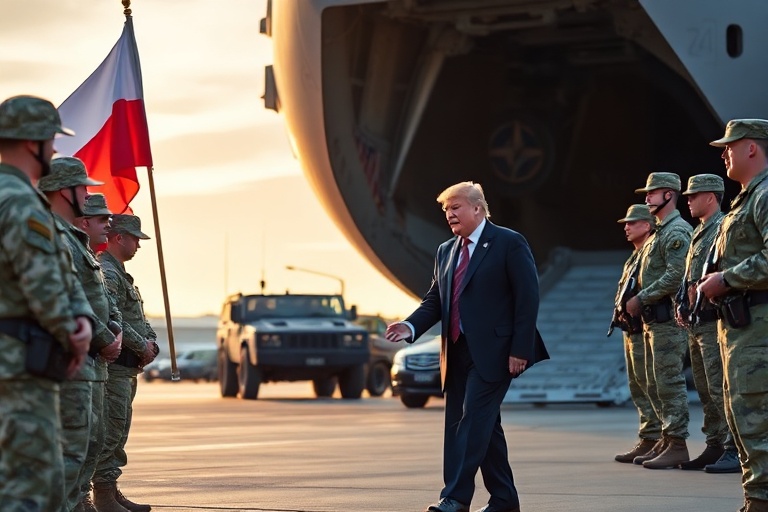
Trump’s Poland Troop Deployment: Strategic Shift or Political Gambit?
“`html
Trump’s Poland Troop Deployment: A Strategic Recalculation or Political Theater?
The announcement of additional U.S. troop deployments to Poland under the Trump administration has sent ripples through NATO and European security circles. While framed as a reinforcement of transatlantic defense, the move reflects deeper geopolitical calculations that extend beyond military logistics. Poland, a key Eastern European ally, has long sought a stronger U.S. presence to counter Russian aggression and deter further expansion into the Baltics. The timing of the deployment, however, raises questions about its dual role as both a deterrent and a bargaining chip in broader U.S.-Europe relations.
The Pentagon confirmed in early 2025 that an additional brigade combat team—approximately 5,000 troops—would be stationed in Poland on a rotational basis, complementing the existing 10,000 U.S. service members already based in the country under NATO’s Enhanced Forward Presence initiative. This expansion isn’t just a numbers game. It signals a deliberate shift in U.S. military posture in Eastern Europe, one that prioritizes rapid deployment capability and interoperability with Polish forces. The move also aligns with Poland’s own military modernization efforts, including the acquisition of F-35 fighter jets and a controversial $15 billion arms deal with South Korea.
But the deployment isn’t without controversy. Critics argue that the timing—amidst a contentious U.S. election cycle—suggests political motivations. Trump’s rhetoric during his 2024 campaign repeatedly questioned NATO burden-sharing, going so far as to suggest that the U.S. might not defend NATO allies who failed to meet defense spending targets. The Poland deployment, therefore, could be interpreted as both a strategic hedge and a demonstration of U.S. commitment to Eastern Europe, particularly at a moment when European leaders are seeking reassurance amid global uncertainty.
The Strategic Logic Behind the Move
From a military standpoint, Poland’s geographic position makes it a critical node in NATO’s eastern flank. The country shares an 800-mile border with Russia’s Kaliningrad exclave and Belarus, a key ally of Moscow. The deployment of U.S. troops to Poland isn’t just symbolic; it’s a tangible commitment to Article 5 collective defense. The rotational brigade, equipped with advanced weaponry and integrated into NATO command structures, enhances the alliance’s ability to respond to hybrid threats, cyberattacks, and conventional military incursions.
Poland has invested heavily in its military, increasing defense spending to 4.1% of GDP in 2024—the highest in NATO. The country has also expanded its defense industry, producing domestically made tanks, drones, and artillery systems. The U.S. deployment complements these efforts by providing advanced training, intelligence-sharing, and logistical support. Analysts note that the rotational model allows for flexibility, enabling rapid reinforcement in the event of a crisis without permanently stationing U.S. troops—a move that could provoke Russia.
Yet, the deployment also reflects a broader U.S. strategy to reduce its footprint in Western Europe while consolidating influence in Eastern Europe. Trump’s administration has repeatedly emphasized the need to “rebalance” U.S. military commitments, shifting resources toward the Indo-Pacific to counter China’s rise. Poland, with its strategic location and pro-NATO stance, fits neatly into this framework. The deployment, therefore, serves a dual purpose: strengthening NATO’s eastern flank while subtly pressuring European allies to take on more responsibility for their own defense.
Political Undercurrents and Transatlantic Tensions
The timing of the Poland deployment has fueled speculation about its political dimensions. Trump’s second term has been marked by a transactional approach to alliances, one that often prioritizes U.S. interests over multilateral commitments. The deployment could be seen as an attempt to shore up support among Eastern European NATO members, many of whom have grown skeptical of Western Europe’s willingness to confront Russian aggression.
Poland, in particular, has positioned itself as a leading advocate for a harder line against Moscow. The country has been a vocal proponent of sanctions, military aid to Ukraine, and expanded NATO membership for Finland and Sweden. By deepening its military ties with Poland, the U.S. may be seeking to create a counterbalance to the more cautious approach of countries like Germany and France, which have been more hesitant to escalate tensions with Russia.
However, the deployment also risks exacerbating divisions within NATO. Some European leaders have expressed concern that the U.S. is prioritizing bilateral agreements over collective defense. The rotational model, while flexible, lacks the permanence of a traditional alliance structure, leaving some allies questioning the long-term reliability of U.S. commitments. Additionally, Trump’s history of criticizing NATO allies and his unpredictable foreign policy decisions have left many European leaders wary of over-reliance on Washington.
Broader Implications for NATO and European Security
The Poland troop deployment is more than a military maneuver—it’s a litmus test for NATO’s future. The alliance has faced unprecedented challenges in recent years, from Russia’s invasion of Ukraine to the rise of authoritarianism in Hungary and Turkey. The deployment underscores NATO’s adaptability, but it also highlights the growing fissures within the alliance.
For Poland, the deployment is a strategic victory. The country has long sought a permanent U.S. military presence, and the rotational brigade is a step in that direction. Poland’s government has framed the move as a victory for European security, but critics argue that it could further isolate Poland from its European neighbors, particularly Germany, which has been lukewarm about increased U.S. military activity in Eastern Europe.
The deployment also raises questions about the future of U.S.-Russia relations. While the move is framed as a deterrent against Russian aggression, it could provoke Moscow to escalate its own military posture in the region. Russia has already responded to NATO’s expansion by increasing its troop presence in Belarus and Kaliningrad, as well as conducting large-scale military exercises near NATO borders. The deployment, therefore, risks triggering a new arms race in Eastern Europe, one that could destabilize the region further.
What Comes Next?
The Poland troop deployment is likely just the beginning of a broader U.S. strategy to reshape NATO’s eastern flank. Analysts anticipate further deployments to the Baltics, Romania, and possibly even Ukraine, pending the outcome of the war. The U.S. may also push for greater integration of Eastern European militaries into NATO command structures, creating a more cohesive and rapid-response force.
However, the success of this strategy hinges on several factors. First, it requires sustained political and financial commitment from both the U.S. and its European allies. Second, it demands careful management of relations with Russia to avoid escalation. Finally, it necessitates a clear and consistent U.S. policy toward NATO—a challenge given the unpredictability of Trump’s second term.
For now, the deployment sends a clear message: the U.S. remains committed to NATO’s eastern flank, even as it reorients its global military posture. Whether this commitment is strategic or political remains to be seen, but one thing is certain—the ripple effects of this decision will be felt across Europe and beyond for years to come.
Key Takeaways
- Military Strategy: The deployment enhances NATO’s eastern flank by providing rapid deployment capability and interoperability with Polish forces.
- Political Motivations: The timing suggests a dual role as both a deterrent and a political signal to reassure allies and pressure NATO members to increase defense spending.
- Transatlantic Tensions: The move risks exacerbating divisions within NATO, particularly between Eastern and Western European allies.
- Broader Implications: The deployment could trigger a new arms race in Eastern Europe and further destabilize U.S.-Russia relations.
- Future Outlook: The strategy may expand to include further deployments and greater integration of Eastern European militaries into NATO command structures.
For more analysis on U.S. military strategy and NATO’s evolving role, visit our Analysis and Politics sections.
Conclusion
The Trump administration’s decision to deploy additional troops to Poland is a calculated gamble with far-reaching consequences. On one hand, it strengthens NATO’s eastern flank and reassures allies of U.S. commitment. On the other, it risks provoking Russia, exacerbating transatlantic tensions, and deepening divisions within NATO.
As the geopolitical landscape continues to shift, the deployment serves as a reminder that military strategy cannot be divorced from politics. The success of this move will depend not only on its military effectiveness but also on the ability of the U.S. and its allies to navigate the complex web of regional tensions and domestic pressures. For Poland, the deployment is a strategic victory. For NATO, it is a test of its resilience. And for the world, it is another chapter in the ongoing struggle to maintain peace and stability in an increasingly uncertain era.