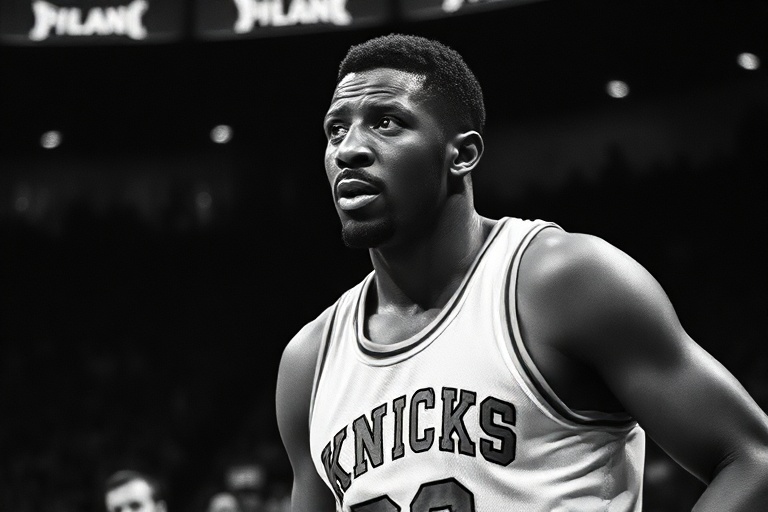
When Walt “Clyde” Frazier took the court in the late 1960s and early 1970s, he wasn’t just playing basketball—he was crafting a legacy that extended far beyond points and assists. A two-time NBA champion with the New York Knicks, Frazier’s influence transcended the hardwood, embedding itself in the cultural fabric of American sports and global style.
His name became synonymous with flair, both in his play and in his fashion. This fusion of athleticism and artistry made him one of the most recognizable figures in sports history, a status that endures decades after his final game. Frazier’s impact is best understood not just as a basketball milestone, but as a cultural touchstone that bridged generations and continents.
The Rise of a Basketball Legend
Born in Atlanta, Georgia, in 1945, Frazier’s journey to basketball immortality began at Southern Illinois University, where he led the Salukis to the 1967 NCAA championship game. His collegiate success quickly translated to the professional stage when the New York Knicks selected him with the fifth overall pick in the 1967 NBA Draft.
Frazier joined a Knicks team in transition, but his arrival marked the beginning of a new era. Paired with Willis Reed, he formed one of the most formidable backcourts in NBA history. Known for his defensive prowess, court vision, and clutch performances, Frazier earned two NBA titles (1970, 1973) and was a seven-time All-Star. His ability to control the tempo of a game with intelligence and creativity set a standard for point guards that continues to influence the position today.
The 1970 championship series against the Los Angeles Lakers became the stuff of legend. Frazier’s 36 points, 19 assists, and tenacious defense in Game 7—played on a severely injured Willis Reed—cemented his reputation as one of the greatest closers in sports history. That performance remains one of the most celebrated in NBA lore, often referenced in discussions of clutch moments in sports.
More Than a Player: The Birth of a Cultural Icon
While Frazier’s on-court achievements were monumental, his off-court presence was equally transformative. He emerged as a fashion pioneer, blending athletic wear with high fashion in a way that had never been seen before. Frazier’s signature style—sharp suits, wide-brimmed hats, and polished shoes—elevated the image of professional athletes from mere competitors to cultural ambassadors.
His partnership with designers and stylists helped popularize the idea of athletes as style icons. Frazier wasn’t just wearing clothes; he was curating an identity. His wardrobe choices reflected sophistication and confidence, challenging the stereotype of the athlete as a one-dimensional figure. This approach resonated globally, particularly in urban centers where his influence extended into music, film, and streetwear.
In New York City, a global cultural hub, Frazier became a symbol of the city’s creative energy. His presence in media—from television broadcasts to magazine covers—helped redefine the visual language of sports. He understood that perception mattered as much as performance, and he leveraged that understanding to build a brand that transcended basketball.
A Global Influence
Frazier’s impact wasn’t confined to the United States. His style and charisma made him a global figure, particularly in cities with vibrant hip-hop and fashion scenes. In the 1980s and 1990s, as basketball gained international popularity, Frazier’s legacy became a reference point for young athletes and artists worldwide.
In Europe, his influence seeped into the emerging streetwear culture. Designers in Paris and London drew inspiration from his tailored aesthetic, blending it with local trends. In Japan, where basketball was growing rapidly, Frazier’s image was often featured in magazines and advertisements, representing a fusion of American athleticism and global style.
His voice, too, became part of the global conversation. After retiring in 1980, Frazier transitioned into broadcasting, where his wit and insight brought the game to life for international audiences. His commentary on MSG Network wasn’t just about basketball—it was about storytelling, culture, and the human experience of the game. Fans from Tokyo to Toronto tuned in not just to watch the Knicks, but to hear Clyde’s perspective.
Legacy: The Man Who Wore Many Hats
Walt Frazier’s legacy is multifaceted. He is remembered as a basketball innovator, a fashion trailblazer, and a cultural bridge-builder. His career offers a blueprint for athletes who seek to extend their influence beyond the game, proving that talent alone isn’t enough—vision and authenticity are essential.
Today, Frazier’s influence is evident in the way athletes approach branding and style. Stars like Allen Iverson and Russell Westbrook have cited him as an inspiration for their bold fashion choices. The rise of athlete-led fashion lines and collaborations with luxury brands can trace some of its roots back to Frazier’s pioneering spirit.
Beyond basketball, Frazier’s story is one of reinvention. He transitioned from player to commentator to mentor, each role amplifying his impact. His ability to adapt while staying true to himself is a lesson in resilience and self-awareness—qualities that resonate in a world where identity and authenticity are increasingly valued.
In 1987, Frazier was inducted into the Naismith Memorial Basketball Hall of Fame, a fitting tribute to a career that redefined excellence. Yet, his greatest contribution may be the cultural footprint he left behind, a footprint that continues to grow as new generations discover his story.
What’s Next for Clyde’s Legacy
As the NBA continues to globalize, Frazier’s legacy serves as a reminder of the power of individuality. In an era where athletes are often reduced to statistics and highlights, his story underscores the importance of personality, style, and cultural relevance. The league’s embrace of storytelling—through platforms like NBA Top Shot and documentary series—offers new avenues to celebrate figures like Frazier, ensuring that his contributions are not forgotten.
For younger fans, Frazier represents the intersection of sport and culture. His ability to move seamlessly between the court and the runway illustrates that greatness isn’t limited to a single domain. It’s a message that resonates in a world where boundaries between disciplines are increasingly blurred.
As we look to the future, Frazier’s legacy challenges us to think differently about athletes—not just as performers, but as cultural architects. His story is a testament to the idea that sports can be more than a game; they can be a platform for change, creativity, and connection.
Walt Frazier didn’t just play basketball. He wore it, lived it, and shaped it. And in doing so, he left an indelible mark on the world.
For more on the intersection of sports and culture, explore our Sports and Culture sections.