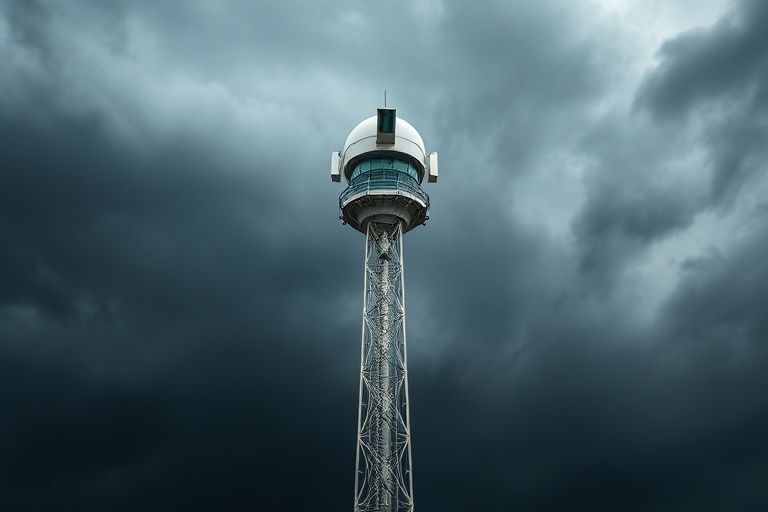
Weather forecasting has evolved dramatically over the past century, shifting from basic observations to sophisticated technology capable of predicting storms with remarkable accuracy. At the heart of this transformation is Doppler radar, a tool that has become indispensable for meteorologists, emergency responders, and even aviation safety. Unlike traditional radar systems, Doppler radar measures not just the location and intensity of precipitation but also the movement of particles within storms, providing critical insights into developing weather patterns.
The Science Behind Doppler Radar
Doppler radar operates on the principle of the Doppler effect, a phenomenon first described by Austrian physicist Christian Doppler in 1842. The technology leverages the shift in frequency of returning radar waves to determine whether precipitation is moving toward or away from the radar site. This shift allows meteorologists to calculate wind speed and direction within a storm, a capability that plain radar cannot match.
Here’s a simplified breakdown of how it works:
- Pulse Transmission: The radar emits a microwave signal that travels outward until it encounters an object, such as a raindrop or snowflake.
- Reflection and Return: When the signal hits the object, it bounces back toward the radar dish. The time it takes for the signal to return helps determine the distance to the object.
- Frequency Shift Analysis: If the object is moving, the frequency of the returned signal changes. Objects moving toward the radar produce a higher frequency, while those moving away produce a lower frequency.
- Data Processing: Sophisticated software converts these frequency shifts into velocity data, which is then displayed as color-coded maps or velocity images.
The result is a dynamic picture of atmospheric conditions, revealing not just where rain is falling but how storms are organizing and intensifying. This level of detail is particularly valuable for detecting severe weather, such as tornadoes and microbursts, which can form rapidly and with little warning.
Key Applications of Doppler Radar
Doppler radar’s versatility extends far beyond weather forecasting. Its applications span multiple fields, each benefiting from its ability to provide real-time data on moving objects and particles.
Meteorology and Severe Weather Detection
In meteorology, Doppler radar is the backbone of modern forecasting. The National Weather Service (NWS) in the United States operates a network of 159 WSR-88D Doppler radar systems, covering the entire country. These systems are crucial for identifying and tracking severe storms, including:
- Tornadoes: Doppler radar can detect the rotational signatures of supercell thunderstorms, often providing advanced warning of a potential tornado.
- Hail: The velocity data helps identify areas where hail is likely to form, allowing for more accurate warnings.
- Flash Floods: By measuring precipitation intensity and movement, Doppler radar aids in predicting areas at risk of sudden flooding.
For example, during the devastating tornado outbreak in Alabama in 2011, Doppler radar data helped forecasters issue warnings with an average lead time of 24 minutes—critical time that saved countless lives.
Aviation Safety
Aviation relies heavily on Doppler radar to ensure safe flight operations. Air traffic controllers and pilots use radar data to avoid turbulent weather, including thunderstorms and wind shear, which can pose serious hazards. Many airports are equipped with Terminal Doppler Weather Radars (TDWR) specifically designed to detect microbursts and wind shifts near runways. These systems have significantly reduced the number of weather-related accidents in the aviation industry.
Military and Defense
The military also utilizes Doppler radar for a variety of purposes, including target tracking, missile guidance, and battlefield surveillance. The technology’s ability to distinguish between moving and stationary objects makes it invaluable in combat scenarios where precision is paramount.
Limitations and Challenges
While Doppler radar is a powerful tool, it is not without its limitations. Understanding these challenges is essential for interpreting radar data accurately and improving future systems.
One of the primary limitations is the radar’s line-of-sight nature. Mountains, buildings, and even the Earth’s curvature can block or attenuate radar signals, creating blind spots. Additionally, the radar beam spreads out as it travels, reducing resolution at greater distances. This phenomenon, known as beam broadening, can make it difficult to pinpoint the exact location of a weather feature.
Another challenge is the presence of non-meteorological targets, such as birds, insects, or even dust particles. These can clutter radar images and obscure meaningful data. Advanced filtering techniques and dual-polarization radar help mitigate these issues by distinguishing between different types of scatterers.
The cost of maintaining and upgrading radar systems also poses a significant hurdle. While Doppler radar has been in use for decades, newer technologies like phased-array radar and dual-polarization are still being adopted widely. These advancements promise greater accuracy and faster data refresh rates, but they require substantial investment.
The Future of Doppler Radar
The next frontier for Doppler radar lies in integration with emerging technologies. Artificial intelligence (AI) and machine learning are already being tested to enhance radar data processing, enabling faster and more accurate predictions. For instance, AI algorithms can analyze vast amounts of radar data in real time, identifying patterns that might elude human forecasters.
Another promising development is the expansion of dual-polarization radar, which transmits and receives both horizontal and vertical pulses. This technique provides more detailed information about the shape and size of precipitation particles, improving the accuracy of rainfall estimates and hail detection. The NWS has been gradually upgrading its radar network to include dual-polarization capabilities, with nearly all WSR-88D systems now featuring this technology.
Looking further ahead, the deployment of small, low-cost radars could revolutionize localized weather monitoring. Networks of these radars, known as gap-filling radars, could be installed in urban areas or mountainous regions to fill coverage gaps left by larger systems. Such a distributed network would provide hyper-local data, improving forecasts for communities at risk of flash floods or other weather hazards.
Doppler radar has already transformed how we understand and respond to weather, but its potential is far from exhausted. As technology advances, so too will our ability to predict and prepare for the unpredictable forces of nature.
Conclusion
Doppler radar stands as a testament to human ingenuity, bridging the gap between raw observation and precise prediction. From its scientific foundations to its wide-ranging applications, this technology has become a cornerstone of modern meteorology and beyond. While challenges remain, the continuous evolution of radar systems promises even greater accuracy and reliability in the years to come. For those who depend on accurate weather forecasts—whether they are pilots, emergency responders, or everyday citizens—Doppler radar remains an indispensable ally in navigating the complexities of the atmosphere.
As we look to the future, the integration of AI, dual-polarization, and distributed radar networks will further enhance our ability to understand and respond to weather. In a world where climate change is increasing the frequency and intensity of extreme weather events, tools like Doppler radar are more critical than ever. They not only save lives but also empower communities to build resilience against the unpredictable forces of nature.
For more insights into the latest advancements in weather technology and their broader implications, visit our Technology and Science sections on Dave’s Locker.