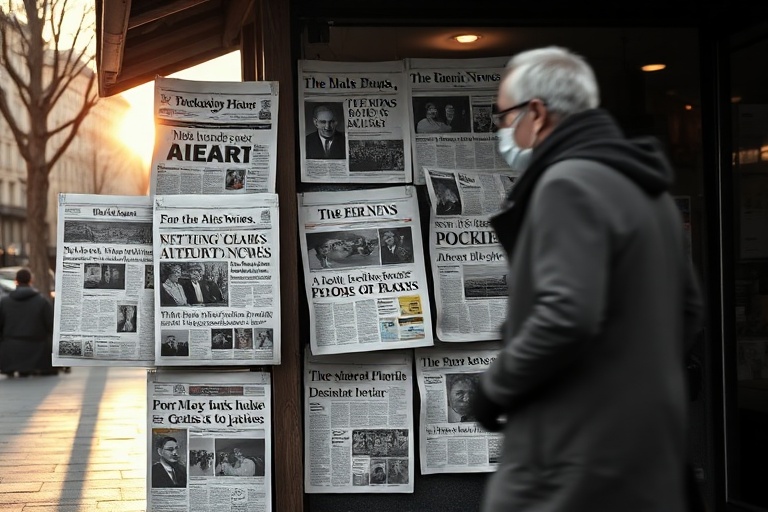
How Newspaper Front Pages Reflect Global Shifts in Media Consumption
The newspaper front page has long been a cultural artifact—a snapshot of history printed in ink and distributed daily. Yet in an era dominated by digital feeds and algorithm-driven content, these front pages still command attention. They serve as tangible records of what editors deem most urgent, relevant, or visually compelling on any given day. More than just a collection of headlines, they reflect societal priorities, technological changes, and the evolving role of journalism in public life.
Across continents, newspaper front pages vary dramatically in design, tone, and focus. In some regions, they remain staunchly traditional, while in others, they have embraced bold visuals and hybrid formats. The front page is not merely a container for news—it is a statement, a curator of public discourse, and, at times, a work of art. Its evolution tells a story of how information is packaged, consumed, and contextualized.
The Visual Language of Front Pages: Design Through the Ages
Newspaper design has undergone profound transformations since the medium’s inception. Early front pages were dense with text, using ornate fonts and intricate layouts to convey authority. By the mid-20th century, bold headlines, photographs, and clear hierarchies became standard. Today, digital-native design principles—minimalism, white space, and high-contrast imagery—have influenced even print layouts.
In Japan, for instance, newspapers like Yomiuri Shimbun maintain a clean, structured front page where text blocks are meticulously balanced with small photographs and concise headlines. This reflects cultural values of order and restraint. In contrast, European papers such as Le Monde often employ atmospheric photography and poetic typography, blending urgency with intellectual gravitas.
The use of color has also evolved. While American tabloids have long used garish hues to grab attention, broadsheets in the UK and Germany often limit color to photographs, preserving a sense of gravitas. This visual contrast underscores how front pages are not just functional—they are cultural mirrors.
Regional Front Pages: A Window Into Societal Priorities
Newspaper front pages reveal what societies prioritize at a given moment. In times of crisis, they converge on shared themes. During the COVID-19 pandemic, front pages worldwide featured similar imagery: masks, empty streets, and graphs tracking infection rates. Yet the framing differed. In China, state-run papers like People’s Daily emphasized collective resilience and government directives. In the United States, papers like The New York Times highlighted data-driven reporting and local impacts.
Climate change coverage has also reshaped front-page aesthetics. Scandinavian newspapers, such as Aftonbladet in Sweden, often lead with stark environmental imagery—melting glaciers, protest signs—paired with policy analysis. In Australia, papers like The Sydney Morning Herald blend disaster coverage with calls for systemic change, reflecting the country’s vulnerability to wildfires and floods.
Conflict zones offer another striking contrast. In Ukraine, newspapers such as Ukrainska Pravda use front pages to rally national unity, featuring soldiers’ testimonials and maps of active zones. In Israel, papers like Haaretz balance hard news with historical context, using muted tones and archival photos to underscore long-standing tensions.
The Digital Disruption: Can Front Pages Survive the Algorithm?
The rise of digital news platforms has challenged the relevance of traditional front pages. Aggregators like Google News and Apple News curate content based on user behavior, not editorial judgment. Social media prioritizes shareability over context, often reducing complex stories to clickable snippets. Yet, paradoxically, the front page has found new life in digital formats.
Many newspapers now maintain “digital front pages”—curated homepages that function similarly to print editions but with interactive elements. The Financial Times, for example, uses a paywall-protected homepage that mimics the structure of its print edition, with prominent headlines and data visualizations. Others, like Le Figaro in France, blend traditional front-page design with multimedia storytelling, embedding videos and live blogs within headline sections.
Some publications have gone further by creating hybrid editions. The Guardian in the UK offers a “digital front page” that updates in real time, with reader comments and social media reactions integrated into the layout. This approach acknowledges that the front page is no longer static—it is a living document that evolves with the news cycle.
The Future of Front Pages: Tradition Meets Innovation
As print circulation declines in many parts of the world, the front page’s future is uncertain—but not obsolete. Its enduring appeal lies in its ability to distill complexity into a single, curated glance. In an era of information overload, the front page offers a moment of clarity, a pause before the scroll.
Innovations in design and technology are ensuring its survival. Augmented reality (AR) is being experimented with by outlets like The Washington Post, which has tested AR features that allow readers to interact with 3D models of news events directly from the front page. Podcasts and audio clips are also being embedded into digital front-page layouts, catering to audiences who prefer auditory consumption.
Yet challenges remain. The pressure to monetize content has led some publications to prioritize sensationalism over substance, diluting the front page’s credibility. Others struggle to balance local relevance with global appeal, especially in regions where digital access is uneven.
Despite these hurdles, the front page endures as a symbol of journalistic intent. It is a declaration of what matters most—not what algorithms predict will engage, but what editors believe should be seen.
What’s Next for Newspaper Front Pages?
The evolution of the newspaper front page is far from over. Several trends are likely to shape its future:
- Personalization: Some publications are experimenting with dynamic front pages that adapt to individual reader preferences, though this risks echo chambers.
- Sustainability Initiatives: As climate concerns grow, front pages may increasingly highlight environmental solutions alongside crises.
- Community-Centric Design: Local papers are revitalizing front pages by incorporating reader-submitted content and hyperlocal data.
- AI-Assisted Curation: Artificial intelligence is being used to suggest front-page layouts, though human editors remain crucial for context and tone.
One thing is clear: the front page will continue to adapt, but its core function—to inform, provoke, and connect—will remain unchanged.
Conclusion: The Front Page as Cultural Compass
The newspaper front page is more than a relic of the past; it is a living medium that adapts to the rhythms of society. From the quiet elegance of a Japanese broadsheet to the urgent typography of a breaking news alert, it reflects the values, fears, and aspirations of its time. As journalism navigates the challenges of the digital age, the front page remains a vital touchstone—a reminder that the news is not just a stream of updates, but a curated conversation with the world.
In an era where information is abundant but attention is scarce, the front page offers something rare: a moment of focus. And in that focus lies its enduring power.