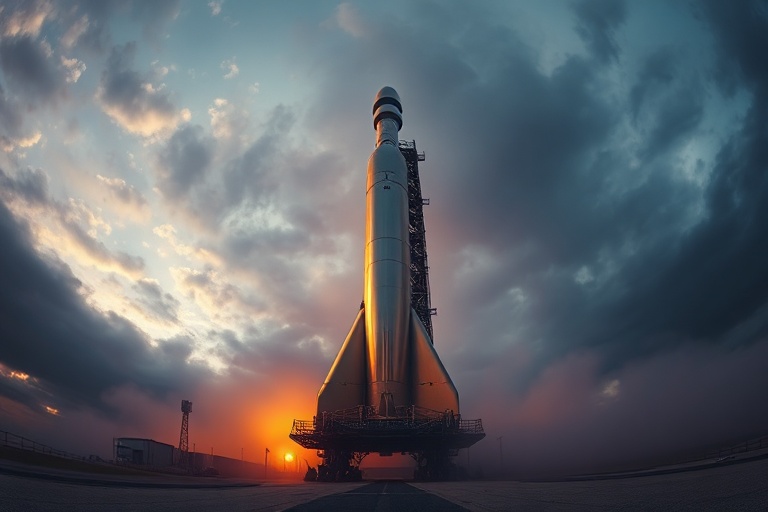
Starship: The Future of Space Exploration Unveiled
“`html
Starship: The Future of Space Exploration Unveiled
Space exploration has entered a new era with Starship, SpaceX’s fully reusable, super heavy-lift launch vehicle. Designed to carry both crew and cargo to Earth orbit, the Moon, Mars, and beyond, Starship represents a monumental leap in aerospace technology. Its development is not just a milestone for SpaceX but a potential turning point for humanity’s multi-planetary future.
At over 120 meters tall, Starship is the largest and most powerful rocket ever built. Its stainless-steel structure, combined with Raptor engines burning liquid methane and oxygen, sets it apart from traditional rockets. Unlike one-time-use launch systems, Starship and its Super Heavy booster are designed for rapid reuse, drastically reducing the cost of space travel. This innovation could democratize access to space, making missions to Mars, lunar bases, and orbital infrastructure far more feasible.
The Design and Technology Behind Starship
Starship’s architecture is built around two key components: the Starship spacecraft and the Super Heavy rocket. The spacecraft serves as both the upper stage and a fully reusable orbital vehicle, capable of carrying up to 100 metric tons of payload to Earth orbit. The Super Heavy booster, equipped with up to 33 Raptor engines, provides the initial thrust needed to escape Earth’s gravity.
One of Starship’s most distinctive features is its stainless-steel construction. Unlike traditional aluminum-lithium alloys, stainless steel offers superior strength at cryogenic temperatures, making it ideal for the extreme conditions of spaceflight. The heat shield, composed of hexagonal ceramic tiles, is designed to withstand the intense heat of re-entry, enabling rapid reuse without extensive refurbishment.
The Raptor engines are another technological marvel. Unlike traditional kerosene-fueled engines, the Raptor uses a full-flow staged combustion cycle, which maximizes efficiency and thrust. This design allows Starship to carry more payload while reducing fuel consumption, a critical factor for long-duration missions to Mars and beyond.
Key Innovations in Starship’s Development
- Full Reusability: Starship is designed to be fully reusable, with both the spacecraft and booster capable of returning to Earth for refurbishment and relaunch. This reduces the cost per launch from tens of millions to potentially under $10 million.
- In-Space Refueling: Starship will rely on orbital refueling to achieve its ambitious range. Tanker versions of the spacecraft will transport fuel to orbit, allowing Starship to refuel before heading to the Moon or Mars.
- Rapid Prototyping: SpaceX has adopted an iterative design process, rapidly building and testing prototypes to identify and address flaws. This approach has accelerated development but has also led to several high-profile test failures.
- Autonomous Landing: Starship uses advanced guidance systems for precise landings, both on Earth and potentially on other celestial bodies. This technology is critical for establishing sustainable bases on the Moon and Mars.
Starship’s Role in Space Exploration and Colonization
Starship’s primary mission is to enable humanity’s expansion beyond Earth. NASA has selected Starship as the lunar lander for its Artemis program, which aims to return astronauts to the Moon by 2026. Unlike the Apollo missions, Artemis will establish a sustainable presence on the lunar surface, with Starship serving as the backbone of this effort.
For Mars, Starship’s potential is even more transformative. Elon Musk, SpaceX’s CEO, has long envisioned Starship as the vehicle that will carry the first humans to Mars. The goal is to establish a self-sustaining city on the Red Planet, a project Musk has described as essential for ensuring the long-term survival of humanity. Starship’s large payload capacity and reusability make it the ideal candidate for such an ambitious endeavor.
Beyond the Moon and Mars, Starship could revolutionize Earth-orbit operations. It could be used to deploy massive satellite constellations, such as SpaceX’s Starlink network, or to construct orbital habitats and space stations. The ability to launch and return large payloads could also enable new scientific missions, including deep-space probes and telescopes.
Challenges and Controversies Surrounding Starship
Despite its promise, Starship’s development has not been without challenges. The program has faced significant regulatory hurdles, particularly from the Federal Aviation Administration (FAA), which has conducted multiple environmental reviews. Concerns about noise, safety, and the impact on local wildlife have delayed test flights and sparked public debate.
Technical challenges have also been a major hurdle. Starship’s development has seen numerous test flights end in explosions or crashes, though SpaceX has often framed these as learning opportunities. The company’s rapid iteration approach has been both praised for its innovation and criticized for its perceived recklessness.
Another controversy revolves around the allocation of public funds. NASA’s $4 billion investment in Starship for the Artemis program has raised questions about the long-term sustainability of such partnerships. Critics argue that SpaceX’s reliance on government contracts could stifle competition and innovation in the private sector.
The Environmental Impact of Starship
Starship’s environmental footprint is another area of concern. While its methane-fueled engines produce fewer pollutants than traditional kerosene engines, the sheer scale of Starship’s operations could still have significant environmental impacts. The production of methane fuel, for example, relies on natural gas extraction, which has its own carbon footprint.
SpaceX has committed to using renewable energy sources for fuel production, but the feasibility of this remains uncertain. Additionally, the noise and visual pollution from frequent launches could affect local ecosystems and communities near SpaceX’s test sites in Texas and Florida.
The Future of Starship: What’s Next?
Starship’s next phase of development will focus on achieving orbital flight, a milestone that has eluded the program so far. If successful, this could pave the way for crewed missions to the Moon and Mars within the next decade. SpaceX has outlined a roadmap that includes uncrewed lunar landings as early as 2025, followed by crewed missions under the Artemis program.
For Mars, the timeline is more speculative but equally ambitious. Musk has suggested that the first crewed mission to Mars could occur in the late 2020s or early 2030s, though this depends on overcoming numerous technical and logistical challenges. The ultimate goal is to transport up to a million people to Mars over the next few decades, establishing a self-sustaining city.
Beyond these immediate goals, Starship could redefine humanity’s relationship with space. By making space travel more accessible and affordable, it could unlock new opportunities for scientific discovery, economic growth, and even tourism. Companies like Space Adventures and Axiom Space are already exploring commercial missions using Starship, hinting at a future where space travel is not just for astronauts but for civilians as well.
As Starship continues to evolve, its success will depend not only on technological breakthroughs but also on regulatory approval, public support, and international collaboration. If it fulfills its promise, Starship could be remembered as the vehicle that finally made humanity a multi-planetary species.
For now, the world watches as SpaceX pushes the boundaries of what’s possible. The journey to Mars and beyond is just beginning, and Starship is leading the way.
How to Stay Updated on Starship’s Progress
To follow Starship’s development, enthusiasts can keep an eye on SpaceX’s official channels, including its website and social media platforms. NASA’s Artemis program also provides updates on Starship’s role in lunar missions. For deeper analysis and commentary, websites like Dave’s Locker Technology and space-focused news outlets offer regular coverage.
Attending space conferences or joining online communities dedicated to space exploration can also provide insights into Starship’s progress. As the program advances, these resources will be invaluable for understanding the challenges and breakthroughs that lie ahead.