Comparing Canada and Ireland: Geography and Population
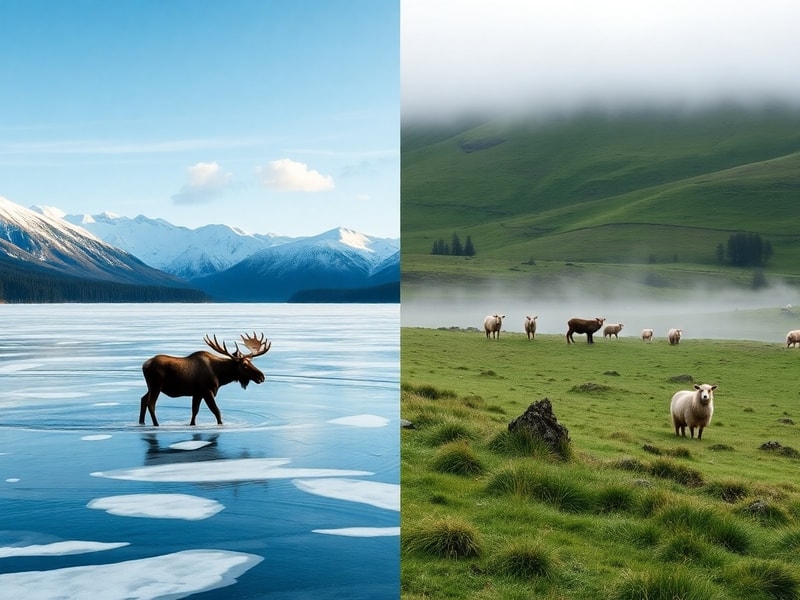
Canada and Ireland represent two distinct models of nationhood despite sharing the English language. Canada stretches across 9.98 million square kilometers, making it the second-largest country in the world by land area. Its vast terrain includes Arctic tundra, dense boreal forests, and sprawling prairies. By contrast, Ireland covers just 70,273 square kilometers—roughly the size of Newfoundland and Labrador alone. The Emerald Isle’s compact geography fosters intense regional identity, especially between urban Dublin and rural counties like Kerry and Donegal.
Population density tells another story. Canada’s 38 million residents are spread thinly, with 80% living within 160 kilometers of the U.S. border. Ireland’s 5.1 million people are more evenly distributed, though Dublin accounts for nearly a third of the population. This density fuels Ireland’s vibrant cultural life, from pub sessions in Galway to literary festivals in Cork. Canada’s sprawl, meanwhile, creates challenges in healthcare access and infrastructure maintenance, particularly in the northern territories.
Economic Models: Growth, Trade, and Innovation
Canada’s economy thrives on resource extraction, technology, and trade. It is the world’s fourth-largest oil producer and a top exporter of minerals like potash and gold. The country’s GDP per capita stands at $47,000, supported by strong financial and automotive sectors. Ireland, though much smaller, has cultivated a different niche: corporate tax arbitrage. Home to tech giants like Google, Meta, and Apple, Ireland’s GDP per capita exceeds $99,000—nearly double Canada’s—thanks to favorable corporate tax rates and an educated workforce.
Yet Ireland’s economic model is not without risks. Over-reliance on multinational corporations creates volatility during global downturns. Canada, while less flashy in its growth, boasts greater economic stability. Its banking system avoided the worst of the 2008 crisis, and its federal structure allows provinces to tailor policies to local needs. Both nations face housing crises, but the causes differ: Canada’s is driven by immigration and speculation, while Ireland’s stems from underinvestment and planning delays.
Key Economic Differences
- Primary Industries: Canada’s economy is anchored in natural resources; Ireland’s in tech and pharmaceuticals.
- Tax Policy: Ireland’s 12.5% corporate tax rate attracts foreign investment; Canada’s higher rates fund public services.
- Trade Partners: Canada’s top partner is the U.S.; Ireland’s is the EU, with significant trade with the U.S. as well.
- Labor Markets: Ireland’s unemployment rate (4.5%) is lower than Canada’s (5.2%), but youth employment tells a different story.
Cultural Identity: Shared Roots, Divergent Paths
The cultural ties between Canada and Ireland run deep. Both nations were shaped by British colonialism, Irish immigration, and Indigenous resilience. Yet their cultural expressions have diverged. Ireland’s identity is rooted in its ancient language, Gaelic games like hurling, and a literary tradition that includes James Joyce and W.B. Yeats. Canada’s identity is more fragmented, a mosaic of Indigenous, French, and immigrant influences. Hockey, not hurling, is the national sport, and its literature—from Margaret Atwood to Michael Ondaatje—often explores themes of isolation and survival.
Music offers another contrast. Ireland’s traditional sessions in pubs are spontaneous and community-driven, while Canada’s folk music, exemplified by artists like Gordon Lightfoot and Joni Mitchell, reflects its vast landscapes and immigrant stories. Both countries excel in contemporary music—Ireland with U2 and Hozier, Canada with Drake and The Weeknd—but their cultural ecosystems operate on different scales. Ireland’s small population allows for tight-knit creative communities, whereas Canada’s size necessitates export-oriented strategies.
Political Systems: Stability and Reform
Canada and Ireland are parliamentary democracies, but their political landscapes reveal fundamental differences. Canada is a constitutional monarchy with a federal system, where power is divided between the federal government and 10 provinces. Its Westminster-style parliament blends British tradition with regional autonomy. Ireland, by contrast, is a republic with a directly elected president and a unicameral parliament (Dáil Éireann). Its political culture is deeply influenced by its struggle for independence and subsequent civil conflicts.
Both nations grapple with contemporary challenges. Canada faces debates over reconciliation with Indigenous peoples, the future of its monarchy, and regional separatism in Quebec. Ireland contends with post-Brexit border issues, housing shortages, and the legacy of the Catholic Church’s influence. Yet their approaches to governance differ. Canada’s federalism allows for policy experimentation—such as Quebec’s language laws—while Ireland’s centralized system prioritizes national consensus, often at the expense of rapid reform.
Climate policy highlights these differences. Canada, a major oil producer, struggles to balance emissions targets with economic growth. Ireland, with its smaller industrial base, has committed to more aggressive climate goals, though progress has been slow. Both nations are signatories to the Paris Agreement, but their paths to decarbonization reflect their distinct economic realities.
Conclusion: Lessons from Two Nations
Canada and Ireland may seem like unlikely comparators, yet their differences offer valuable insights. Canada’s vastness and resource wealth provide economic stability but also create social and environmental challenges. Ireland’s compact size and agility in attracting global capital demonstrate the power of niche strategies, though they come with vulnerabilities. Culturally, both nations showcase how history and geography shape identity, whether through Ireland’s Gaelic revival or Canada’s multicultural mosaic.
As the world faces interconnected crises—climate change, economic inequality, and democratic backsliding—Canada and Ireland offer contrasting models of resilience. One relies on scale and stability; the other on adaptability and innovation. Neither is a perfect template, but each provides lessons for nations navigating an uncertain future.
For those interested in exploring these themes further, visit Dave’s Locker News for ongoing analysis of global trends and Dave’s Locker Culture for deeper dives into societal shifts.