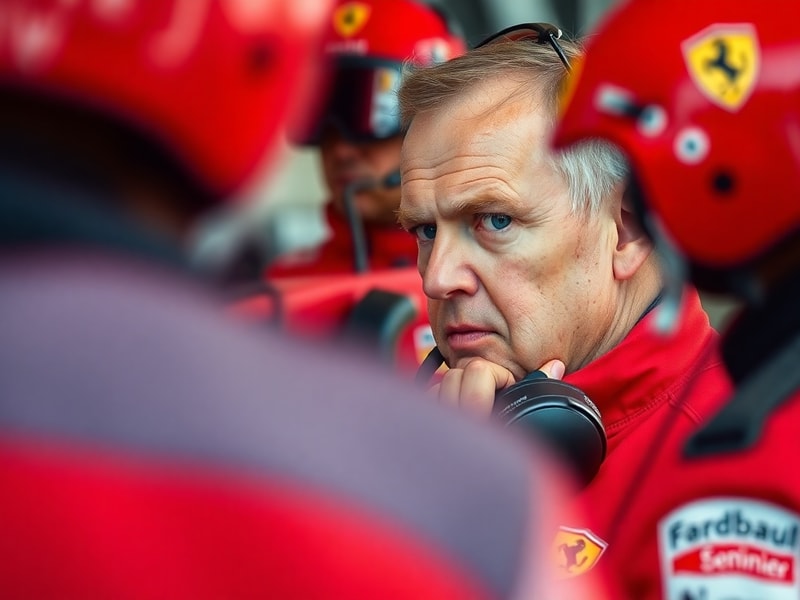
In the high-stakes world of Formula 1, leadership often defines success as much as engineering. Few figures embody this truth as clearly as Frédéric Vasseur, the current team principal of Scuderia Ferrari. Since taking the reins in January 2023, Vasseur has orchestrated a remarkable turnaround for the storied Italian team, blending tactical acumen with a focus on long-term stability. His journey—from a young engineer in France to the top of motorsport’s most iconic outfit—offers a compelling case study in leadership under pressure.
Vasseur’s appointment came at a pivotal moment for Ferrari. The team had struggled with inconsistency, strategic errors, and a lack of direction in the hybrid era. But under his leadership, Ferrari has reclaimed its status as a championship contender, with two race wins in 2023 and a renewed sense of purpose. His approach combines data-driven decision-making with a deep respect for Ferrari’s history and culture, making him a rare leader who balances innovation with tradition.
From Engineer to Team Principal: A Career Defined by Precision
Fred Vasseur’s path to Ferrari is rooted in engineering excellence. Born in 1968 in Draveil, France, he studied mechanical engineering before joining Renault in the early 1990s as a race engineer. His early career was marked by rapid advancement, working with drivers like Jacques Villeneuve and Jarno Trulli in Formula 1. These experiences honed his ability to merge technical insight with real-time decision-making—skills that would later define his leadership style.
In 2009, Vasseur founded ART Grand Prix, a junior team that became a breeding ground for future F1 talent. Under his guidance, ART produced champions like Nico Rosberg, Lewis Hamilton, and Stoffel Vandoorne. The team’s success in feeder series like GP2 and GP3 demonstrated Vasseur’s knack for identifying and developing raw talent, a philosophy he brought to Ferrari.
His rise to F1 team principal was not immediate. After ART’s expansion into GP2 and GP3, Vasseur returned to F1 as team principal at Sauber in 2017. The Swiss team was in financial turmoil, but he stabilized operations and laid the groundwork for future success. His tenure at Sauber also highlighted his ability to manage under constraints—a challenge he would later face at Ferrari.
A Leadership Style Built on Data and Discipline
Vasseur’s leadership is characterized by a methodical, almost clinical approach. He is known for his meticulous preparation, often reviewing race data late into the night to identify areas for improvement. This attention to detail extends to his team management, where he emphasizes clear communication and accountability. Unlike some of his predecessors at Ferrari, Vasseur avoids micromanagement, instead empowering his engineers and strategists to make critical decisions.
One of his most notable traits is his willingness to challenge conventional wisdom. During the 2023 season, Vasseur’s team made bold strategic calls, such as the controversial decision to pit Charles Leclerc during a safety car in Monaco—a move that ultimately cost the Monegasque driver a potential podium. While the outcome was disappointing, the decision reflected Vasseur’s commitment to aggressive, calculated risks, a hallmark of his leadership.
Ferrari’s Transformation Under Vasseur: A Blueprint for Revival
When Vasseur joined Ferrari, the team was in disarray. The 2022 car, the F1-75, had shown promise but suffered from reliability issues and strategic missteps. Vasseur’s first priority was to restore confidence within the team. He restructured the technical leadership, bringing in figures like Enrico Gualtieri as head of chassis and Dave Robson as performance director, creating a more cohesive and efficient organization.
The 2023 season became a turning point. Ferrari’s SF-23, while not dominant, showed significant progress in race pace and reliability. Leclerc secured two victories, including a dominant display in Austria, while Carlos Sainz emerged as a consistent performer. Vasseur’s focus on consistency over flashiness paid dividends, as Ferrari climbed from fifth in the constructors’ championship in 2022 to second in 2023.
Vasseur’s impact extended beyond the track. He fostered a culture of accountability, where mistakes were addressed openly but constructively. This transparency helped rebuild trust among drivers, engineers, and the wider team. His ability to unite a historically divided organization has been one of his greatest achievements.
Challenges and Criticisms: Navigating the Road Ahead
Despite his successes, Vasseur’s tenure has not been without scrutiny. Some critics argue that his conservative approach stifles innovation, particularly in areas like simulator development and aerodynamic flexibility. Others point to Ferrari’s struggles in qualifying sessions, where the team often trails behind Red Bull and Mercedes. Vasseur has acknowledged these weaknesses, emphasizing that progress is incremental and not always visible in real time.
The 2024 season presents new challenges. Ferrari’s car, the SF-24, has shown flashes of brilliance but remains inconsistent. The team’s primary goal is to close the gap to Red Bull, which has dominated since 2022. Vasseur’s ability to adapt to new regulations and evolving competition will be crucial. His focus on long-term development—including the recruitment of key technical personnel—suggests he is playing the long game, a strategy that may not yield immediate results but could pay off in the future.
The Human Side: Vasseur’s Legacy Beyond the Track
Beyond his professional achievements, Fred Vasseur is known for his humility and approachability. Unlike many F1 team principals, he avoids the spotlight, preferring to let his work speak for itself. He is fluent in multiple languages, including French, English, and Italian, a skill that has helped him navigate the multicultural environment of F1.
Vasseur’s personal life also reflects his disciplined nature. He is an avid reader, particularly of history and biographies, and enjoys cycling in his spare time. These interests provide balance to his high-pressure career, offering a glimpse into the man behind the strategist.
His leadership style has drawn comparisons to other successful F1 principals, such as Toto Wolff at Mercedes and Christian Horner at Red Bull. Like Wolff, Vasseur emphasizes data and process; like Horner, he balances aggression with pragmatism. However, Vasseur’s ability to blend these traits with Ferrari’s unique culture sets him apart.
Lessons from Vasseur’s Career for Aspiring Leaders
Fred Vasseur’s career offers several lessons for leaders in any field. First, his emphasis on data-driven decision-making underscores the importance of relying on objective insights rather than intuition alone. Second, his ability to rebuild teams—whether at ART Grand Prix, Sauber, or Ferrari—highlights the value of patience and persistence. Finally, his focus on culture and transparency demonstrates that success is not just about results but also about creating an environment where people thrive.
For those looking to emulate his success, Vasseur’s journey suggests that leadership is a blend of technical expertise, emotional intelligence, and adaptability. His career also serves as a reminder that setbacks are not failures but opportunities to learn and improve.
Looking Ahead: What’s Next for Vasseur and Ferrari?
As Ferrari enters a critical phase in its development, all eyes are on Vasseur. The team’s 2025 car, currently in development, will be a true test of his vision. With Red Bull’s dominance showing signs of waning, Ferrari has a real chance to close the gap. Vasseur’s focus on aerodynamics, power unit efficiency, and race strategy will be key to achieving this goal.
Off the track, Vasseur’s role in shaping Ferrari’s future extends to driver management. Both Leclerc and Sainz have praised his leadership, and his ability to handle the complexities of F1 politics—such as contract negotiations and media scrutiny—will be vital. The team’s recent extension of his contract through 2026 underscores Ferrari’s confidence in his leadership.
For fans of Ferrari, Vasseur represents a beacon of hope. His arrival coincided with a renewed sense of optimism, a sentiment that has only grown as the team’s performances have improved. While the championship remains elusive, Vasseur’s impact is undeniable: he has restored pride, discipline, and ambition to the Scuderia.
As the 2024 season unfolds, one thing is clear: Fred Vasseur is not just a caretaker of Ferrari’s past but a architect of its future. His story is far from over, and the lessons from his journey will continue to resonate in the world of motorsport and beyond.
For those interested in exploring more about Ferrari’s history or the evolution of F1 leadership, be sure to check out our Sports and Analysis sections for deeper insights.